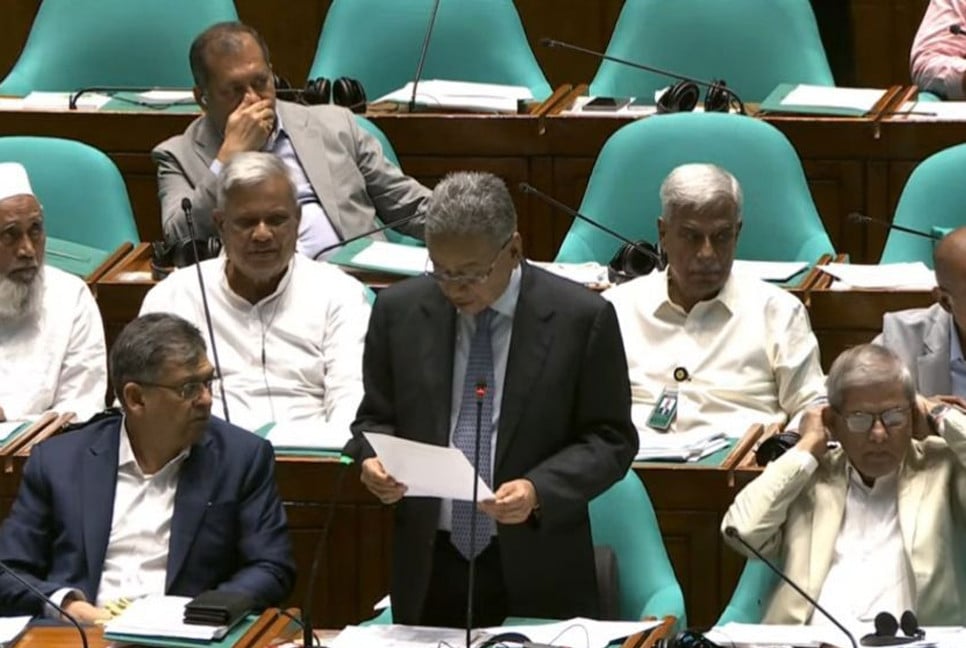
A significant amendment to the Bank Resolution Ordinance, introduced during the interim government, has sparked intense debate in the banking sector ahead of its passage as law in parliament.
The inclusion of a new provision, Section 18A, allowing former shareholders to return to merged weak banks has divided economists, business leaders, and customers.
On Friday, the final day for converting ordinances into laws, several ordinances were placed before parliament as bills. Among them was the Bank Resolution Ordinance, which grants special powers to the central bank to deal with weak and distressed banks. However, the addition of the new clause, rather than passing the ordinance unchanged, has triggered controversy.
Under the ordinance, five Shariah-based private banks, EXIM Bank, First Security Islami Bank, Global Islami Bank, Union Bank, and Social Islami Bank, were merged due to high default loans, irregularities, and weak financial conditions, forming Sammilito Islami Bank PLC.
These banks had earlier faced ownership controversies. EXIM Bank was controlled by businessman Nazrul Islam Mazumder, while the remaining four were linked to the S Alam Group. In this context, the government intervened to restructure the institutions.
What Section 18A says
The newly added Section 18A allows former shareholders or other parties deemed suitable by Bangladesh Bank to apply to reacquire shares, assets, and liabilities of a bank under resolution, subject to strict conditions.
Applicants must commit to repaying all funds provided by the government or Bangladesh Bank, injecting fresh capital, covering capital shortfalls, settling depositor and creditor liabilities, paying taxes, compensating affected parties, and rebuilding risk management, internal controls, and compliance systems.
They must also deposit at least 7.5% of the required amount within three months, while the remaining 92.5% must be paid within two years with 10% simple interest. Bangladesh Bank will supervise the bank’s operations for two years, after which a special committee will assess compliance. Failure to meet conditions may result in cancellation of approval.
Diverging views among analysts
The amendment has sharply divided economists and business leaders.
Former World Bank lead economist Zahid Hussain said the new provision could allow the same parties under whose management the banks collapsed to return, potentially weakening accountability.
He noted that the key problems in the merged or restructured banks included high non-performing loans, capital shortages, and governance failures. For this reason, the government had taken temporary control with plans to introduce a new structure and bring in strategic investors to revive the institutions. However, allowing former shareholders to return raises questions about the continuity of that reform approach, he added.
Zahid, also a member of the interim government’s banking reform task force, said the source of the required 7.5% down payment remains unclear. If funds come from opaque sources, risky actors could regain influence, he warned, potentially creating a “culture of impunity” and eroding depositor confidence.
He further noted that the amendment may weaken ongoing reforms and create policy uncertainty, adding that credibility in policy continuity is crucial for successful banking sector reform. He also expressed concern that it could trigger negative reactions among international development partners and policymakers.
In contrast, former Dhaka Chamber of Commerce and Industry (DCCI) president Shams Mahmud argued that a bank’s asset value cannot be considered zero. From a business perspective, he said, restoring participation of previous investors based on fair valuation could help revive the sector.
“Foreign investment is also present in the banking sector, and foreign investors are now stakeholders. If the system is changed in this way, investors will be discouraged, especially foreign investors,” he said.
He added, “From a business perspective, why would I invest again? For fair value to be established, all assets of the bank should be auctioned. Whatever is recovered should be used, as per law, to repay depositors and investors. Only then can a fair valuation be determined.”
Mixed reactions from customers
Customers of the merged banks are also divided.
Some welcomed the move, saying restoring ownership to former shareholders could strengthen corporate governance, ensure accountability, and rebuild investor confidence. They believe returning banks to genuine owners may improve depositor security and sector stability.
Others strongly opposed the idea, alleging that previous owners used political influence to secure large loans without repayment intent. They questioned whether those same individuals would now inject fresh capital to revive already weakened banks.
There are also concerns that funds could be sourced from other financial institutions or opaque channels, potentially repeating past cycles of risk.
What Bangladesh Bank says
Bangladesh Bank has reaffirmed its strict stance on restoring discipline in the banking sector, saying the measures aim to ensure good governance and protect depositor interests.
Assistant spokesperson Shahriar Siddiqui told journalists that only directors against whom there are no allegations or objections will be allowed to return. He added that foreign investors will also be eligible to invest.
“All matters will be reviewed in accordance with the law,” he said in response to questions on whether previously accused directors could return.
He further said the merger process of the five banks will continue as planned and the core framework remains unchanged. Therefore, International Monetary Fund (IMF) conditions regarding bank consolidation will not be affected.
Other key changes in Bank Resolution Ordinance
Other amendments include the removal of the detailed chapter on voluntary liquidation, now replaced with a brief provision.
References to the Bank Deposit Insurance Act 2000 have been replaced with the Deposit Protection Act 2026.
Provisions related to the Banking Sector Crisis Management Council have been streamlined, and terminology has been updated, including the redefinition of “systemically important banks”. Despite these changes, most core powers and the overall policy framework of the central bank remain intact.
Source:Daily Sun
Bd-pratidin English/ ANI