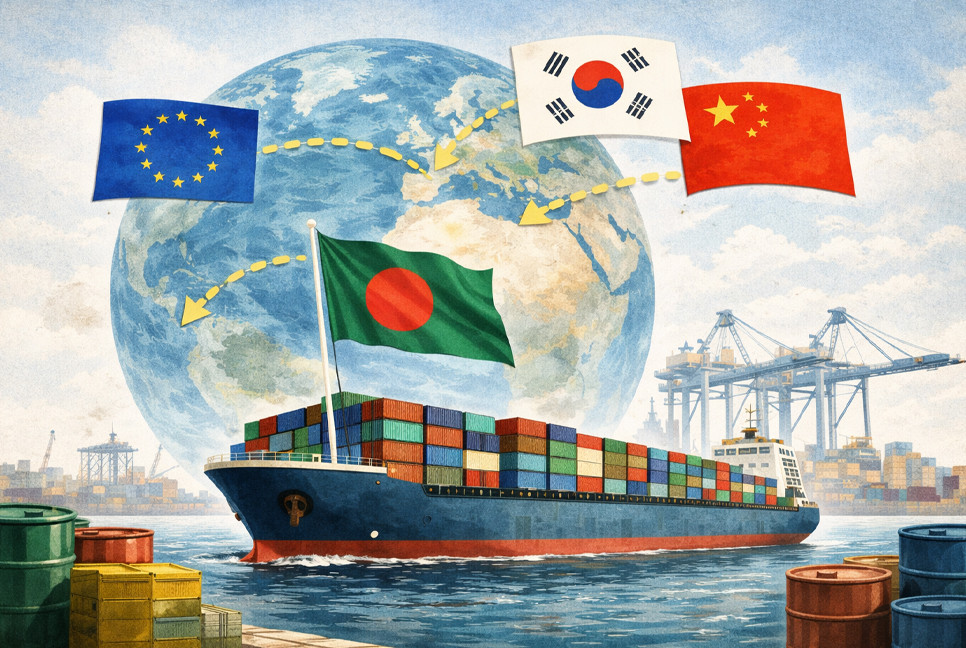
Bangladesh is being advised to join new international trade alliances to address emerging challenges in global commerce, including the impact of conflicts in the Middle East and the Russia–Ukraine War, as well as the country’s upcoming graduation from the list of least developed countries (LDCs).
Bangladesh is scheduled to graduate from LDC status this year. Once the transition takes place, the country will no longer enjoy duty-free export facilities in developed markets, posing a significant challenge for its export sector.
To tackle these challenges, experts have suggested that Bangladesh join the Regional Comprehensive Economic Partnership (RCEP), the largest trade bloc linking major economies including China and the European Union, and pursue a Preferential Trade Agreement (PTA) with South Korea.
Sources said three agencies under the Prime Minister’s Office — the Bangladesh Investment Development Authority, the Bangladesh Economic Zones Authority and the Public Private Partnership Authority Bangladesh — recently presented these proposals at a meeting with the Ministry of Commerce.
Representatives of the three agencies also proposed a timeline for trade negotiations. They suggested concluding a PTA with South Korea within 180 days, initiating negotiations for a Free Trade Agreement (FTA) with the European Union this year and finalising it by 2028, and taking a decision within this year on joining the RCEP.
South Korea was described as the fifth-largest investor in Bangladesh and one of the country’s top ten sources of foreign direct investment (FDI). Officials believe a bilateral trade agreement could further increase investment flows into Bangladesh.
The agencies also recommended sending an expression of interest to the European Union to begin discussions on a potential FTA.
Highlighting the importance of joining RCEP, the agencies noted that member countries of the bloc account for about 30 per cent of global GDP. Participation would help Bangladesh integrate into global value chains and emerge as a regional production hub.
Officials said South Korea, the EU and RCEP are currently considered the most promising trade partners for Bangladesh. Although discussions on joining these arrangements have taken place in the past, the government has yet to take a final decision.
Among Bangladesh’s export competitors, India and Vietnam have already concluded FTAs with the European Union, placing Bangladesh at a relative disadvantage.
The European Union remains Bangladesh’s largest export destination. In 2025, Bangladesh’s share in the EU ready-made garments market rose to 21.57 per cent. Currently, Bangladesh enjoys duty-free export benefits to the EU under the Everything But Arms (EBA) scheme. However, the facility will end after the country graduates from LDC status.
Officials warned that unless negotiations on a trade agreement with the EU begin soon, Bangladesh may face tougher competition from rival exporting countries.
Meanwhile, China — Bangladesh’s largest trading partner — has already concluded the world’s largest free trade agreement with 14 countries, including the 10-member Association of Southeast Asian Nations, along with Japan, South Korea, Australia and New Zealand, forming the RCEP bloc.
Several of Bangladesh’s economic competitors, including Vietnam, Myanmar and Cambodia, are already members of the agreement, enabling them to attract greater export trade and investment.
Experts believe that joining such a trade alliance would not only strengthen Bangladesh’s economic capacity but also play a significant role in export diversification and trade liberalisation.
Bd-pratidin English/TR