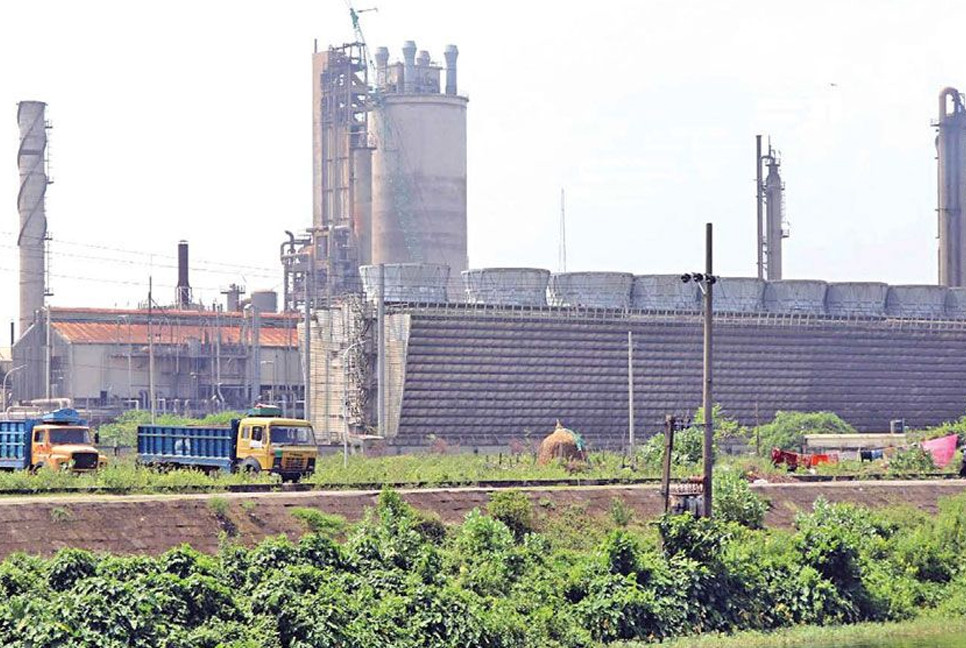
The government has halted gas supply to most urea fertiliser factories as part of an energy rationing plan aimed at managing limited gas resources amid uncertainty in global energy markets.
Officials said gas supply to several fertiliser plants was suspended from Wednesday following government instructions, forcing production to stop at most of the country’s urea-producing units.
According to the state-run Bangladesh Chemical Industries Corporation (BCIC), five of the country’s six urea fertiliser factories have been affected by the decision.
The factories where production has been suspended include Ghorashal Polash Fertiliser Public Limited Company, Chittagong Urea Fertiliser Factory Ltd (CUFL), Jamuna Fertiliser Company Ltd, Ashuganj Fertiliser and Chemical Company Ltd, and the privately operated Karnaphuli Fertiliser Company Limited (KAFCO).
Officials noted that production at the Ashuganj factory had already remained suspended for several months due to earlier operational issues.
At present, only the Shahjalal Fertiliser Company Limited remains operational, although officials warned that the plant could also face shutdown if the gas shortage persists.
Two state-owned fertiliser factories that do not rely on gas continue to operate.
Pressure on gas supply
Bangladesh currently meets nearly 30% of its gas demand through imported liquefied natural gas (LNG), equivalent to about 2,650 million cubic feet per day (mmcfd), as domestic gas production continues to fall short of rising demand.
Officials said around 197 million cubic feet of gas per day are required to run the five urea factories at full capacity. Even before the suspension, the plants had been facing irregular gas supply.
Engineer Syed Abu Naser Md Saleh, general manager of the engineering services division at Karnaphuli Gas Distribution Company, confirmed to the media that gas supply to fertiliser plants had been halted in line with government instructions.
“Around 70 to 80 million cubic feet of gas used to be supplied daily to the two plants,” he said.
Impact on fertiliser production
The five affected factories together have a combined daily production capacity of around 7,100 tonnes of urea. If the shutdown continues for the planned 15 days, more than one lakh tonnes of fertiliser production could be lost.
Officials said the fertiliser production target for the 2025-26 fiscal year was set at 10 lakh tonnes. However, only around 5.5 lakh tonnes have been produced during the first eight months up to February.
Some officials have expressed doubts about whether the annual production target can be achieved within the remaining months.
Boro cultivation concerns
The suspension comes during the crucial planting season for Boro rice, the country’s main dry-season crop, which accounts for more than half of Bangladesh’s annual grain output of roughly 40 million tonnes.
Bangladesh requires more than 2.6 million tonnes of urea fertiliser each year. Around 40% is produced domestically, while the remaining portion is imported from countries including Saudi Arabia, the United Arab Emirates and Qatar.
Nearly two-thirds of the annual demand for urea occurs between November and March, mainly for Boro cultivation.
Authorities assure adequate stocks
Despite the temporary halt in production, officials say there will be no immediate shortage of fertiliser.
Md Moniruzzaman, director of production and research at BCIC, said the corporation currently has around 4.68 lakh tonnes of urea in stock.
“So, there will be no shortage of fertiliser during the current Boro cultivation season,” he said.
Bd-pratidin English/ ANI