With the onset of Ramadan, fruit markets in Dhaka have witnessed a surge in trading activity, while ordinary buyers are struggling with rising prices.
Although consumers show greater interest in local fruits than in imported varieties, supply constraints and high prices are forcing many to rely on imported fruits for their iftar tables.
At the Khilgaon Railgate market, Mozammel Haque, a regular shopper, noted that a bunch (four pieces) of Sabri bananas costs Tk60. Considering their size and quality, he finds purchasing an apple for Tk35 more economical than buying a banana. Watermelons are selling for Tk90 to Tk100 per kilogram, with medium-quality fruit costing around Tk500 each.
Haque said that only small amounts of fruit are now bought daily for iftar, rather than in bulk, to save money. As a result, smaller quantities of imported fruits - such as one pomegranate, two oranges, or two maltas - are becoming the practical choice. While prices have increased, buying in smaller portions makes the cost appear more manageable.
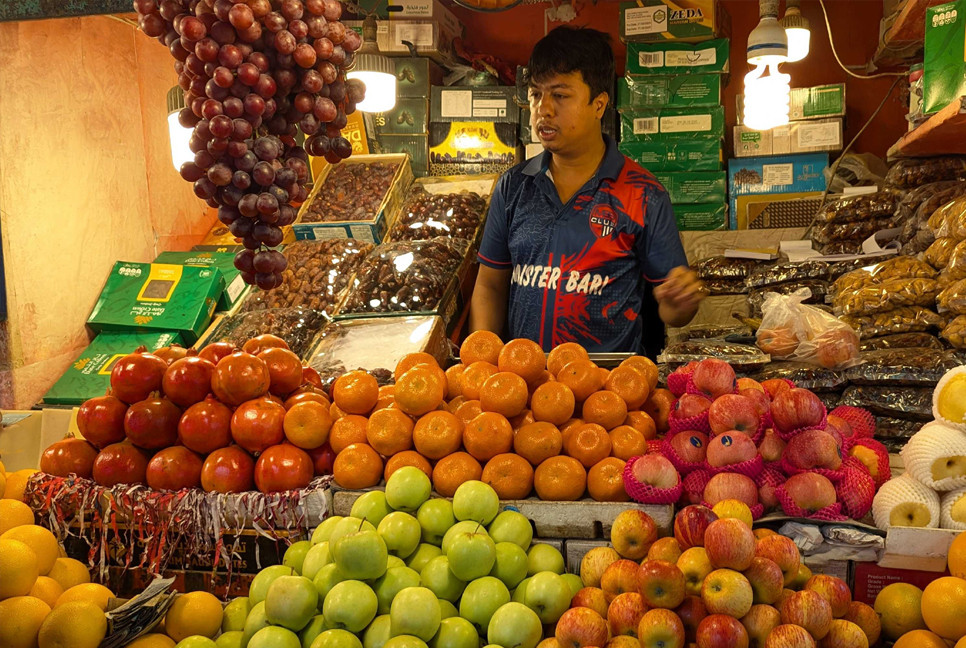
Markets in Mirpur, Paltan, and Khilgaon have seen imported fruit prices rise by Tk50 to Tk150 per kilogram during the first week of Ramadan. Maltas and oranges are selling for Tk320–350 per kilogram, red apples at Tk350-400, and green apples at Tk400-420.
Supermarkets charge even higher rates for imported fruits. Chinese oranges are sold at Tk345 per kilogram, Kinnow oranges at Tk400, green grapes at Tk550, and Australian red grapes at Tk700. Red apples are priced at Tk440, green apples at Tk475, maltas at Tk325, and pears at Tk410. Some supermarkets are even selling pomegranates at Tk730 per kilogram.
Dates, an essential item for iftar, are also expensive. Retail prices range from Tk600 to Tk1,500 per kilogram, depending on quality.
Dhaka’s historic Badamtoli Fruit Market serves as the country’s main wholesale hub, handling billions of taka in transactions daily. Fruits such as dates, apples, oranges, maltas, grapes, pears and pomegranates are imported from 46 countries and distributed nationwide from here.
Business owners say the sudden surge in demand during Ramadan has put immense pressure on the market. Wholesale costs have risen by Tk60 to Tk100 per kilogram per batch, making it difficult for traders to sell at lower retail prices. Delays in port clearance of imported fruits, higher import duties, transport costs and currency fluctuations have all contributed to the price hikes.
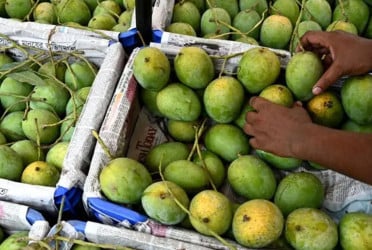
Local fruit prices have also soared. Bangla Kola, a type of banana, was sold at Tk140–160 per dozen at the start of Ramadan, dipping briefly by Tk30, but prices have now climbed back to Tk150–180. Sabri bananas are selling for Tk150–160 per dozen, while Champa bananas cost Tk90–100 per dozen. Papayas are selling for Tk140–150 per kilogram, up from Tk130–140. Common fruits such as boroi are priced at Tk110–130, compared with Tk80–90 earlier.
Sirajul Islam, former president of the Badamtoli Fruit Traders’ Association, said that both imported and local fruit prices have risen across markets. The increase in consumer demand allows traders to sell at higher prices. For dates in particular, Badamtoli offers more affordable options than other markets. However, other fruits have become comparatively expensive.
He added that market pressure is driven by the sudden surge in Ramadan demand, higher import duties, currency fluctuations, delayed port clearance and rising transportation costs. Buyers noted that although interest in local fruits remains high when imported fruits become unaffordable, rising local prices limit any significant savings.
A resident of Paltan said that the amount of money which once bought three to four types of fruit now secures only one or two kilograms. Consequently, many families are revising their iftar fruit plans, carefully deciding which fruits to buy and which to skip.
Source: Daily Sun
Bd-pratidin English/ ANI