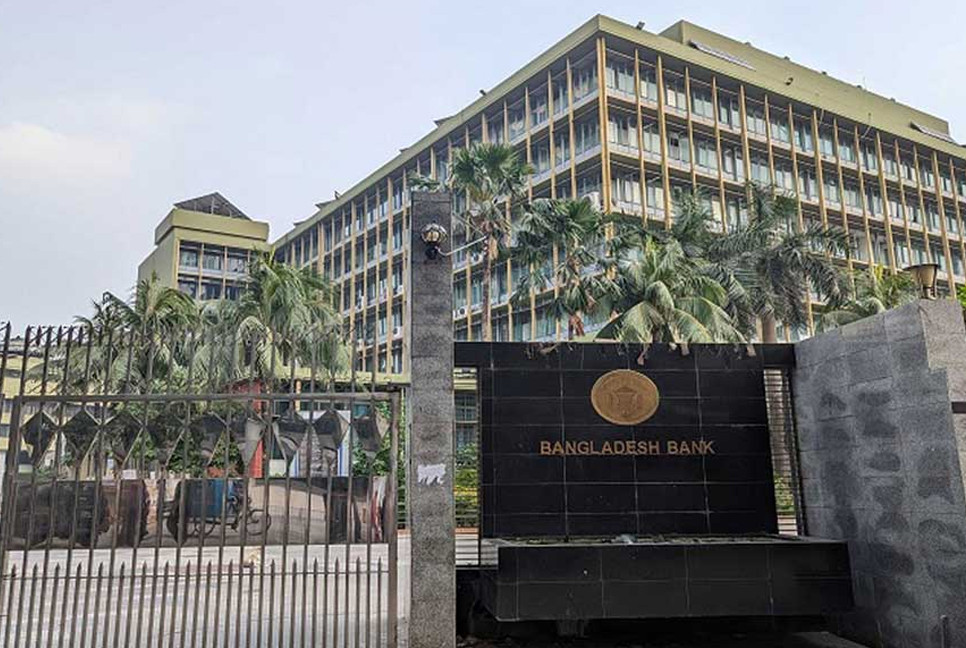
The Bangladesh Bank (BB) has relaxed loan rescheduling conditions in a move aimed at supporting struggling industries and preventing a further surge in defaulted loans, a decision widely welcomed by the business community.
In a circular issued on Sunday by its Banking Regulation and Policy Department (BRPD), the central bank allowed distressed borrowers to pay only half of the required down payment-equivalent to 2% of the total outstanding loan -at the time of approval. The remaining 50% can be paid within six months of the effective date.
Previously, borrowers were required to deposit the entire stipulated down payment upfront to qualify for rescheduling or restructuring facilities.
Under the revised rules, eligible borrowers may now pay the required one-time deposit in instalments. If policy support had already been approved but could not be implemented due to valid reasons, banks are permitted to extend the previously fixed deadline by up to three months. The deadline for special loan restructuring has also been extended from 31 December 2025 to 31 March 2026.
The central bank said the latest decision was taken following applications from various scheduled banks and stakeholders seeking flexibility in implementing earlier policy instructions.
Regarding interest-related matters, banks have been instructed to take decisions in line with existing policies, based on banker-customer relationships and applicable guidelines.
Business community sees positive signal
Business leaders described the move as timely and supportive, especially as investment has slowed, construction activity has weakened, non-performing loans (NPLs) have climbed above 35% and borrowing costs remain between 14% and 16%.
Ashraf Ahmed, former president of the Dhaka Chamber of Commerce and Industry (DCCI), termed the decision “timely and appropriate,” arguing that existing restructuring rules have been overly restrictive.
He said, “This is a welcome relief, as many businesses are struggling amidst the very tight market conditions across the product and finance markets. In addition, we hope Bangladesh Bank will also start looking at the capitalization of uncollected interest by Banks, which in many cases are the core source of stress. It would also help framing prudential regulations in line with market realities in Bangladesh.”
Anwar-ul Alam Chowdhury Parvez, president of the Bangladesh Chamber of Industries (BCI), praised the central bank’s structured approach.
“Closing down an industry is easy, but overcoming political, climatic and global shocks is not. This initiative will help unintentionally affected industries recover and restore confidence in the business community,” he told the Daily Sun, adding that careful scrutiny by banks would ensure genuine borrowers benefit.
Shams Mahmud, president of the Bangladesh Thai Chamber of Commerce and Industry, said genuine borrowers often default due to unavoidable events such as strikes or factory shutdowns.
“In such cases, an exit policy is essential. Unlike past rescheduling efforts that favoured the influential, this initiative has the potential to help actual victims and support broader economic recovery,” he said.
Details of the facility
According to the new instructions, half of the required 2% down payment for rescheduling and one-time settlement may be paid at the time of application, with the remainder payable within six months.
Borrowers who were previously unable to regularise their loans due to failure to deposit the full one-time amount will now get another opportunity. The board of directors of the respective financing institution may also decide on interest waivers under existing policies and banker-customer relationships.
For affected businesses- including those hit by political instability or exchange rate volatility-the maximum tenure under restructuring will be 10 years, with a two-year grace period if the loan is regularised. Banks must dispose of applications within six months of receipt, and no separate no-objection certificate from the central bank will be required.
In one-time settlement cases, borrowers will need to deposit 5% of the outstanding balance to apply, reduced from the earlier 10% requirement.
If the principal loan is up to Tk20 lakh, the bank’s management committee may decide on providing exit facilities. For loans exceeding Tk20 lakh, the board of directors or executive committee will take the final decision.
Addressing rising defaults
According to central bank data, total loans in the banking sector stood at Tk17,41,700 crore at the end of September last year, of which 36.3% were classified as defaulted.
About 300 companies, including several large conglomerates- applied for loan rescheduling or restructuring facilities amounting to nearly Tk2 lakh crore in the first nine months of last year.
Bankers say that while strict monitoring will be necessary to prevent misuse by wilful defaulters, the latest concessions could provide temporary but vital relief to viable businesses, restore confidence and help curb a further rise in defaulted loans during a delicate recovery phase.
Source: Daily Sun
Bd-pratidin English/ ANI