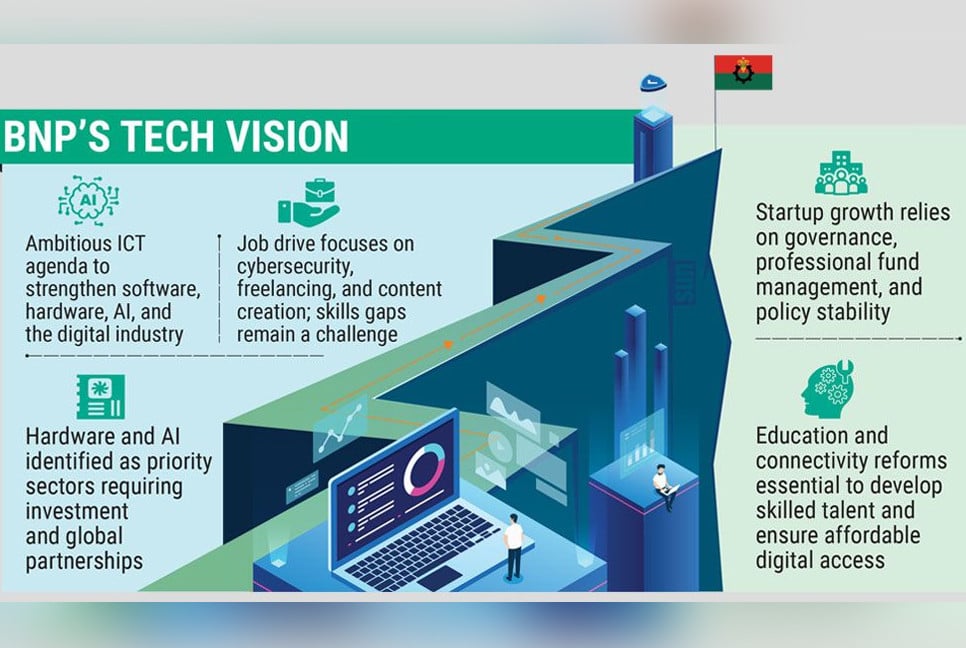
Promising to reposition Bangladesh at the forefront of the digital economy, the incoming government led by the Bangladesh Nationalist Party (BNP) has unveiled an ambitious ICT agenda centred on job creation and high-tech industrial expansion.
The party’s election manifesto commits to generating one million direct and indirect jobs in cybersecurity, freelancing and content creation, while strengthening the country’s global standing in software, application development, hardware manufacturing and artificial intelligence.
Industry leaders have welcomed the scale of the vision but cautioned that implementation will require structural reform.
Without a credible long-term policy framework, curriculum modernisation, regulatory stability and sustained investment in skills and governance, the targets may prove difficult to achieve.
Semiconductor and AI take centre stage
The manifesto outlines plans to position Bangladesh as a competitive player in software, app and hardware manufacturing, including semiconductors, a sector projected to reach a US$1 trillion global market by 2030.
It also pledges to transform the country into an international hub for artificial intelligence and hardware production.
Muhammad Mustafa Hussain, professor of Electronics and Communication Engineering at Purdue University, said the explicit prioritisation of semiconductors signals strategic recognition of future value creation.
He expressed hope that the commitment would evolve into a time-bound national semiconductor roadmap focused on design capability, advanced packaging, workforce development and integration with AI and robotics under broader initiatives such as BEAR and Silicon River.
“Semiconductor development requires coordinated investment in infrastructure, global partnerships, diaspora engagement and policy stability, not isolated initiatives,” he said.
“If executed with discipline, meritocracy and measurable milestones, this emphasis could redefine Bangladesh’s position in the global innovation economy.”
Industry stakeholders say a focused semiconductor strategy could catalyse high-value exports, skilled employment and long-term technological resilience.
Freelancing: persistent skills deficit
The BNP has also pledged to expand opportunities in cybersecurity, freelancing and content creation.
However, sector insiders argue that Bangladesh’s freelancing ecosystem continues to face a significant skills gap.
Tanvir Ibrahim, president of the Bangladesh Association of Contact Center & Outsourcing, said the country currently earns around $500 million annually from freelancing, but growth is constrained by inadequate technical and soft skills.
Freelancing services span computer programming, web design, translation, video editing and search engine optimisation. Yet previous government-led training initiatives, he noted, failed to produce globally competitive outcomes.
“I hope the new government can correctly identify the core challenges and address them effectively,” said Tanvir, who is also country director of Automation Solutionz.
Abul Kashem, founder of Hyaroo, echoed similar concerns. He said freelancers from countries such as India and the Philippines often outperform their Bangladeshi counterparts in both hard and soft skills.
He called for comprehensive curriculum reform from primary through higher secondary levels, alongside systematic efforts to strengthen English-language proficiency to enhance competitiveness in the global ICT marketplace.
Investment climate and governance critical for startups
The manifesto further promises an investment-friendly policy environment, a 10-year tax holiday, subsidised loans and startup funds to accelerate entrepreneurship.
Shahir Chowdhury, founder and CEO of Shikho, identified three priorities for the incoming administration.
“The first and most important step is to establish world-class management for the proper utilisation of the Fund of Funds allocated for startups,” he said.
Startup Bangladesh Limited currently operates a $33 million Fund of Funds.
In April 2025, a new equity fund of Tk800 crore, approximately $66 million, was announced to support early- and growth-stage startups.
“There is no alternative to world-class management to ensure the success of startups in Bangladesh. Otherwise, funds risk being misallocated and the sector will not realise its potential. If necessary, global experts should be brought in,” he added.
Secondly, he stressed the importance of strengthening governance and transparency in the capital market.
“Foreign investors closely assess capital market management before making investment decisions. Without credible governance, attracting investment into the startup ecosystem will remain challenging,” he said.
Finally, he called for a review of internet taxation and a reduction in broadband prices, arguing that affordable connectivity is essential for startup scalability and digital inclusion.
Policy depth over rhetoric
While the BNP’s ICT commitments articulate a high-growth, technology-driven economic vision, industry leaders emphasise that execution will determine credibility.
Education reform, policy continuity, regulatory predictability and professional fund management will be far more consequential than short-term training drives or isolated infrastructure projects.
Stakeholders maintain that only a coordinated, long-term national strategy can convert manifesto pledges into sustainable employment, export diversification and durable technological competitiveness.
Source: Daily Sun
Bd-pratidin English/ ANI