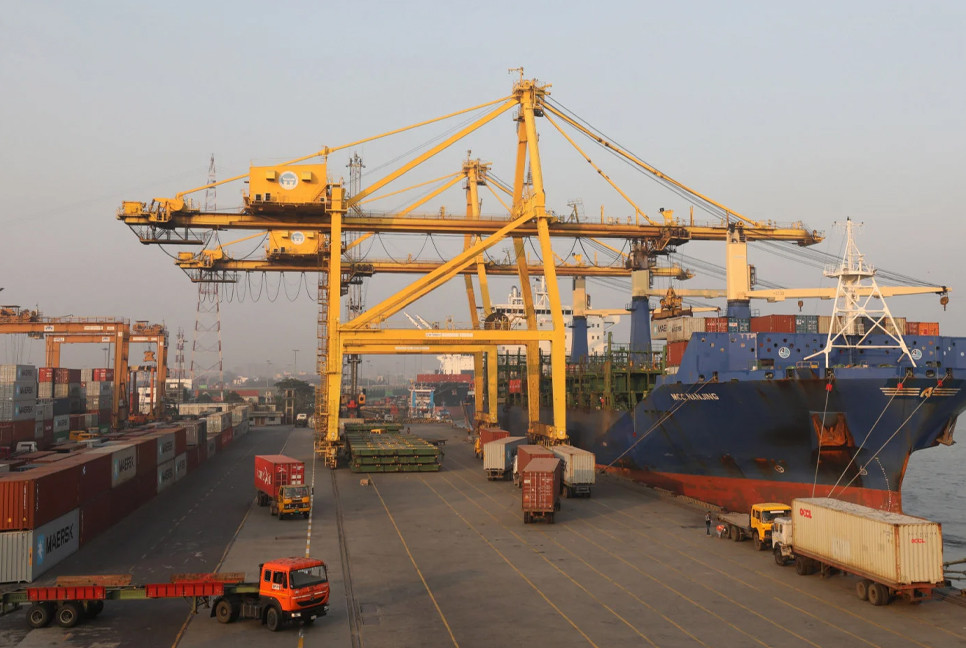
Export–import operations through Chattogram port came to a halt on Monday as port employees continued their agitation against the proposed leasing of the New Mooring Container Terminal (NCT) to a foreign operator, extending their strike for another 24 hours from this morning.
The workers observed eight-hour work stoppages from 8am to 4pm for three consecutive days until Monday. As their demands remained unmet, the agitation was escalated into a fresh 24-hour strike.
Sector insiders warned that while the initial three days of partial strikes had already disrupted port operations, a prolonged shutdown could inflict severe damage on the country’s international trade.
They cautioned that mounting congestion at the port would cause export containers to miss mother vessels, forcing exporters to resort to costly air shipments, offer discounts to overseas buyers, or even face order cancellations due to delivery delays.
In addition, vessels delayed while waiting for containers are likely to charge demurrage ranging from $15,000 to $20,000 per day, significantly increasing costs for traders.
Import-dependent industries, meanwhile, risk shortages of raw materials due to delayed container deliveries, hampering production. Importers will also be compelled to pay additional storage charges at the port.
Trade experts further warned that the ongoing supply chain disruption could negatively affect the availability and prices of essential commodities ahead of the holy month of Ramadan.
The agitation was initially announced by Jatiyatabadi Sramik Dal at a rally on Thursday as a two-day programme, which was later extended through Monday.
The Sramik Karmachari Oikya Parishad (SKOP) also expressed solidarity with the strike.
Sramik Dal coordinator Ibrahim Khokon alleged that the port authority had failed to take any meaningful initiative to resolve the crisis and had instead transferred 16 protesting employees to other port establishments “illogically”.
“Since the authority is not paying heed to our movement, we extended it for another 24 hours starting from 8am today (Tuesday),” Khokon said.
As on the previous days, workers refrained from duty during Monday’s eight-hour strike, severely disrupting both operational and administrative activities. Container loading, unloading and transportation remained suspended during the strike hours.
Fazle Ekram Chowdhury, president of the Chattogram Port Berth Operators, Ship Handling Operators and Terminal Operators Owners Association, told the Daily Sun that four workable vessels were waiting at the General Cargo Berth (GCB) on Monday.
“The workers refrained from work during the strike hours. The impacts of the strike will be visible once the vessels begin waiting for containers,” he said, adding that longer turnaround times would lead to substantial demurrage charges.
Ruhul Amin Sikder, secretary general of the Bangladesh Inland Container Depots Association (BICDA), said container transportation was also badly affected.
Against a daily average of 2,500 TEUs, only 1,472 TEUs of export containers were sent to the port, while just 534 TEUs of import containers, compared to an average of 1,200 TEUs, were transported to inland container depots (ICDs) during Sunday’s strike.
He said that currently 9,901 TEUs of export containers, 8,717 TEUs of import containers, and 50,467 TEUs of empty containers are lying at 21 ICDs in Chattogram.
According to Chattogram Port Authority (CPA) sources, against a storage capacity of 59,000 TEUs, a total of 37,307 containers were stacked at the port yards as of 8:00am on Monday, up from 32,873 containers the previous day.
Only 1,684 containers were delivered in the 24 hours leading up to Monday morning, compared to the usual daily average of more than 4,000 TEUs.
Former vice-president of the Bangladesh Freight Forwarders Association Khairul Alam Suzan said importers would have to bear additional port charges, while shipping lines would impose daily demurrage fees of $15,000-20,000 per vessel.
“Delays in transportation will disrupt the supply chain and push up prices of essential commodities ahead of Ramadan,” he warned.
Bd-pratidin English/TR