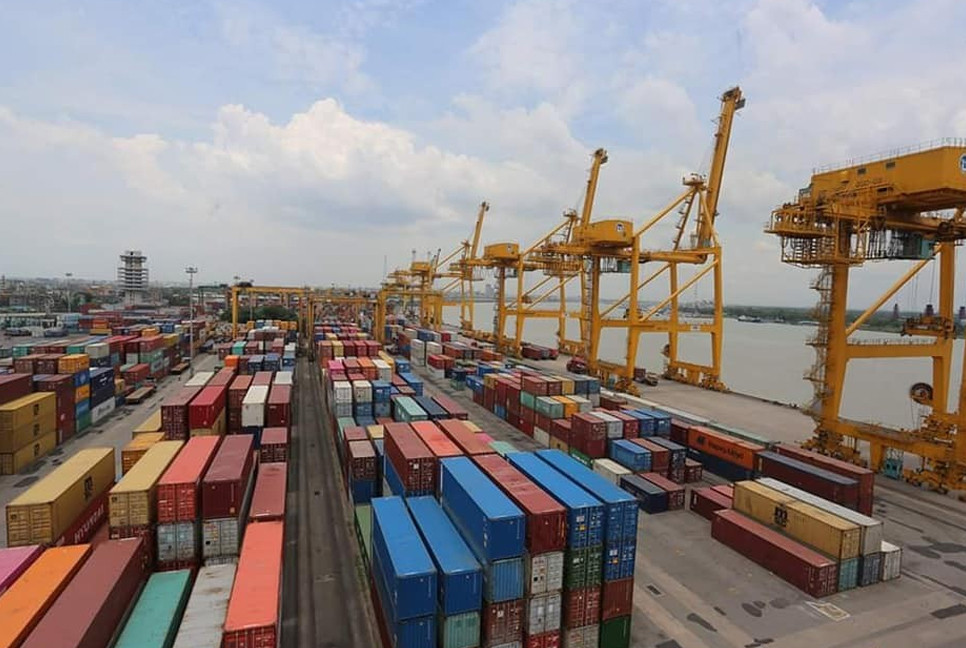
Multiple ongoing mega projects centred on the country’s premier seaport in Chattogram are set to enhance its container handling capacity by around 55 lakh twenty-foot equivalent units (TEUs) by 2031, on top of the current annual handling of around 34 lakh containers with a steady year-on-year growth.
However, concerns are mounting over whether the country’s weak hinterland connectivity – by road, rail and waterways – will be able to cope with the anticipated surge in container and cargo volumes, as insufficiencies are already driving up logistics costs and eroding the trade competitiveness.
Sector insiders warned that without smooth and efficient transport links, the massive investment involving thousands of crores of taka could become unsustainable.
They stressed the need for quicker development of dedicated road and rail corridors to fully reap the benefits of the ongoing port expansion projects.
According to an unofficial estimate, around 96% of the country’s import and export containers and containerised goods are transported through the Dhaka-Chattogram highway while 3 percent are by rail and merely 1% by the waterways.
The situation is likely to worsen further as the narrow Chattogram-Cox’s Bazar highway remains incapable of handling the additional container traffic that will originate from the Matarbari Deep Seaport at Moheshkhali in Cox’s Bazar.
Besides, against a daily requirement of seven to eight locomotives for container movement, Bangladesh Railway can currently provide only one to two locomotives to transport containers between Chattogram Port and Kamalapur Inland Container Depot in Dhaka.
Meanwhile, the inland waterway route connecting the port with Pangaon Inland Container Terminal at Keraniganj in Narayanganj is steadily losing appeal due to irregular and unaffordable services. Currently, only six vessels operate on the route.
Chattogram port handles 92% of the country’s seaborne trade and recorded growth across all three key indicators – container, cargo and vessel handling – in 2025.
Compared to 2024, the port registered a 4.07% year-on-year growth in container handling, 11.43% in cargo and 10.50% in vessel handling, said sources at the port.
Terminal building in focusThe government engaged the country’s first foreign terminal operator “RSGT Chittagong,” an international venture of Red Sea Gateway Terminal (RSGT), to operate the Patenga Container Terminal (PCT) in 2023, but it is yet to begin full-scale operation.
The terminal is expected to handle around six lakh TEUs annually once all modern equipment is installed by May this year, which raises concerns regarding the country’s hinterland capacity.
Meanwhile, the government inked a 30-year concession deal with Netherlands-based APM Terminals BV, a subsidiary of the Danish shipping giant AP Moller-Maersk’s Transport and Logistics Division, in November last year to build, operate and transfer the Laldia Container Terminal located in the city’s Patenga area.
Once operational, the terminal is expected to handle around eight lakh TEUs annually by mid-2029.
The Bay Terminal, which will feature one multipurpose and two container terminals, is expected to handle over 30 lakh TEUs of containers annually.
Two terminals of the dream project are expected to be developed and operated by two foreign operators – PSA Singapore and DP World.
Earlier, the Executive Committee of the National Economic Council (ECNEC) approved the “Bay Terminal Marine Infrastructure Development Project” (BTMID) last year, with completion targeted by June 2031.
Moreover, the Chittagong Port Authority (CPA) inked deals with two Japanese contractors in April last year for construction and procurement of cargo handling equipment for the country’s first deep seaport at Matarbari in Moheshkhali.
The CPA initially expected to get the works of the landmark “Matarbari Port Development Project” done by the deadline set for December of 2029. The mobilisation for starting the excavation activities at the project site is now underway.
By 2029, the deep seaport is expected to handle six to 11 lakh TEUs annually, with a projected capacity of 22 to 26 lakh TEUs by 2041, officials said.
Transportation through highways faces challengesOver the years, the Dhaka-Chattogram highway, considered the economic artery of the country, has shrunk for different reasons, increasing travel time and costs. The additional costs ultimately affect the country’s international trade competitiveness.The 250-kilometre highway was upgraded to four lanes in 2016, but traffic on it has risen sharply.
Chattogram Divisional Additional Chief Engineer Ataur Rahman said a feasibility study suggested upgrading the highway to eight to ten lanes based on traffic density, but the donor for the mega project is yet to be finalised.
Once the Matarbari Deep Seaport becomes operational, containers not meant for transshipment will have to move through the narrow Chattogram-Cox’s Bazar highway, which has been hitting headlines regularly for repeated fatal road accidents.
Some portions of the 159-kilometre highway has been expanded, and the Japan International Cooperation Agency (JICA) has conducted a feasibility study for upgrading it to four lanes.
Roads and Highway Department Executive Engineer Pintu Chakma told the media that it will take one to two years to start the project work upon completion of all necessary procedures and securing a donor.
“It is uncertain how many years it will take to complete,” he added.
Railway, waterway provide low supportSources in the Bangladesh Railway (East Zone) said for freight operations, just one to two locomotives can be allocated against a demand for around seven to eight daily, despite having a significantly higher profit from this operation compared to that of the passenger trains.
The freight service through train reportedly remained suspended for 11 days in December last year due to locomotive shortage.
Meanwhile, CPA sources said only six container vessels operate to and from Chattogram and Pangaon Container Terminal in Keraniganj. Even that is not on a regular basis.
High freight rates, lengthy clearance times and lack of supporting logistics facilities have left the route less viable.
What stakeholders sayBangladesh Freight Forwarders Association former Vice President Khairul Alam Suzan said that severe tailbacks at multiple points along the Dhaka-Chattogram highway increase transportation time.
“Poor transport facility raises costs and puts the country at a disadvantage compared to competing countries in international trade,” he said, calling for dedicated expressway and rail track for cargo.
CPA former Member and former project director of the Matarbari Deep Seaport Project Zafar Alam said global cargo growth averages around 3% while Bangladesh witnesses 5–6% during favourable periods.
“If the road capacity is not increased, people will not be able to travel since cargo-laden vehicles will occupy it entirely,” he warned.He stated that initiative must focus simultaneously on road, rail and waterway.
Acknowledging the weak contribution of rail and waterways in container transportation, CPA Director (Admin) and Spokesperson Mohammad Omar Faruk told the media that dedicated road and rail corridors are necessary for this purpose.
He also expressed optimism that handing over of Pangaon Terminal to a foreign operator would help make inland waterway transport more viable in the coming days.
Courtesy: Daily Sun.
Bd-pratidin English/TR