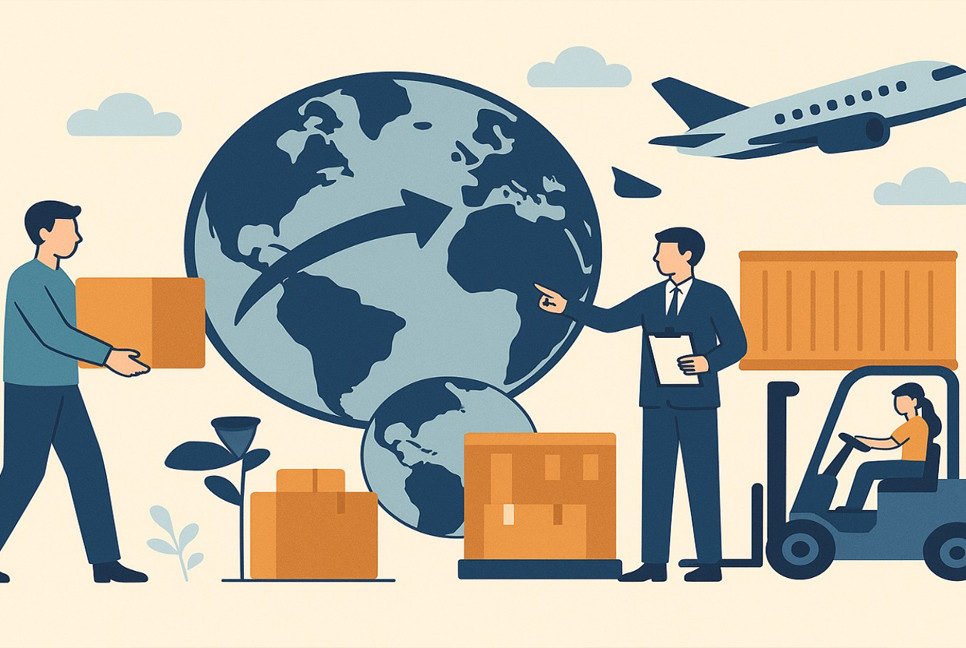
Bangladesh depends heavily on imports, from industrial machinery to everyday consumer goods, yet many of these items reach shop shelves at prices far higher than in neighbouring countries such as India, putting extra pressure on household budgets and raising questions about how the import system works.
The issue is becoming more urgent. Bangladesh is projected to become the world’s ninth-largest consumer market by 2030, suggesting import dependence will grow further in the coming years.
Economists and business leaders argue that without reforms, the cost of imported goods will continue to rise, affecting both consumers and the wider economy.
According to the Bangladesh Bureau of Statistics (BBS), the country imported goods and services worth about $95.3b in the 2024-25 fiscal year (FY25). Of this, $84.83b was goods and around $11.6b services.
Exports during the same period stood at $54.83b, including $48.28b in goods and $6.55b in services. In the previous financial year, Bangladesh imported $86.72b worth of goods and services while exporting about $58.03b.
Why are imported goods more expensive?
An examination of prices in recent weeks shows stark differences between Bangladesh and India for a range of common imported products.
In Dhaka’s supermarkets, a 500-gram packet of California almonds sells for about $8-8.5, compared with $5.46-6 in India. A 462-gram jar of Skippy peanut butter costs $7-7.5 in Bangladesh, but $4.48-5 in India. Heinz tomato ketchup (570g) is priced at around $6 in Dhaka, compared with $4.49 in India, while Gerber baby cereal (227g) costs $10.5-13 in Bangladesh, almost double India’s $5.64.
Data from the National Board of Revenue (NBR) show that import taxes play a major role.
California almonds with an import price of $4 attract an overall tax rate of 61.8%. Skippy peanut butter, imported at $4.25, faces a total tax of 88.75%. Heinz tomato ketchup, imported at $1.71, is subject to a 93.16% tax rate, while Gerber baby cereal, imported at $7, carries taxes of up to 61.8%.
In India, by contrast, total taxes are lower: around 39.65% for California almonds, 39-45% for peanut butter, about 39-40% for tomato ketchup, and slightly above 40% for baby cereal, according to Indian export-import agencies.
Delays also add to costs. Business insiders say it takes an average of 9.57 days, including physical inspection and testing, to release imported milk powder in Bangladesh, compared with 3.6 days in India.
Complex procedures and weak logistics
Business leaders point to lengthy documentation procedures and inefficiencies at ports as key drivers of higher prices. Mohammad Borhan E-Sultan, president of the Bangladesh Foodstuff Importers and Suppliers Association (BAFISA), says importers must deal with at least 13 separate stages before goods are released, involving banks, shipping agents, customs officials, testing authorities and port authorities.
“This lengthy and complex process hampers business operations and causes significant delays in both import and export activities,” he told the media. “As a result, the cost of imported products goes up in our country.”
He added that incoherent policies, inefficient logistics, long customs procedures and limited technological adoption at ports all increase the cost of doing business, with knock-on effects across the economy.
Who sets the prices?
Imported goods are mainly sold through supermarkets, but retailers say they have little control over pricing. Zakir Hossain, general secretary of the Bangladesh Supermarket Owners’ Association (BSOA), said prices are largely fixed by importers.
“Importers fix the rate of a product after calculating tax, other costs and profit. So it depends on importers,” he said. He added that supermarket profit margins are limited by competition and rejected claims of syndication among retailers.
Governance and market oversight
Some consumers and campaigners argue that weak governance worsens the problem. Rezaul Karim, a corporate professional who has travelled widely across Asia, Europe and the United States, said prices of everything from baby food to luxury items are much higher in Bangladesh.
He said he often buys products abroad because they are cheaper and better quality.
“Traders in Bangladesh take higher profit on foreign products as there is a lack of strong monitoring management in markets,” he claimed, adding that a saree priced at Tk5,000-7,000 in India or Thailand can sell for Tk15,000-16,000 in Bangladesh. The Consumers Association of Bangladesh (CAB) shares similar concerns. Its president, AHM Shofiquzzaman, blamed higher prices on irregularities, corruption, poor logistics and weak oversight by government bodies, including the Bangladesh Competition Commission (BCC), Directorate of National Consumer Rights Protection (DNCRP), NBR and Bangladesh Standards and Testing Institution (BSTI).
He alleged that some importers are forced to use unofficial channels and pay extra money to secure document clearance.
“If importers don’t pay extra money, the concerned government officials disagree to release documents or products,” he said, adding that longer lead times significantly raise costs.
Mr Shofiquzzaman also warned of “invisible syndication” and a lack of healthy competition. Although laws cap profits on agricultural products at 25%-30%, he said maximum retail prices are often much higher and poorly monitored.
He argued that while the commerce ministry has the authority to fix prices for 24 essential goods, it currently intervenes only in edible oil and sugar.
He called for stronger political commitment, reduced import duties, better governance at all stages of transport and more reasonable profit margins.
Supply-chain pressures
BAFISA President Borhan E-Sultan pointed to broader supply-chain challenges. A weaker taka and higher dollar exchange rates increase import costs, while freight, insurance and shipping charges are passed on to consumers.
“Imported foods often incur customs duties, regulatory fees and compliance costs, such as food-safety testing and certification,” he said. He added that long clearance times, port and shipping demurrage, poor cold-chain facilities and multiple intermediaries further inflate retail prices.
Calls for reform
Importers and suppliers argue that lowering duties could reduce prices while boosting consumption and tax revenue.
Borhan said reduced tariffs would encourage formal imports and cut the risk of under-invoicing and smuggling.
He also suggested simplifying certification requirements and allowing a second test if a product fails initial inspection.
“Prioritising clearance within three days can help maintain product availability, support price stability and minimise port and shipping demurrage,” he said.
Logistics and competitiveness
Economists say improving logistics could have a major impact. Dr M Masrur Reaz, chairman of Policy Exchange of Bangladesh, said trade facilitation has become a key driver of competitiveness.
Bangladesh ranked 88th out of 139 countries in the World Bank’s Logistics Performance Index 2023, well behind India at 38th and Vietnam at 43rd.
Masrur Reaz said a 25% reduction in logistics costs could increase exports by 20%, while a 1% cut in transport costs could raise exports by 7.4%. Reducing dwell times by one day could have a similar effect.
“If there were no congestion, total costs borne by truck operators would be 35.5% lower on average,” he said, adding that in-transit inventory carrying costs could fall by 84%.
He called for automated, technology-based logistics management and full automation of customs and clearance processes.
Official response
The Bangladesh Competition Commission says it is seeking to strengthen its capacity. Its secretary, Mahbubur Rahman Khan, said more officials would be appointed to improve market monitoring.
“We have a crisis of employees,” he said, adding that complaints about abnormal pricing would be investigated.
Meanwhile, Commerce Adviser Sk Bashir Uddin said a draft Import Policy Order for 2025-2028 has been prepared and awaits cabinet approval.
He said the ministry is working on “structural, procedural and cultural changes” to simplify trade operations.
Courtesy: Daily Sun.
Bd-pratidin English/TR