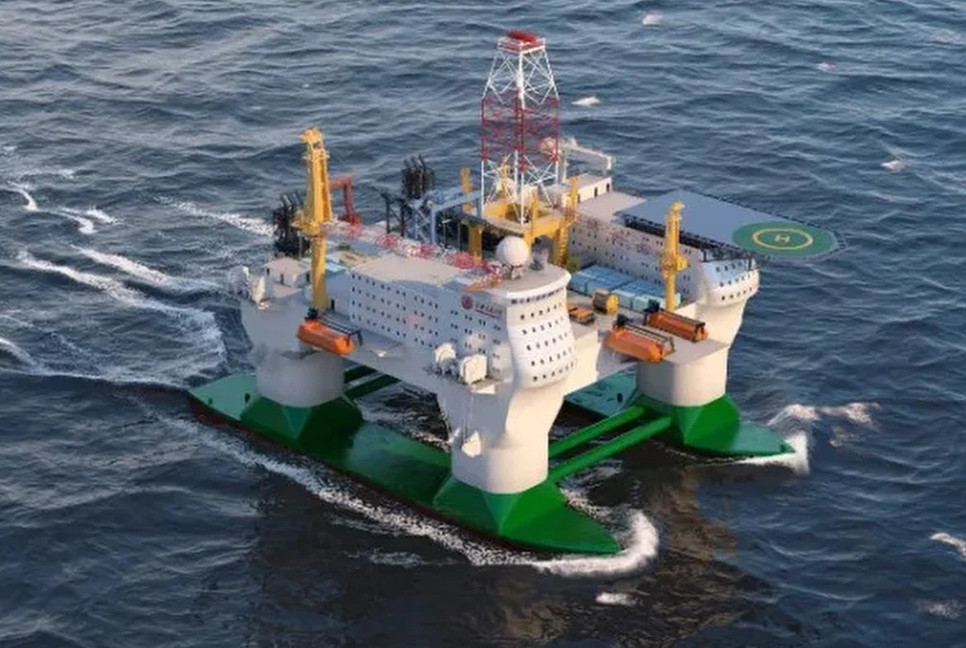
China has begun work on constructing a colossal 'floating artificial island' that they claim could survive a nuclear attack.
The 78,000-tonne semi-submersible platform is being hailed as the world's first mobile, self-sustaining artificial island, and is set to launch in 2028.
With a displacement comparable to China's latest Fujian aircraft carrier and room for 238 people to live and work for four months at a time, defence analysts have warned it could project Chinese influence into contested waters like never before.
Officials insist it is a scientific project - but its rare nuclear-resistant construction has raised eyebrows.
Researchers say the island uses futuristic 'metamaterial' sandwich panels capable of turning the violent force of nuclear shockwave into little more than a squeeze.
'This deep-sea major scientific facility is designed for all-weather, long-term residency,' the team behind the project wrote earlier this month.
'Its superstructure contains critical compartments that ensure emergency power, communications and navigation control – making nuclear blast protection for these spaces absolutely vital'.
Its official title is the Deep-Sea All-Weather Resident Floating Research Facility - also dubbed a 'far-sea floating mobile island' - and it has been a decade in the making, according to the Shanghai Jiao Tong University (SJTU).
Design documents signed in December 2024 detail a giant platform 138 metres long and 85 metres wide, with a deck towering 45 metres over the waves.
Its twin hulls mean it can ride out monstrous seas, including Category 17 typhoons - the strongest on Earth.
But unlike traditional ships dependent on fuel or fixed bases permanently cemented into dispute reefs, this floating island offers the one thing regional rivals fear most - permeance through mobility.
It can reportedly sail at 15 knots while enabling dozens of scientists to conduct continuous research - and potentially support seabed mining on resource-rich territory.
'We're racing to complete the design and construction, aiming for operational status by 2028,' said Lin Zhongqin, an academician leading the project, in an interview with Economic Information Daily last year.
Officials claim the facility could transform ocean science and offer 'real-scale testing capabilities' unmatched by any lab or ship.
Yet its likely deployment zones include strategic locations such as the South China Sea - a region already bristling with territorial conflicts.
Although labelled a civilian initiative, the project cites GJB 1060.1-1991 - a Chinese military standard for nuclear blast protection- strongly suggesting dual-use intentions.
Yang's team described the threat by explaining that nuclear detonations create supersonic shockwaves capable of obliterating structures through extreme pressure.
Traditional armour is too heavy and bulky for a vessel designed to remain nimble and liveable.
So engineers devised a cutting-edge solution - the 'sandwich bulkhead'.
This structure, a lattice of crumpling metal tubes, behaves like a super-strong sponge. When crushed, it tightens and stiffens instead of tearing apart.
In a blast, instead of being smashed by a single catastrophic impact, the panel absorbs the force gradually, spreading it out and reducing the damage.
Yang's simulations found just 60mm of this material can beat far heavier steel.
Under blast conditions powerful enough to flatten buildings, the metamaterial reduced structural movement by 58.53 per cent and peak stresses by 14.25 per cent - keeping the hull intact.
Crucially, it does all this while saving weight and space - a dream come true for naval architects.
Military observers say the platform could be a strategic game-changer. Unlike Beijing's controversial land-reclamation projects, a mobile island can quietly 'set up shop' in disputed waters - then vanish just as quickly.
It could serve as a communications hub, logistics base or even a surveillance station.
Its endurance - 120 days without resupply - exceeds that of some nuclear-powered carriers, giving China extraordinary reach into remote oceans.
Some analysts also believe the platform signals China's determination to dominate the 'blue economy' from offshore energy to deep-sea minerals.
Source: Daily Mail
Bd-pratidin English/ ANI