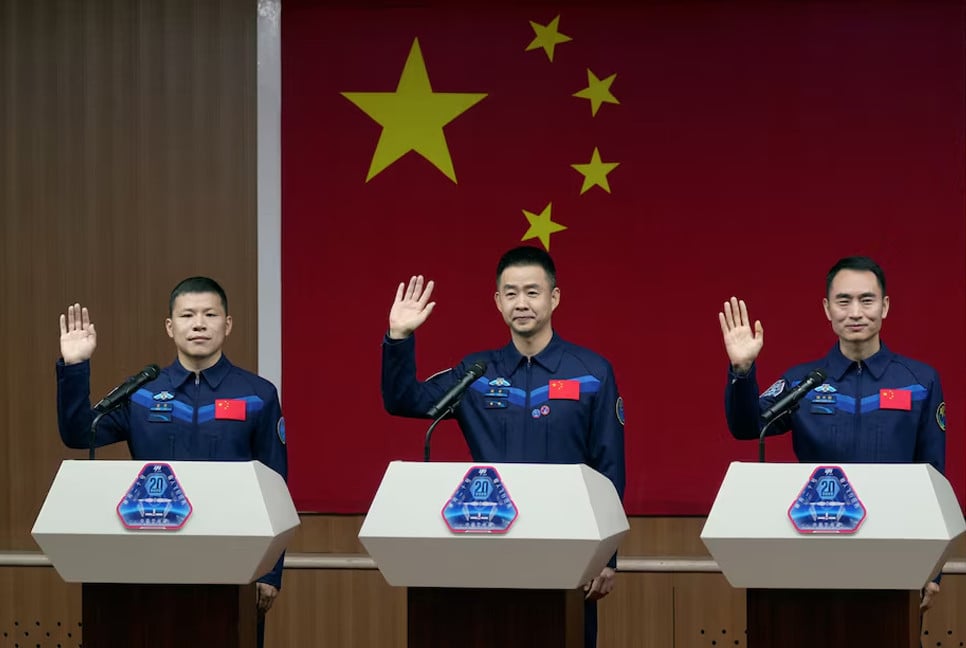
A trio of Chinese astronauts returned to Earth on Friday after getting stuck on China's space station for more than a week due to their spacecraft sustaining debris damage, leaving China without an immediate way of bringing home the new crew in an emergency.
What happened to the Shenzhou-20 spacecraft?
The Shenzhou-20 vessel was left at the space station after China Manned Space Agency decided that a window crack was enough to make it unfit to fly.
The Shenzhou-20 crew - Chen Dong, Chen Zhongrui and Wang Jie - came home in the Shenzhou-21, which had been due to return to Earth in six months' time.
Two weeks ago, the Shenzhou-21 transported the three astronauts taking over from the Shenzhou-20 crew at the permanently inhabited space station known as Tiangong, or "Heavenly Palace".
What risks do the Shenzhou-21crew face?
Tiangong is facing the unprecedented situation of having no working spacecraft to bring the Shenzhou-21 crew back to Earth in the event of an emergency.
Among the trio currently stuck in Tiangong is 32-year-old Wu Fei, China's youngest astronaut to be sent to space.
China's space authorities and state media have so far remained silent on the vulnerability of Tiangong and its inhabitants. State broadcaster CCTV on Friday focused instead on minute-by-minute descriptions of the Shenzhou-21 spacecraft's journey to Earth.
State news agency Xinhua said The astronauts had spent six months aboard the station and were supposed to return on Nov. 5, four days after the new crew arrived. Their mission was extended by nine days, bringing their total time in orbit to 204 days — the longest stay by any astronaut on China’s space station to date.
How can China help the Shenzhou-21 crew?
CMSA said on Friday that the Shenzhou-22 spacecraft would be sent at an appropriate time in the future.
The premature deployment of Shenzhou-22, originally scheduled for launch next April, could be based on the experience of Russia's Soyuz programme. The design of Shenzhou vessels is based on the Soyuz spacecraft.
In December 2022, a micrometeoroid particle struck the radiator of the thermal control system on Soyuz MS-22 while aboard the International Space Station, the 25-year-old science lab led by the U.S. and Russia.
Due to the risk of overheating, Russia's space agency decided to send Soyuz MS-23 to the ISS to bring back the crew of the slightly damaged vessel.
Igor Marinin, a member of the Russian Academy of Cosmonautics, said it was likely Chinese specialists would have studied the "non-standard situations" experienced by Russian crews.
Can china remove the damaged spacecraft from Tiangong?
China's Shenzhou missions have been sending trios of astronauts to Tiangong for six-month stays since 2021. This marks the first time a Shenzhou vessel has been left behind in space while its crew returns to Earth.
The debris-hit Shenzhou-20 spacecraft needs to be fixed in orbit before being sent back or removed outright. Failure to do so would make future missions impossible as Tiangong needs to have a vacant port free at all times for newly arrived Shenzhou vessels to dock.
Source:Reuters
Bd-pratidin English/ ANI