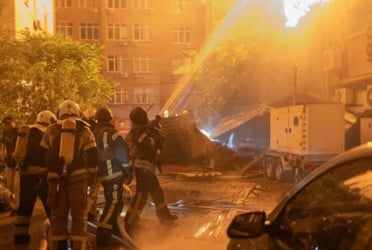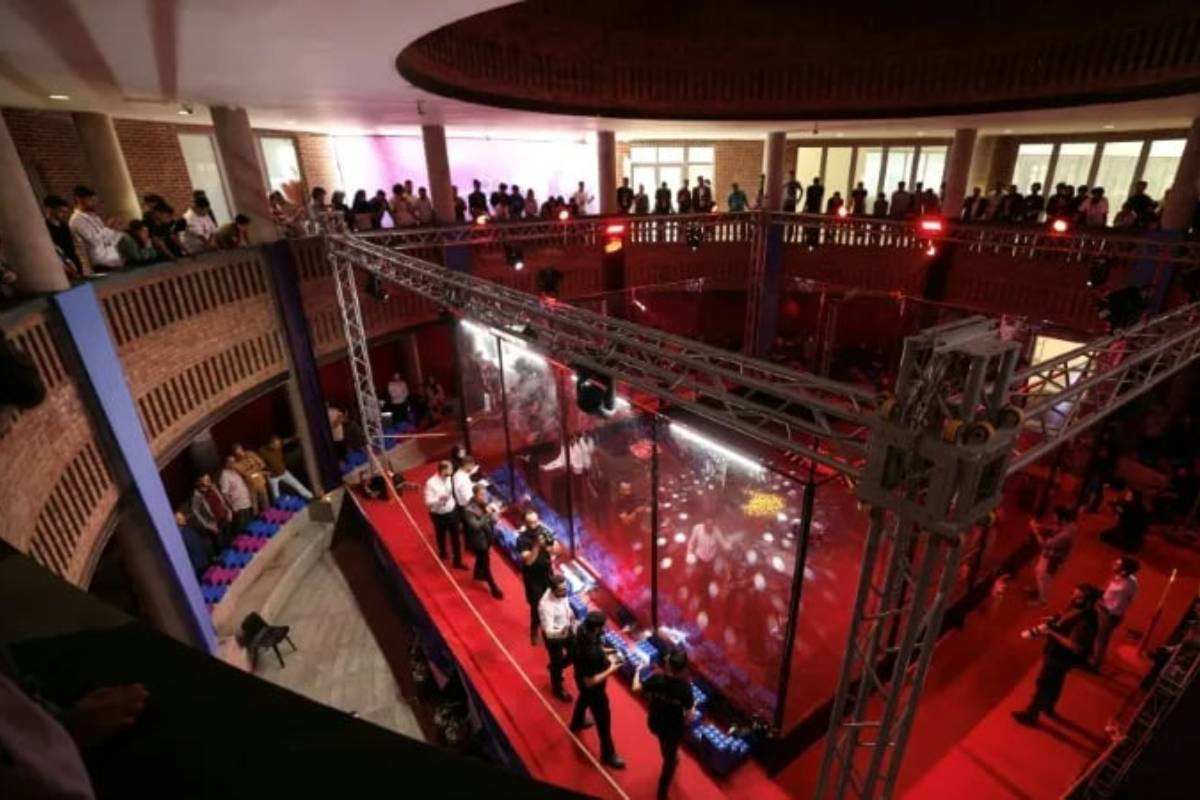
Two robots resembling oversized vacuum cleaners sped around a ring, colliding, sparking, and even catching fire — as Iranian engineering students watched in excitement from behind a plexiglass barrier, reports AFP.
The fiery showdown was one of many events at Iran’s “Tech Olympics”, a national competition designed to identify and promote the country’s brightest engineering talents.
Despite decades of international sanctions that have stifled scientific and industrial development, Iran is striving to establish itself as a regional leader in emerging technologies.
This year’s Tech Olympics featured contests in robot battles, programming, artificial intelligence, drones, cybersecurity, and connected devices, drawing participants from across the country — and a few teams from abroad.
A few hours before his match, 21-year-old Alireza Hosseini was fine-tuning his combat robot, Arash — a simple machine of wires and wheels, far from a humanoid in appearance but deadly in precision.
“What’s more important than design is the operator,” said Hosseini, a student from Kerman in southern Iran. “Design is only a third of the work — the operator decides how and where the robot attacks.”
Hosseini’s multidisciplinary team of electrical, mechanical, and computer engineering students has already been crowned Iran’s robotics champion three times.
Launched last year as a government initiative, the Tech Olympics now serves as a talent pool for tech companies seeking new recruits among the country’s rising innovators.
Some participants were racing against time. “Unfortunately, we started late, and the robot isn’t quite ready yet,” admitted Mr. Azizi, coach of an under-18 team, moments before competition began.
The robot battles — judged by three referees much like a wrestling match — thrilled spectators as machines smashed into each other, spewing sparks and sometimes small bursts of flame. Victory went to whichever robot disabled its opponent first.
The event took place at Pardis Technology Park, on the outskirts of Tehran, often dubbed “Iran’s Silicon Valley.” The park is home to dozens of high-tech firms, research centers, and startups.
Organizers said they received more than 10,000 applications, ultimately narrowing the field to 1,000 competitors. According to Iranian media, participants came from more than a dozen countries, including Iraq and Romania.
Iran has made significant investments in robotics and artificial intelligence, with dozens of companies developing applications for industrial, commercial, and medical use.
In September, the country unveiled its first AI-powered legal assistant robot, capable of accurately answering a wide range of legal queries, according to state media.
The Iranian military has also developed autonomous systems, including the Aria combat robot, which uses AI to detect obstacles and navigate independently.
Earlier, in 2021, Iranian veterinarians made headlines for performing the first-ever remote surgery on an animal using Sina, a surgical robot designed and built domestically.
For many students, the competition is more than a contest — it’s a real-world challenge.
“We designed a drone that can take off automatically and follow a set trajectory,” said Mohammad-Javad Asadolahi, a 21-year-old mechanical engineering student. “About 60 to 70 percent of the components are Iranian-made.”
He acknowledged that limited educational resources in Persian and English posed challenges, but added, “Thanks to our knowledge and research, we have gradually succeeded.”
Bd-pratidin English/ Jisan