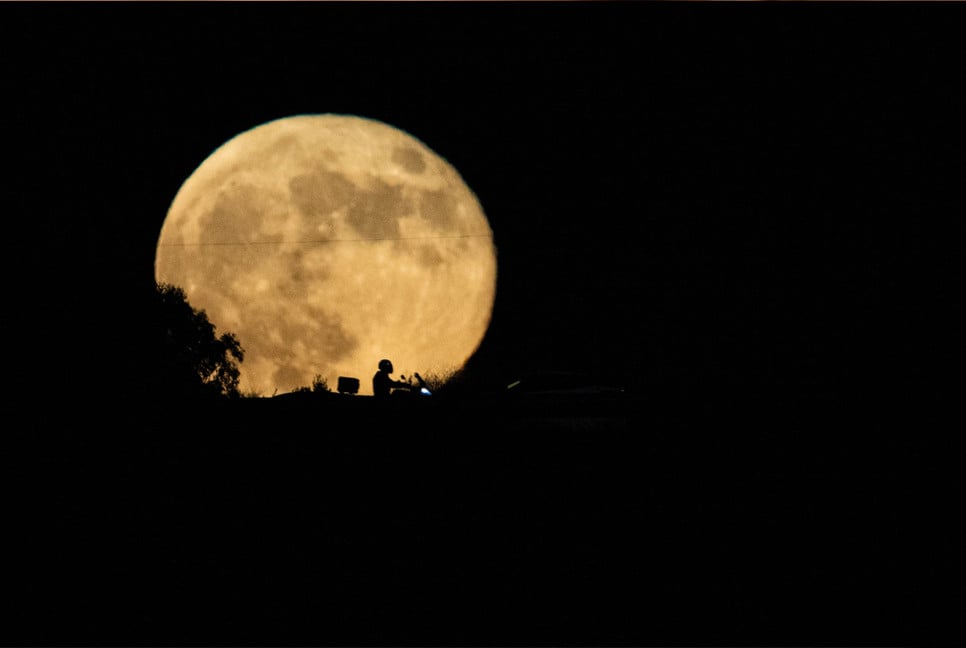
A fantastic opportunity awaits space enthusiasts! On Monday and Tuesday, October 6 & 7, the first supermoon of 2025 will light up the sky in evening and overnight. This full moon in October is traditionally known as the "Hunter’s Moon."
According to astronomers, the supermoon is expected to be visible across South Asia on both October 6 and 7. The moon will appear particularly large and vividly golden-orange when it is positioned close to the horizon.
What makes a full Moon a supermoon?
The Moon's orbit around the Earth is not circular but elliptical, meaning that the distance between the two varies throughout the year.
If the Moon is full at its closest point to Earth - called the perigee - or within 90% of its closest point, it can be referred to as a 'supermoon'.
The term was first coined in 1979 by astrologer Richard Nolle to describe full Moons that appear noticeably larger and brighter as they coincide with the perigee.
They can seem to be up to 14% bigger and 30% brighter than other full moons, external.
Different parts of the astronomical community chose to define supermoons in slightly varying ways. An alternative definition is any full Moon within 360,000km of the centre of the Earth - and under this interpretation October's Harvest Moon would not qualify.
What is a Harvest Moon?
Full Moons throughout the year are given names, often dating back centuries, that reflect what is happening in nature.
October's full Moon is known as the Hunter's Moon but it is also this year's Harvest Moon. The Harvest Moon is the name given to the full Moon that rises closest to the autumn equinox, traditionally a time for gathering crops. It also rises around sunset for several evenings in succession creating extra light for farmers working outside.
The equinox this year was on 22 September, and often the Harvest Moon occurs in the same month. In fact it's on 7 October and is the latest since 1987.
No special equipment is needed to view the supermoon. Simply looking toward the horizon under an open sky is enough to enjoy this breathtaking sight. However, it is best viewed from areas with minimal light pollution.
This will be the first supermoon in 11 months, with the last one having appeared in November 2024.
Two more supermoons are expected to occur later this year, on November 5 and December 5. A fourth supermoon is expected in early January 2026, although it will not be counted as part of the 2025 supermoon cycle.
Source: DBC, BBC, Indian Express
Bd-pratidin English/ ANI