
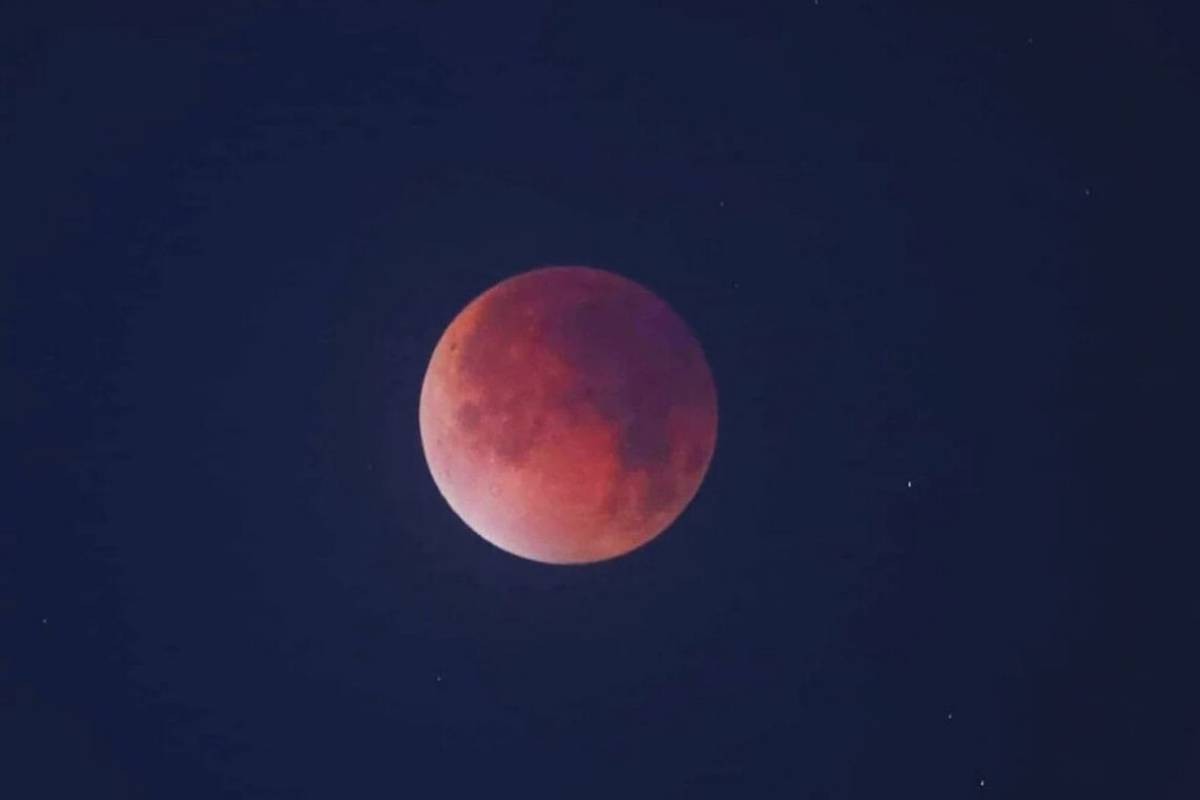
Skywatchers across the country were treated to a rare and stunning celestial event on Sunday night — a total lunar eclipse, popularly known as the ‘Blood Moon.’
The eclipse began at 9:27 PM on September 7, with the moon gradually slipping into Earth’s shadow. Initially, it appeared only partially covered, but soon lost its familiar silvery glow. By midnight, the transformation was complete, as the moon took on a deep reddish-brown hue — a characteristic feature of the Blood Moon.
This year’s total lunar eclipse lasted 82 minutes, making it the longest since 2022. In total, the entire event spanned 7 hours and 27 minutes, concluding in the early hours of September 8.
A lunar eclipse occurs when the Earth moves directly between the Sun and the Moon, casting a shadow that blocks sunlight from reaching the lunar surface. The reddish tint appears due to Earth's atmosphere bending and scattering sunlight, allowing only red wavelengths to illuminate the moon. Because the Moon’s orbit is tilted, such events do not occur with every full moon; typically, two to three total lunar eclipses are visible worldwide each year.
According to the Inter-Services Public Relations (ISPR), the eclipse was fully visible across a region stretching from Hila Island in Indonesia to the port city of Mombasa in Kenya. However, large parts of North and South America were outside the viewing range and missed the spectacle.
The Blood Moon of 2025 offered a captivating reminder of the wonders of the cosmos — and a moment of awe for those who looked up.
Bd-pratidin English/ Jisan