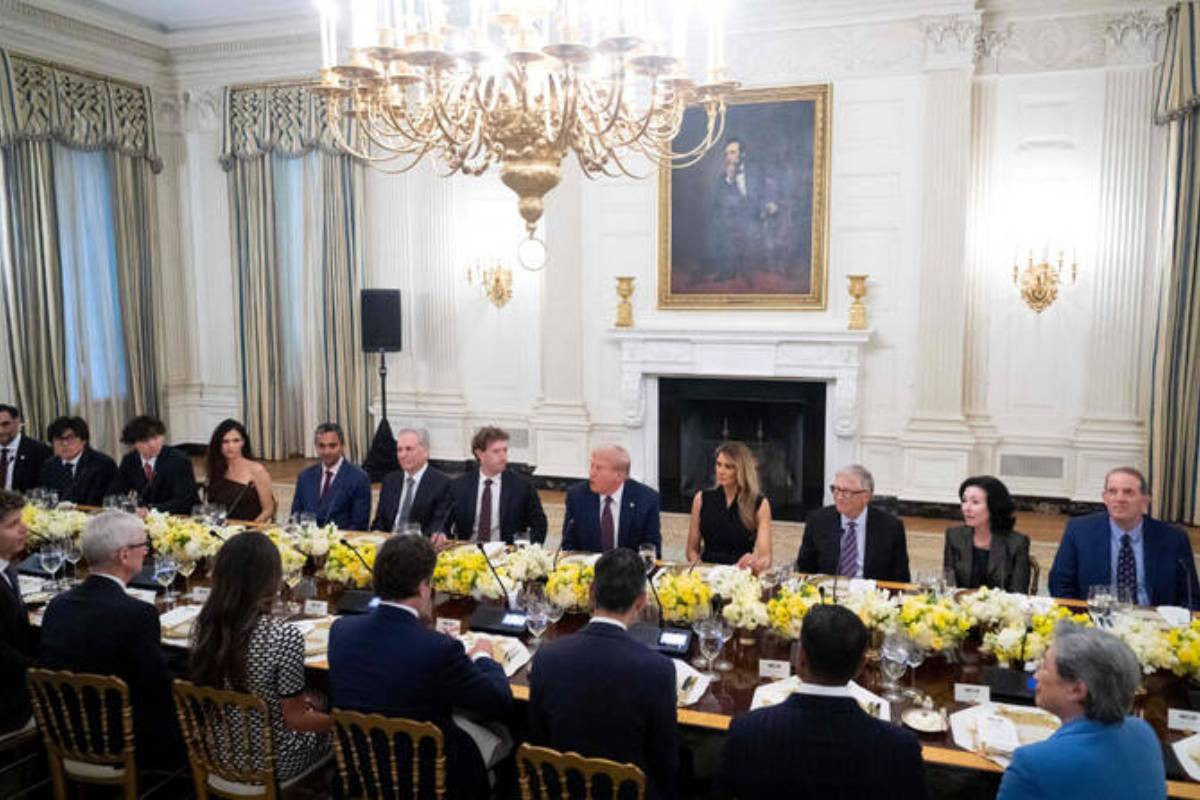
On Thursday evening, U.S. President Donald Trump welcomed a group of the nation’s leading tech CEOs to the White House for a dinner focused on artificial intelligence (AI) and investments in the U.S. economy. The event, which saw key industry figures like Tim Cook (Apple), Sundar Pichai (Google), Bill Gates (Microsoft), and Mark Zuckerberg (Meta) in attendance, underscored the importance of the tech sector in the current administration's economic agenda, reports AFP.
Seated between First Lady Melania Trump and Zuckerberg, President Trump invited each executive to share their companies' investments in the U.S. with a particular focus on AI's future impact. The dinner highlighted the administration's commitment to fostering innovation, but not without controversy — most notably, the conspicuous absence of Elon Musk.
While many high-profile CEOs attended, Musk, CEO of Tesla and SpaceX, was notably missing. The billionaire entrepreneur, once a strong supporter of Trump, has distanced himself from the president due to recent disagreements over space policy and government contracts. Musk’s absence was a reminder of the complex relationship between tech giants and the White House.
The dinner also highlighted the growing influence of Indian-American executives in Silicon Valley and Washington. Five Indian-origin tech leaders — Satya Nadella (Microsoft), Sundar Pichai (Google), Sanjay Mehrotra (Micron), Vivek Ranadive (TIBCO), and Shyam Sankar (Palantir) — were in attendance. Their presence underscored their rising prominence in the industry, even as Trump has made moves to tighten immigration policies.
During the dinner, Trump downplayed the significance of the upcoming U.S. jobs report, claiming that "the real economic numbers" would become clearer in a year. He suggested that current gains in the job market were largely driven by construction and promised that the U.S. would soon see an economic boom "like our country has never seen before."
Google CEO Sundar Pichai also took the opportunity to thank Trump for a favorable court ruling in Google’s ongoing antitrust case. A judge had dismissed a case that sought to break up Google’s Chrome browser, a ruling that boosted the company’s market value. For Pichai, it was a chance to reset relations with the administration, which had previously accused Google of bias against conservatives.
Microsoft’s Bill Gates praised Trump’s handling of the Covid-19 vaccine rollout, calling it a "model for rapid medical innovation." Gates also highlighted Microsoft’s ongoing collaborations with the U.S. government on disease research, emphasizing projects related to HIV, polio, and sickle cell.
In a lighter moment, Trump commented on Robert F. Kennedy Jr.’s recent Senate testimony regarding vaccines, praising him as a "very good person" who "means very well," despite Kennedy's contentious stance on health and vaccine policy. Trump noted that while he didn’t watch the testimony, he appreciated Kennedy’s willingness to express unconventional views.
As the evening wrapped up, the gathering served as a reminder of the tech sector’s increasing influence in Washington and the evolving relationship between the government and Silicon Valley. While Elon Musk may have skipped the dinner, the discussions surrounding AI, investment, and the economy remain at the forefront of the national conversation.
Bd-pratidin English/ Jisan