There’s something truly enchanting about seeing the Moon gradually transform the atmosphere of the night sky. For millennia, people have observed countless lunar eclipses and marveled at the Moon’s shifting hues from bright white to deep orange and red. Unlike solar eclipses, which are brief, require protective eyewear, and can be tricky to observe, lunar eclipses are longer-lasting, easy to enjoy, and completely safe to view with the naked eye.
This September, skywatchers are in for a remarkable experience, as a stunning total lunar eclipse will be visible across large parts of Asia, Africa, and Australia.
When and where to watch
A total lunar eclipse or "blood Moon" is set to grace the night sky on September 7, 2025. According to the BBC Sky at Night Magazine, the entire event will be visible in India, China, Russia, western Australia, eastern Africa, or across central Asia quite clearly.
Sky enthusiasts in Bangladesh are set to witness a rare and mesmerizing celestial event. A total lunar eclipse, popularly known as a "Blood Moon," will be visible in the night sky on Sunday night (September 7), reports DBC News.
According to the Bangladesh Meteorological Department, the eclipse will be visible across the country with the naked eye, provided the sky remains clear, and no special equipment will be needed.The eclipse will begin at 9:28 PM local time (penumbral phase), with the total eclipse phase starting at 11:30 PM. The maximum eclipse will occur at 12:11 AM, and the total phase will end at 12:52 AM. The entire eclipse process will conclude at 2:55 AM on Monday.
According to Times of India the eclipse will reach its peak during the night from 11:00 PM on September 7 to 12:22 AM on September 8. However, the entire eclipse will span from as early as 8:58 PM to as late as 2:25 AM.
The 82 minutes of totality of the eclipse make it one of the longest total lunar eclipses in recent years, and because it's just before the Moon's closest point to Earth (perigee), it will appear slightly larger in the sky.
What is a Blood Moon, and why does it occur
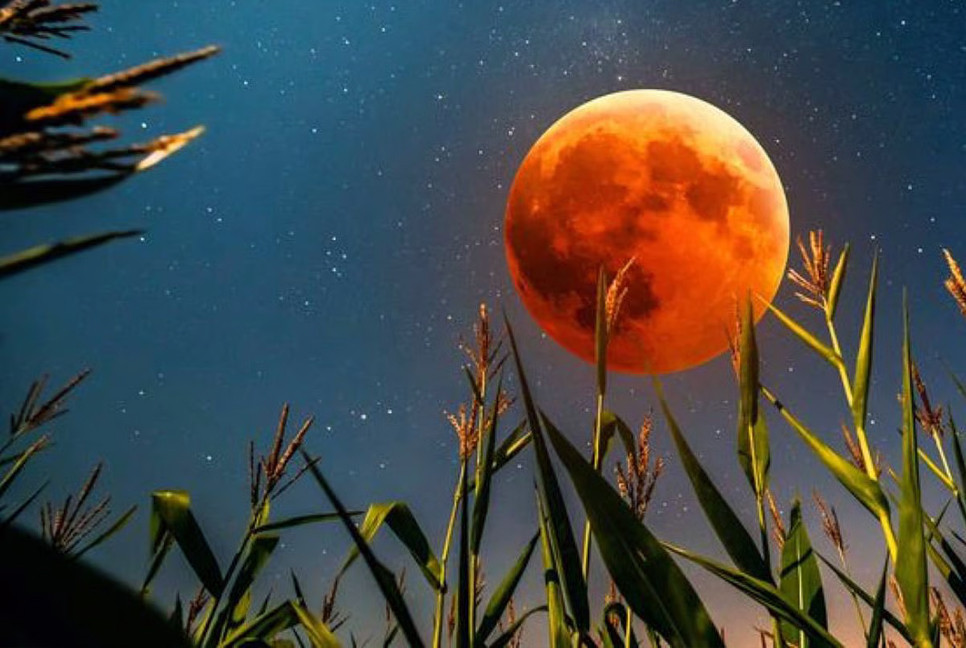
A "Blood Moon" is a nickname for a total lunar eclipse, when the Moon moves completely into Earth's shadow. During this time, instead of going dark, the Moon turns a deep red or coppery color.
As sunlight passes through Earth's atmosphere, it gets filtered and scattered. Blue light is scattered more, while red light bends around Earth and reaches the Moon, casting that eerie reddish glow.
This effect is the same reason sunsets appear red. So, despite its name, a Blood Moon has nothing to do with actual blood. It's just our planet's atmosphere painting the Moon red, one of nature's most beautiful and haunting tricks.
This is a Corn Moon eclipse
Some people also call the upcoming total lunar eclipses the Corn Moon eclipse, but what exactly does that mean?
Every full Moon of the year has a traditional nickname, based on seasonal changes or events happening near them. For example, the February full Moon is called the "Snow Moon" because it's typically the snowiest time of year. The June full Moon is the "Strawberry Moon", since strawberries are usually harvested then.
The September full Moon is known as the "Corn Moon", named for the time of year when corn is ready to be harvested. So, the name "Corn Moon" isn't unique to 2025; it happens every September.
This Corn Moon is special because it's also turning into a total lunar eclipse, which is why it is being called the "Corn Moon eclipse."
This September, the Corn Moon eclipse will bring together tradition and science in a breathtaking display. For skywatchers, it's a chance to witness not just a full Moon, but one of nature's most striking shows-the Moon glowing red in the night sky.
Source: Times of India, DBC
Bd-pratidin English/ ANI