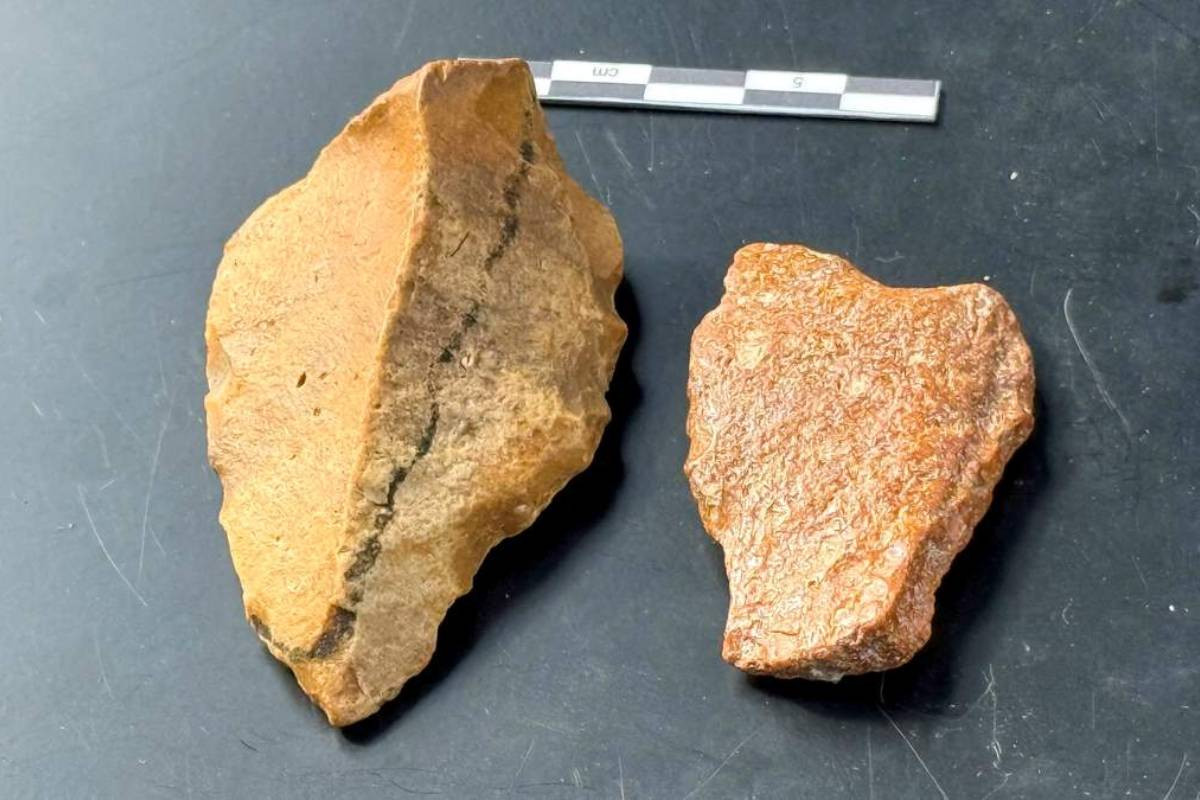
Scientists have found stone tools on Sulawesi Island in Indonesia, potentially identifying the earliest known human presence in the Wallacea region, dating back as far as 1.5 million years ago. This information came as a significant archaeological breakthrough.The discovery, made by Australian and Indonesian archaeologists, challenges previously held beliefs about early human migration and capabilities, reports Reuters/ JN.
The tools, which include small, chipped stones used for cutting animals and carving rocks, were uncovered in the Soppeng region of South Sulawesi. Radioactive dating of the tools and animal teeth found at the site placed the artifacts at up to 1.48 million years old, offering new insights into the migrations of early humans.
Previously, it was believed that Homo erectus, the species known to have first settled in the Wallacea region, only reached Indonesia's Flores Island and the Philippines' Luzon Island about 1.02 million years ago, largely due to the assumption that early humans were not capable of long-distance sea travel. However, the findings on Sulawesi suggest that Homo erectus may have crossed significant ocean gaps at least 1 million years ago, challenging these earlier assumptions.
“These artifacts were made by ancient humans, long before the evolution of Homo sapiens,” said Adam Brumm, lead archaeologist from Griffith University in Queensland, Australia. “We now believe that Homo erectus somehow managed to travel across a vast ocean gap from the Asian mainland to Sulawesi over a million years ago.”
The Wallacea region, a stretch of islands lying between Borneo and Java and Australia and New Guinea, is named after the British naturalist Alfred Russel Wallace, who famously studied its unique biodiversity. The discovery of these ancient tools adds to a growing body of evidence suggesting that early humans were far more adept at long-distance migration and survival than previously imagined.
Bd-pratidin English/ Jisan