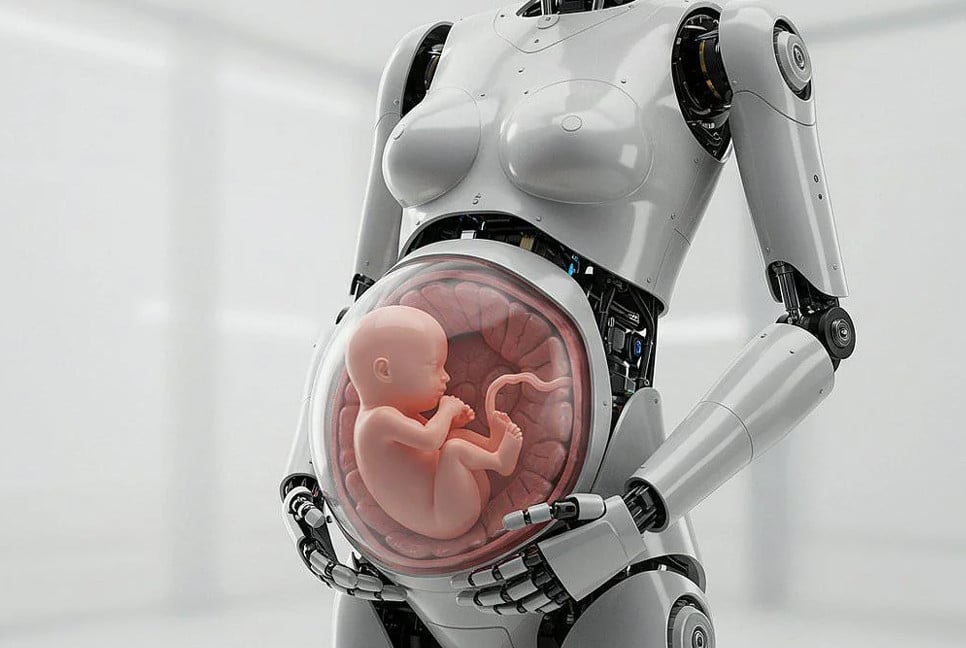
The world’s first humanoid robot surrogate could give birth to a live baby, scientists have claimed.
Experts are developing technology that will mimic a pregnancy from conception to delivery, with the infant growing inside an artificial womb and receiving nutrients through a tube.
After nine months, a live baby will be born, according to Dr Zhang Qifeng, who founded the company Kaiwa Technology, in the city of Guangzhou.
Dr Zhang, a PHD graduate from Nanyang Technological University in Singapore, has claimed the technology is already in a “mature stage”.
He added: “Now it needs to be implanted in the robot’s abdomen so that a real person and the robot can interact to achieve pregnancy, allowing the fetus to grow inside”.
A prototype of the humanoid is set to be sold for around £10,000 (100,000 yuan) next year.
Reports in the Chinese media said that the humanoid has been designed to mimic the entire process of pregnancy, from the moment of conception to birth.
However, the specifics on exactly how the egg and sperm are fertilised are currently unclear.
For the entire gestation period, the infant will live inside the robot’s body, although experts have not yet stated how the foetus will be implanted in the tech womb.
The developing babies will be surrounded by artificial amniotic fluid to create a womb-like environment.
Dr Zhang said the technology is not an entirely new concept, as scientists in the past have successfully kept premature lambs alive inside a “biobag” for weeks.
The innovation has already prompted a legal and ethical debate. Dr Zhang said he had already been in talks with Guangdong Province authorities to prepare drafts for policy and legislation.
If successful, the science could revolutionise medical science and our notions of family and fertility.
The humanoid could be seen as a tool to tackle rising rates of infertility in China, which has gone up from 11.9 per cent in 2007 to 18 per cent in 2020.
‘Problematic’ technology
But some critics have condemned the “problematic” technology, arguing that depriving a foetus of maternal connection is unethical and cruel.
Chinese News outlet The Standard reported that some medical experts are sceptical over the technology’s ability to replicate human gestation.
The experts have allegedly stated that complex biological processes, such as maternal hormone secretion, cannot be duplicated by science.
Andrea Dworkin, the radical feminist writer, has previously hit out at artificial womb technology for fears that it would result in “the end of women”.
Researchers from The Children’s Hospital of Philadelphia published an article in 2022 in which they said that such technology might “pathologise” pregnancy.
However, some argue that artificial wombs could liberate women from pregnancy risks so that they would no longer have to endure the physical burden of carrying a baby.
BP English/ARK