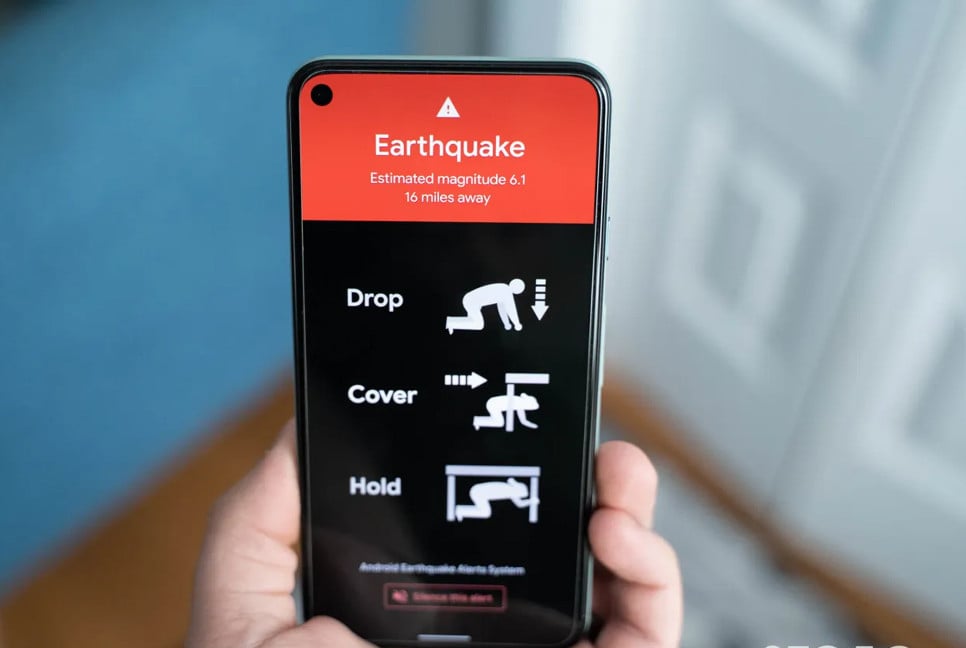
Google's system, named Android Earthquake Alerts (AEA), is able to detect shaking from a vast number of mobile phones that use the Android operating system.
Google has acknowledged that its earthquake early warning system did not function as intended during the devastating 2023 earthquake in Turkey.
Despite the potential to send highest level alert to around 10 million people within 98 miles of the epicenter potentially offering up to 35 seconds of advance warning only 469 "Take Action" alerts were actually issued for the initial 7.8 magnitude quake.
Instead, about half a million people received a lower-level warning, which is intended for mild shaking and does not trigger a prominent alert on users’ devices. These alerts were sent through Android phones, which account for over 70% of mobile devices in Turkey.
Previously, Google had stated that the system "performed well," but now admits it underestimated the strength of the earthquake.
The system was active on the day of the quakes, which struck southeastern Turkey on February 6, 2023, killing over 55,000 people and injuring more than 100,000. Many victims were asleep when buildings collapsed around them.
A Google spokesperson said, “We continue to improve the system based on what we learn from each earthquake.”
How it works
Google's Android Earthquake Alerts (AEA) system detects ground shaking through Android phones and can send warnings before the quake's full impact is felt, as earthquakes travel relatively slowly.
Google's most serious warning is called "Take Action", which sets off a loud alarm on a user's phone - overriding a Do Not Disturb setting - and covering their screen.
This is the warning that is supposed to be sent to people when stronger shaking is detected that could threaten human life.
AEA also has a less serious "Be Aware" warning, designed to inform users of potential lighter shaking - a warning that does not override a device on Do Not Disturb.
The Take Action alert was especially important in Turkey due to the catastrophic shaking and because the first earthquake struck at 04:17, when many users would have been asleep. Only the more serious alert would have woken them.
Limitations
Google researchers have written in the Science journal details of what went wrong, citing "limitations to the detection algorithms".
For the first earthquake, the system estimated the shaking at between 4.5 and 4.9 on the moment magnitude scale (MMS) when it was actually a 7.8.
A second large earthquake later that day was also underestimated, with the system this time sending Take Action alerts to 8,158 phones and Be Aware alerts to just under four million users.
After the earthquake Google's researchers changed the algorithm, and simulated the first earthquake again.
This time, the system generated 10 million Take Action alerts to those at most risk – and a further 67 million Be Aware alerts to those living further away from the epicentre
"Every earthquake early warning system grapples with the same challenge - tuning algorithms for large magnitude events," Google informed.
But Elizabeth Reddy, assistant professor at Colorado School of Mines, says it is concerning it took more than two years to get this information.
"I'm really frustrated that it took so long," she said
"We're not talking about a little event - people died - and we didn't see a performance of this warning in the way we would like."
Google says the system is supposed to be supplementary and is not a replacement for national systems.
However some scientists worry countries are placing too much faith in tech that has not been fully tested.
"I think being very transparent about how well it works is absolutely critical," said Harold Tobin, director of the Pacific Northwest Seismic Network.
"Would some places make the calculation that Google's doing it, so we don't have to?"
Google researchers say post-event analysis has better improved the system - and AEA has pushed out alerts in 98 countries.
The BBC has asked Google how AEA performed during the 2025 earthquake in Myanmar, but has yet to receive a response.
Source: BBC
Bd-pratidin English/ ANI