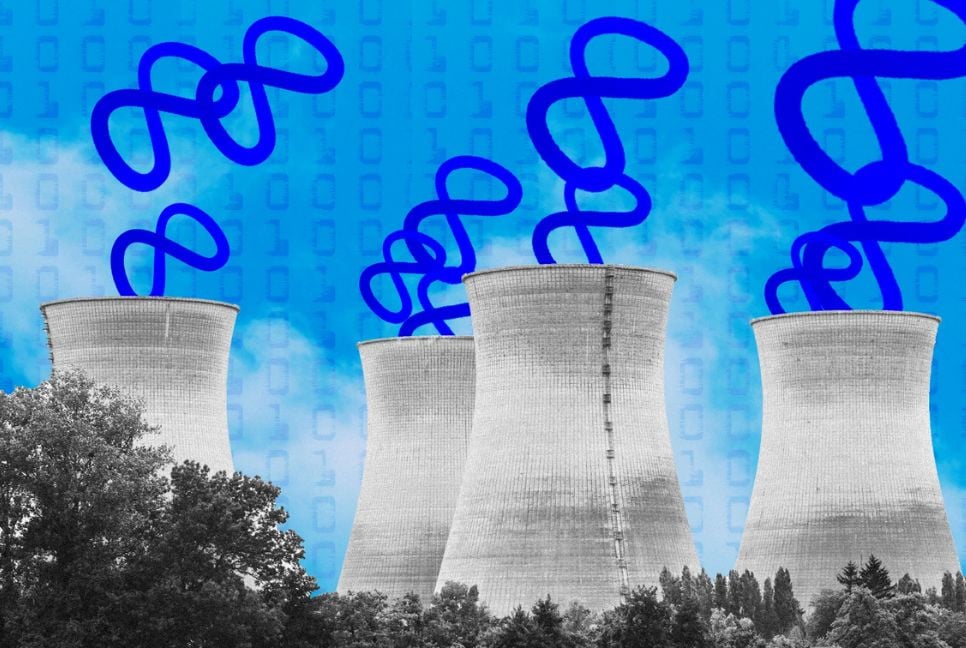
Meta has cut a 20-year deal to secure nuclear power to help meet surging demand for artificial intelligence and other computing needs at Facebook’s parent company.
The investment with Meta will also expand the output of a Constellation Energy Illinois nuclear plant, reports AP.
The agreement announced Tuesday is just the latest in a string of tech-nuclear partnerships as the use of AI expands. Financial details of the agreement were not disclosed.
Constellation’s Clinton Clean Energy Center was actually slated to close in 2017 after years of financial losses but was saved by legislation in Illinois establishing a zero-emission credit program to support the plant into 2027. The agreement deal takes effect in June of 2027, when the state’s taxpayer funded zero-emission credit program expires.
With the arrival of Meta, Clinton’s clean energy output will expand by 30 megawatts, preserve 1,100 local jobs and bring in $13.5 million in annual tax revenue, according to the companies.
The plant currently powers the equivalent of about 8,00,000 U.S. homes. George Gross, professor of electrical and computer engineering at the University of Illinois. estimates that 30 additional megawatts would be enough to power a city with about 30,00 residents for one year.
“Securing clean, reliable energy is necessary to continue advancing our AI ambitions,” said Urvi Parekh, Meta’s head of global energy.
Surging investments in small nuclear reactors comes at a time when large tech companies are facing two major demands: a need to increase their energy supply for AI and data centers, among other needs, while also trying to meet their long-term goals to significantly cut greenhouse gas emissions.
Constellation, owner of the shuttered Three Mile Island nuclear power plant, said in September it planned to restart the reactor to supply power for Microsoft data centers. Three Mile Island, near Harrisburg, Pennsylvania, was the site of the worst U.S. commercial nuclear accident in 1979.
Last fall, Amazon announced an investment in small nuclear reactors just two days after Google made a similar move. More recently, Google said it was backing three advanced nuclear energy projects with Elementl Power.
To meet growing energy demands from tech giants, U.S. states are pushing nuclear expansion. In 2023, 25 states passed legislation supporting advanced nuclear energy, and over 200 new pro-nuclear bills have been introduced this year, according to the Nuclear Energy Institute.
Competing advanced reactor designs are flooding federal regulatory pipelines as the industry promotes nuclear power as a reliable, climate-friendly energy source for AI-driven growth.
Still, the White House’s goal to quadruple nuclear output in 25 years faces steep hurdles. No next-generation reactors are commercially operating in the U.S., and only two new large reactors have been built in nearly 50 years—both in Georgia, completed years late and at least $17 billion over budget.
Gross, an energy expert, emphasized another barrier: the aging power transmission grid. “That’s my biggest concern,” Gross said, noting grid investment has declined despite surging energy demand.
Meanwhile, Amazon, Google, and Microsoft continue investing in solar and wind power to generate emissions-free electricity.
Shares of Baltimore-based Constellation Energy Corp. were flat Tuesday.
Bd-pratidin English/FNC