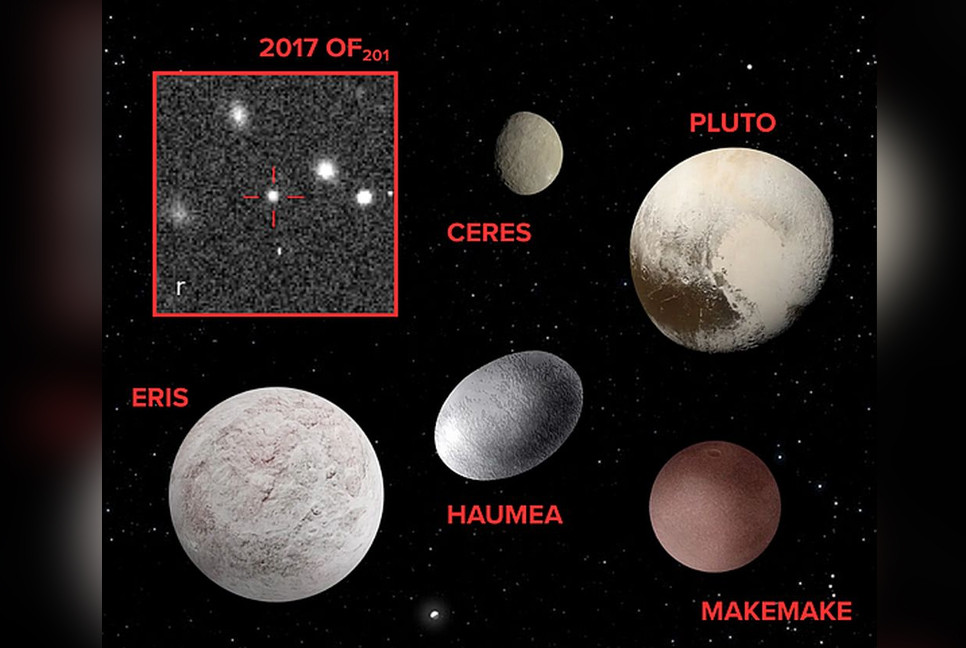
A group of scientists has identified a mysterious icy object on the far edge of our solar system that could be big enough to be classified as a dwarf planet, according to a study released this week.
The object, named 2017 OF201, measures about 435 miles (700 kilometers) across and follows an extremely elongated orbit that carries it up to 1,600 astronomical units (AU) from the Sun far beyond the Kuiper Belt, a remote zone of icy bodies past Neptune.
The new finding was confirmed by the Minor Planet Centre of the International Astronomical Union, which tracks such discoveries. It is based on telescope data collected over the last seven years from observatories in Chile and Hawaii.
Astrophysicist Sihao Cheng of the Institute for Advanced Study in Princeton, who led the study, said 2017 OF201 may help unravel the secrets of the solar system’s distant frontier, long considered to be an empty stretch of space.
“It is potentially large enough to qualify as a dwarf planet,” said Cheng, adding that its wide and elongated orbit suggests a history of orbital migration likely triggered by the gravitational influence of a massive planet in the distant past.
While its precise composition remains unknown, Cheng said it is “likely similar to other icy bodies” that populate the Kuiper Belt.
The object is currently located 90.5 AU from the sun—meaning it is 90.5 times farther away from the sun than Earth is. For comparison, Pluto’s distance from the sun ranges between 30 and 49 AU.
2017 OF201 takes an estimated 25,000 years to complete one orbit around the sun, placing it among the most distant visible objects ever observed in our solar system.
Its mass is believed to be 20,000 times smaller than Earth’s and about 50 times less than Pluto’s. Though slightly smaller than Ceres, the smallest recognised dwarf planet, its shape has not been resolved due to the extreme distance.
The discovery could challenge current assumptions about the distribution of trans-Neptunian objects (TNOs)—celestial bodies that orbit the sun beyond Neptune. These objects are often clustered in a way that has led scientists to hypothesise the existence of a hidden giant planet, often dubbed Planet Nine or Planet X.
However, Cheng notes that 2017 OF201 appears to be an outlier to that clustering. “The existence of 2017 OF201 as an outlier to such clustering could potentially challenge this hypothesis,” he said.
Current technology limits the ability to detect objects beyond approximately 150 AU, raising the possibility that hundreds of similarly sized objects could remain undiscovered.
“This single object suggests that the space beyond Neptune is not empty, but rather holds many secrets waiting to be uncovered,” Cheng said.
The five officially recognised dwarf planets in the solar system are Ceres, Pluto, Haumea, Makemake, and Eris. While planets are defined as celestial bodies that orbit the sun and have cleared their orbital neighbourhoods, dwarf planets meet all criteria except the last—they have not cleared their orbits of other objects.
Source: SAMAA
Bd-pratidin English/ Afia