SpaceX's Starship rocket launched from Texas on Tuesday but lost control mid-flight, failing to meet several key test objectives.
The setback adds new engineering challenges to CEO Elon Musk's already troubled Mars rocket initiative.
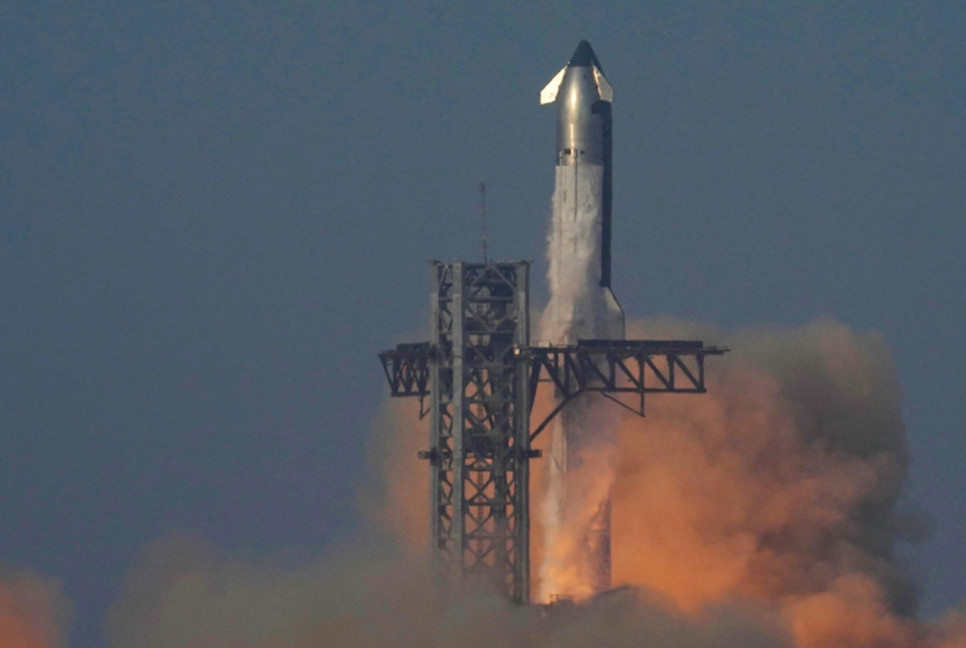
The 400-foot (122-meter) Starship rocket system, central to Elon Musk’s vision of human missions to Mars, launched from SpaceX’s Starbase site in Texas.
It flew farther than two earlier test flights this year, which ended in explosions that scattered debris over Caribbean islands and caused numerous airliners to reroute.
For the latest launch, the ninth full test mission of Starship since the first attempt in April 2023, the upper-stage cruise vessel was lofted to space atop a previously flown booster - a first such demonstration of the booster's reusability.
But SpaceX lost contact with the 232-foot lower-stage booster during its descent before it plunged into the sea, rather than making the controlled splashdown the company had planned.
Around 30 minutes into the mission, Starship entered suborbital space but started spinning uncontrollably.
This malfunction occurred after SpaceX aborted its plan to release eight mock Starlink satellites, as the rocket’s “Pez dispenser”-style deployment system did not function as intended.
"Not looking great with a lot of our on-orbit objectives for today," SpaceX broadcaster Dan Huot said on a company livestream.
Elon Musk was expected to share an update on his space exploration plans in a livestreamed speech from Starbase after the test flight, titled "The Road to Making Life Multiplanetary." However, hours passed with no sign of the speech taking place or any indication that he still planned to deliver it.
Instead, Musk posted on X, highlighting the successful in-space engine shutdown—a milestone also reached in previous test flights. He explained that a leak in Starship’s main fuel tank caused the rocket to lose control.
“There’s a lot of valuable data to analyze,” Musk wrote, adding that the launch schedule for the next three flights would accelerate to roughly one every three to four weeks.
The recent setbacks indicate SpaceX is struggling to overcome a complicated chapter of Starship's multibillion-dollar development. But the company's engineering culture, widely considered more risk-tolerant than many of the aerospace industry's more established players, is built on a flight-testing strategy that pushes spacecraft to the point of failure, then fine-tunes improvements through frequent repetition.
Tuesday’s mission was intended to take Starship on an almost complete orbit of Earth, ending with a controlled splashdown in the Indian Ocean. The flight aimed to test updated heat shield tiles and redesigned flaps for managing the rocket’s fiery re-entry and descent.
Instead, the rocket’s premature failure, seen as a fireball streaking across the night sky over southern Africa, marks another delay in Elon Musk’s ambitious timeline for Starship—a rocket expected to play a key role in the future of the U.S. space program.
Source: Reuters
Bd-pratidin English/ Afia