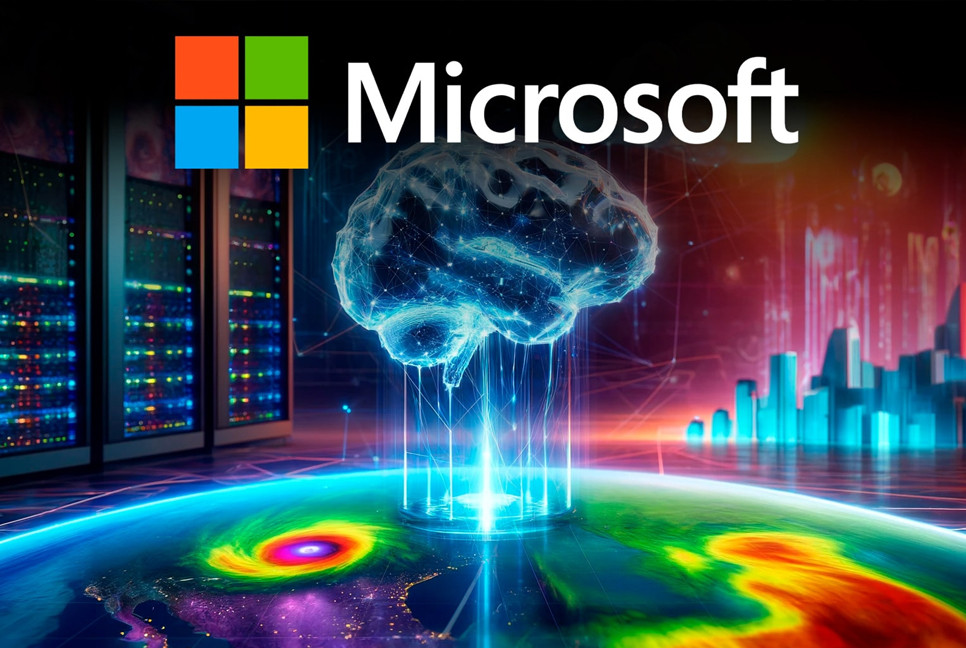
Microsoft has upgraded its AI-based weather forecasting model, Aurora, which can now also provide accurate air quality forecasts.
Created by Microsoft Research, Aurora is built to predict a wide range of weather events like hurricanes and typhoons more precisely and rapidly than traditional forecasting systems. The company shared the update in a blog post earlier this week and published a related research paper in the journal Nature.
Microsoft further said that Aurora’s source code and model weights are now publicly available. A specialised version of the model that produces hourly forecasts, including for clouds, has been integrated into the MSN Weather app.
Aurora, which draws compute power from graphics processing units (GPUs), provides weather forecasts in seconds compared to hourly predictions by traditional weather systems running on supercomputers.
Microsoft claimed that its Aurora AI model accurately predicted the landfall of Typhoon Doksuri in Philippines four days in advance and better than some expert predictions. The model also successfully predicted a sandstorm in Iraq two years ago. It beat the US National Hurricane Center by providing accurate five-day forecasts of tropical cyclone paths in 2022 and 2023, as per the company.
The Windows maker has claimed that Aurora is one of the top-performing AI models in the field of weather forecasting.
“What sets Aurora apart is that it is originally trained as a foundation model and can then be specialized through fine-tuning to go beyond what is considered traditional weather forecasting, such as air pollution prediction,” Microsoft said.
“Because the model first learns from a large and diverse set of data, it can be fine-tuned with smaller amounts of air quality data,” it added.
Aurora has been trained on over a million hours of data captured by satellites, radar and weather stations as well as past weather simulations and forecasts, the company said. The AI model can be fine-tuned using additional data to provide forecasts about specific weather events.
Its underlying encoder architecture helps to translate massive amounts of data drawn from multiple sources into a standard format that the AI model uses to make predictions.
“We’re not putting in strict rules about how we think variables should interact with each other. We’re just giving a large deep-learning model the option to learn whatever is most useful. This is the power of deep learning in these kind of simulation problems,” Megan Stanley, a senior researcher with Microsoft Research, said.
While the initial cost involved in training Aurora was high, Microsoft said its operational expenses are lower than traditional weather forecast systems.
AI weather models like Aurora are not entirely new. Over the past few years, Google DeepMind has released several AI models designed for weather forecasting such as WeatherNext.
Source: The Indian Express
Bd-pratidin English/ Afia