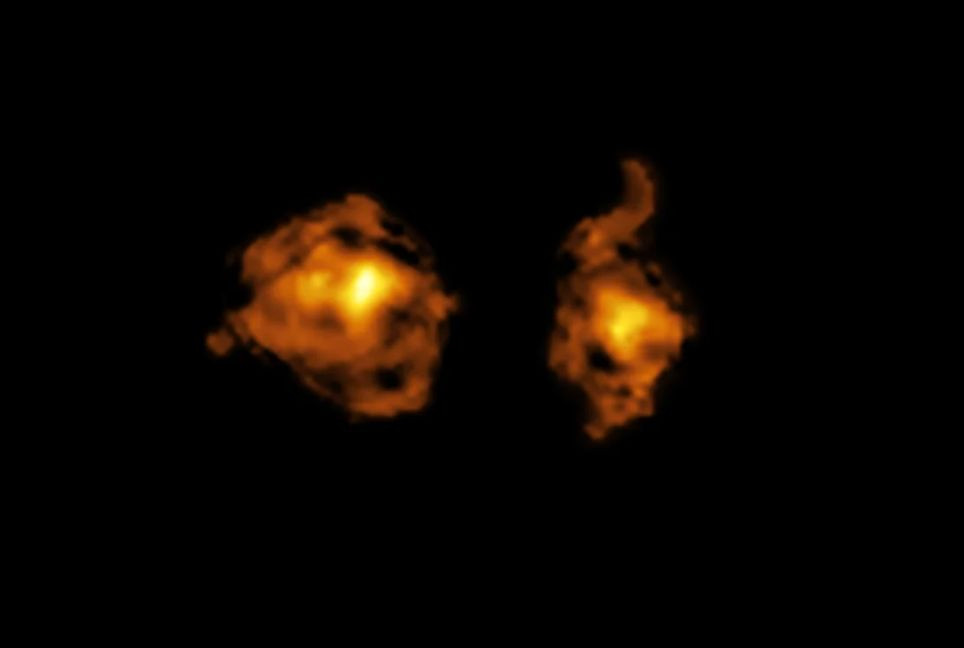
Astronomers have, for the first time, observed a rare “cosmic joust” between two galaxies, 11 billion light-years away, as they merge into one. Using Chile's Atacama Large Millimeter/submillimeter Array (ALMA) and the Very Large Telescope (VLT), scientists tracked the galaxies colliding at over 1.1 million mph, with one galaxy’s quasar blasting powerful radiation that disrupted the other's ability to form stars.
“That’s why we call it a ‘cosmic joust,’” said Pasquier Noterdaeme of the Paris Institute of Astrophysics and the French-Chilean Laboratory for Astronomy. The attacking galaxy’s bright quasar—a supermassive black hole surrounded by a glowing accretion disk—emits ultraviolet radiation strong enough to scatter hydrogen molecules in the neighboring galaxy, halting star formation, reports CNN.
“Each blast of the quasar’s ultraviolet waves are about a thousand times stronger than the radiation of our Milky Way,” the study notes. Star formation usually occurs when gas clouds collapse under their own gravity, but radiation from the quasar prevented this process.
Sergei Balashev, coauthor and researcher at Russia’s Ioffe Institute, explained, “It’s really the first time that we can see the radiative effect of a quasar on the molecular gas of a nearby galaxy.” This interaction had been theorized but never directly observed.
Initially, scientists were drawn to the quasar due to its unique low-resolution spectral “fingerprint.” “It’s really (like) finding a needle in a haystack,” said Balashev. The quasar’s brightness often overwhelms surrounding galaxies, but high-resolution imaging revealed the presence of two galaxies, separated by thousands of light-years.
“At first, we just knew there was some molecular gas between the (attacking galaxy’s) quasar and us. It’s only after, when we started to look with bigger telescopes, that we detected there were actually two galaxies,” said Noterdaeme.
Though it's unclear if the galaxies have already merged—given the time light takes to travel—this rare sighting gives a glimpse into what astronomers call the “noon of the universe,” a period marked by rapid star formation.
Dong-Woo Kim of the Harvard-Smithsonian Center for Astrophysics, not involved in the study, said, “Research like this can teach us more about the birth of new galaxies and observe how they evolve over time.”
Even the Milky Way is expected to merge with the Andromeda galaxy in a few billion years.
Bd-pratidin English/FNC