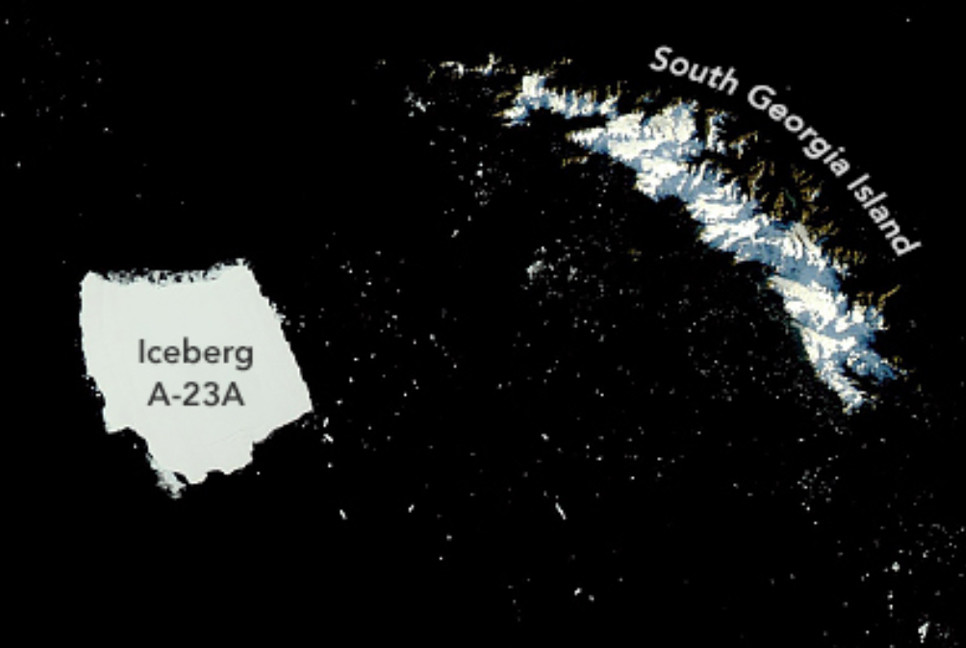
The world's largest iceberg, A23a, is gradually breaking apart into smaller fragments, posing potential risks to human activities and the wildlife on nearby South Georgia Island, an Antarctic sanctuary.
Captured by NASA’s Aqua satellite using its MODIS (Moderate Resolution Imaging Spectroradiometer), the images reveal thousands of ice chunks detaching from A23a’s northern edge, creating a dangerous and shifting icy landscape.
The iceberg itself is enormous about 1,200 square miles, almost the size of South Georgia Island (around 1,400 square miles), which is famous for its role in Ernest Shackleton's rescue mission after the Endurance shipwreck.
NASA describes the scene as "a dark, starry night", with thousands of ice fragments scattered across the ocean, highlighting the iceberg’s colossal size and the hazards that follow its disintegration.
A23a: The “megaberg” on the move
A23a calved from Antarctica’s Filchner-Ronne Ice Shelf in 1986, remaining trapped until 2023, when it regained its title as the largest iceberg in June.
After briefly becoming stuck again in early 2024, it broke free in December and is now grounded near South Georgia Island. Here, it is expected to remain until it either melts or breaks apart in the Scotia Sea, which scientists call the "iceberg graveyard."
A23a is disintegrating through a process known as “edge wasting”, where the edges gradually break off into smaller icebergs. Though the new chunks may seem small compared to A23a, some measure up to a kilometer across, still posing a risk to ships. The largest chunk to break off, known as A23c, is around 50 square miles. Since A23a became stuck in March, it has shrunk by approximately 200 square miles and is expected to take months or even years to completely break apart.
Its size lead is narrowing, with Iceberg D15A emerging as a challenger to its title.
The Impact
South Georgia Island is home to a diverse wildlife population, including seals, seabirds, and over 2 million penguins, but has a sparse human presence with only a few dozen researchers visiting annually.
The massive iceberg A23a, currently grounded offshore, could potentially disrupt the ecosystem by forcing penguins to travel longer distances to find prey and altering the surrounding water temperature and salinity with its meltwater.
Some of these fragments measure over half a mile wide and could therefore "pose a risk to ships," according to NASA.
However, its relatively distant location from the coast may mitigate the impact. Some researchers suggest the melting iceberg could also have a positive effect by releasing nutrients into the ocean, benefiting the marine ecosystem.
Scientists warn that similar events, such as massive iceberg break-offs, may become more frequent in the future because of climate change. This acceleration of ice shelf melting could have significant implications for global sea levels, ocean ecosystems and the planet's climate as a whole.
Source: NDTV
Bd-pratidin English/ Afia