Astronomers using NASA’s James Webb Space Telescope (JWST) have, for the first time, confirmed the existence of frozen water in a young, distant star system.
Although water ice is commonly found within our own solar system, this marks the first clear evidence of its presence in star systems beyond it.
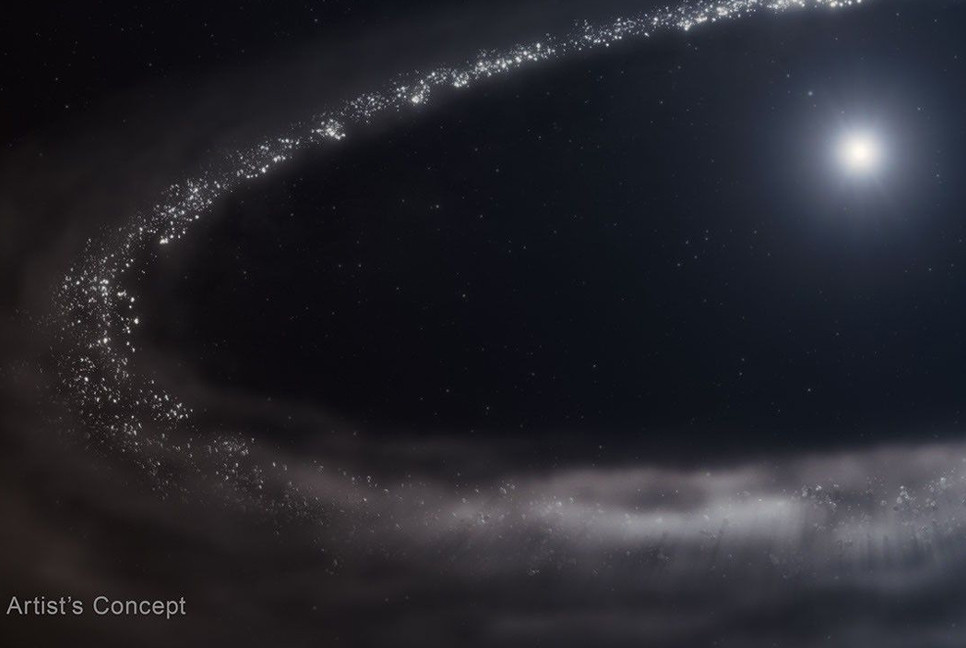
The details, published in the journal Nature, state that crystalline water ice has been found in a dusty debris disk that orbits a Sun-like star, only 23 million years old, 155 light-years away. The star is slightly more massive and hotter than the Sun, which led to the formation of a slightly larger system around it.
Webb's findings showed there is a significant gap between the star, named HD 181327, and its debris disk, which is similar to our solar system's Kuiper Belt.
"Webb unambiguously detected not just water ice, but crystalline water ice, which is also found in locations like Saturn's rings and icy bodies in our solar system's Kuiper Belt," said Chen Xie, the lead author of the new paper.
"HD 181327 is a very active system. There are regular, ongoing collisions in its debris disk. When those icy bodies collide, they release tiny particles of dusty water ice that are perfectly sized for Webb to detect."
The presence of water ice in a similar region could point towards a pattern about how planetary systems evolve across the universe. It may be more than a coincidence that the first confirmed water ice we're seeing around another star mirrors the distribution of our solar system.
Additionally, the water ice is not spread evenly throughout this system, with the majority of it found where it's coldest and farthest from the star.
"Toward the middle of the debris disk, Webb detected about eight per cent water ice. Here, it's likely that frozen water particles are produced slightly faster than they are destroyed."
Scientists have long posited that ice could be present in debris disks, but prior to Webb, they did not have the instruments sensitive enough to make such observations. After the success with HD 181327, the researchers are expected to increase their efforts to search for and study water ice in debris disks in actively forming planetary systems throughout the Milky Way galaxy.
Source: NDTV
Bd-pratidin English/ Afia