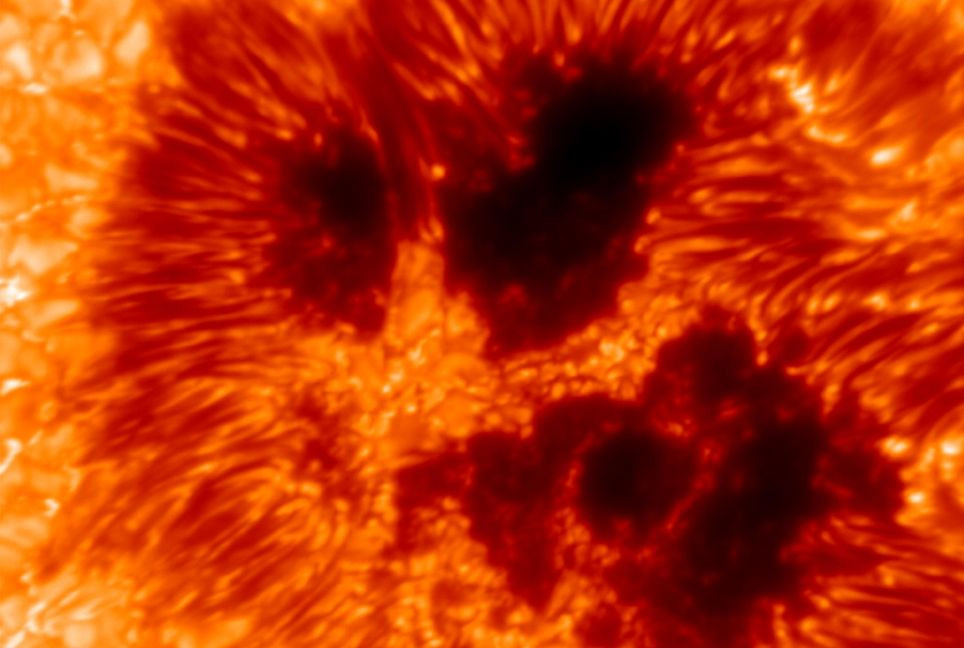
A newly released image of the sun, taken by the world’s largest solar telescope, offers an unparalleled view of the star’s fiery surface.
Captured by the US National Science Foundation’s Daniel K. Inouye Solar Telescope, the image is the first taken using its new Visible Tunable Filter (VTF), which builds a closer-than-ever, three-dimensional view of solar activity, reports CNN.
The detailed close-up shows continent-sized sunspots in the sun’s inner atmosphere at a scale of 6.2 miles (10 kilometers) per pixel. These sunspots are zones of intense magnetic activity, which are likely sites for solar flares and coronal mass ejections (CMEs)—vast clouds of plasma and magnetic fields that erupt from the sun’s outer atmosphere.
Taken in early December, the image will help scientists study and anticipate potentially disruptive solar weather. “A solar storm in the 1800s (the Carrington Event) reportedly was so energetic that it caused fires in telegraph stations,” said Friedrich Woeger, instrument program scientist for the NSF Inouye Solar Telescope. “We need to understand the physical drivers of these phenomena and how they can affect our technology and ultimately our lives.”
Solar outbursts can interfere with Earth’s electromagnetic field, disrupting power grids and satellite communication systems, Woeger explained.
The sun is currently at the peak of its 11-year magnetic cycle, known as the solar maximum. In October, scientists confirmed the sun had reached this phase, when its magnetic poles flip and sunspots become more frequent. The maximum is expected to continue for several months—an ideal time for the Inouye Telescope to ramp up its testing.
According to Mark Miesch, a research scientist at the University of Colorado Boulder, “Like boiling soup on a stove, heat escapes the core of the sun and rises to its surface through fluid motions.” Sunspots act like “magnetic plugs,” blocking heat and appearing darker and cooler. Still, he added, they are “hotter than any oven on Earth.”
The sun’s surface has a layered structure like an onion, and the VTF “tunes” into different wavelengths to analyze each layer. While a typical camera captures multiple wavelengths at once, the VTF—a type of imaging spectro-polarimeter—filters light one wavelength at a time using a device called an etalon, which consists of two glass plates separated by microns.
“The principle is not unlike that of noise-canceling headphones,” said Woeger. “Light waves ‘trapped’ between those two plates interfere, and the distance between the plates selects which exact ‘colors’ of the light are passed on, and which ones cancel out.”
In seconds, the VTF captures hundreds of filtered images and combines them into a single 3D snapshot. Scientists can then analyze temperature, pressure, velocity, and magnetic fields across the sun’s layers.
“Seeing those first spectral scans was a surreal moment,” said Dr. Stacey Sueoka, senior optical engineer at the National Solar Observatory. “This is something no other instrument in the telescope can achieve in the same way.”
The telescope joins efforts like NASA’s Parker Solar Probe and the ESA-NASA Solar Orbiter to deepen our understanding of the sun’s behavior and its impact on Earth.
Bd-pratidin English/FNC