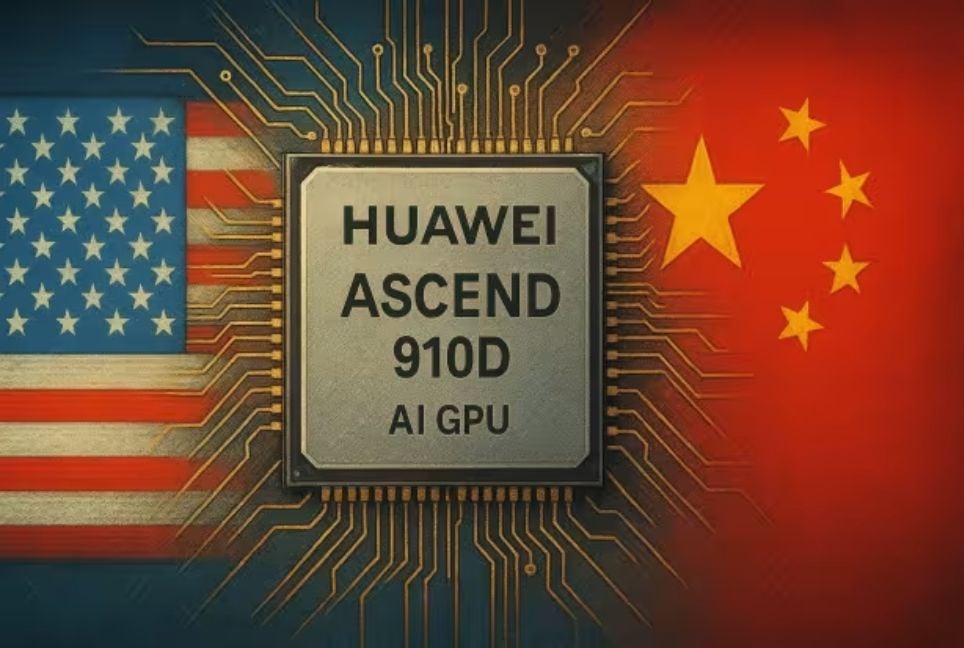
Huawei Technologies is preparing to test its most powerful artificial-intelligence processor yet, aiming to replace some higher-end products of U.S. chip giant Nvidia.
The move highlights the resilience of China's semiconductor industry despite Washington’s efforts to restrict its growth, including limiting access to Western chip-making equipment, reports The Wall Street Journal.
Huawei has approached Chinese tech firms about testing the technical feasibility of the new chip, called the Ascend 910D, according to people familiar with the matter. The first batch of processor samples could arrive as early as late May, they said. The project remains in early stages, with several tests needed to assess performance before commercial rollout.
Huawei hopes the new Ascend 910D will outperform Nvidia’s H100, a popular AI training chip released in 2022, said one person. Previous Huawei AI chips include the Ascend 910B and 910C.
The Shenzhen-based company has developed some of China’s strongest alternatives to Nvidia’s chips and plays a key role in Beijing’s push for semiconductor self-sufficiency.
Huawei, blacklisted by the U.S. for nearly six years, demonstrated its resilience in 2023 by launching the Mate 60 smartphone, powered by a domestically produced chip, during a visit to Beijing by then-U.S. Commerce Secretary Gina Raimondo.
Meanwhile, the U.S. tightened restrictions this month by limiting sales of Nvidia’s H20 chip—the most advanced chip the company could sell in China without a license. Nvidia expects to take a $5.5 billion charge due to the restrictions.
These curbs present opportunities for Chinese firms like Huawei and Cambricon Technologies. Huawei is expected to ship more than 8,00,000 Ascend 910B and 910C chips this year to customers including state-owned telecom carriers and private AI developers like TikTok’s parent company ByteDance, according to people familiar with the matter. Some customers are already in talks to increase orders of the 910C following the U.S. export restrictions on Nvidia.
Facing limitations on critical AI chip components like high-bandwidth memory units, Huawei is focusing on building more efficient computing systems. In April, it introduced the CloudMatrix 384 system, which connects 384 Ascend 910C chips. Analysts said under certain conditions, it can outperform Nvidia’s rack system, which connects 72 Blackwell chips, despite higher power consumption.
“Having five times as many Ascends more than offsets each GPU being only one-third the performance of an Nvidia Blackwell,” research firm SemiAnalysis wrote. “The deficiencies in power are relevant but not a limiting factor in China.”
Bd-pratidin English/FNC