Back in 2015, Pete Townshend of the Who told me of his recent encounter with Bob Dylan. “He’s a total enigma,” said Townshend, who left the meeting none the wiser about the character or intentions of his fellow rock genius. “I remember asking him why he felt the need to keep on touring the entire time. He replied, ‘I’m a song and dance man. That’s what I do.’”
A decade later, forever young in the week of his 85th birthday, the song and dance man is still out there. It’s not like he needs the money. With an estimated fee of $150,000-$250,000 per concert, a bigger problem must be to know what to do with it all. He is still on the Rough and Rowdy Ways tour, which began on November 2, 2021, not long after the release of his album of the same name, and is scheduled to end on August 1 in Nashville — but don’t bet on it.
One way or another, beyond a serious chest infection in 1997 and a worldwide pandemic in 2020, Dylan has been playing concerts regularly since June 7, 1988. That’s when he turned up at the Concord Pavilion in California and decided to just keep going. He reached the 3,000 mark in Innsbruck, Austria, in 2009 and has played more than 3,700 gigs, typically clocking up well over 100 shows a year.
In 1989 the journalist Adrian Deevoy dubbed Dylan’s approach to live performance the Never Ending Tour. It’s not a term the man himself appears to like very much. But then Dylan is not known for liking anything that journalists, authors and Dylanologists of all stripes have to say about him, good or bad.
“Critics should know there is no such thing as for ever,” Dylan pointed out in 2009. “Does anyone call Henry Ford a never-ending car builder? Anybody ever say that Duke Ellington was on a never-ending bandstand tour? These days people are lucky to have a job. Any job.”
He claimed in the liner notes to his 1993 album, World Gone Wrong, that the so-called Never Ending Tour ended in 1991, when his guitarist GE Smith left the band. In February 2010 Barack Obama introduced a performance at the White House by thanking Dylan for being “good enough to take time off from his Never Ending Tour”. I wouldn’t be surprised if he got the death stare.
The truth is that before 1988 Dylan’s tours were not never-ending. Even his legendary 1966 jaunt, when he changed the face of modern music by going electric and was accused of being a Judas by an audience member at Manchester Free Trade Hall, was only 41 concerts.
What changed? A realisation from Dylan, it seems, that it made practical sense to keep on trucking. “It’s all the same tour. It works out better for me that way,” Dylan told Deevoy in that 1989 interview. “You can pick and choose better when you are just out there all the time and your show is already set up.”
There cannot be many 85-year-olds who still travel from town to town, getting up in front of audiences night after night, still confounding faithful fans, and sometimes even his own band members, with shows that never feature anything as predictable as a greatest hits set.
A Dylan concert might contain a stone-cold masterpiece such as Like a Rolling Stone (2,011 times and counting, according to setlist.fm) or some novelty nonsense like Asshole from El Paso. He has a reliably tight band, with the upright bassist Tony Garnier, the guitarists Bob Britt and Doug Lancio, the pedal steel player Donnie Herron and the drummer Anton Fig doing a cool, restrained take on jazz, rockabilly and country.
But on any given night their leader might be magical or horrific. He might subject the crowd to a set of early 20th-century standards, mangle beloved favourites beyond all recognition, or deliver poetic gems like It’s Alright, Ma (I’m Only Bleeding) or Gates of Eden with all the mysterious beauty with which he first imbued them.
At one infamous concert in Buffalo, New York, on September 17, 2024, he tapped along to Desolation Row with a wrench. As countless fans the world over have accepted, when it comes to Dylan, you pay your money and take your chances.
The first time I saw him, at the O2 arena, London, in 2009, was an exercise in disappointment. Maggie’s Farm and Highway 61 Revisited existed in name only, all traces of the original melody diligently scrubbed out. Dylan hid behind a little keyboard at the side of the stage and made a mockery, willingly it seemed, of the very concept of an arena concert, with the spectacle and people-pleasing it generally involves.
But a 2022 concert at the London Palladium was transcendent. It included a sweet and tender rendition of I’ll Be Your Baby Tonight — Dylan has always managed to pull a love song of exquisite romance out of the hat when he needs to. At one point he even said, in a nod to John Lennon’s famous quip during the Beatles’ Royal Variety Performance at the Palladium in 1963, “Is this the place where you clap your hands and rattle your jewellery?” By Dylan’s standards, that was positively garrulous.
What Dylan does is increasingly rare. In an age when sets by stadium-fillers like Beyoncé and Coldplay are entirely locked into the visual and pyrotechnic cues, he remains genuinely, resolutely live.
“You really learnt the value of spontaneity, of how a moment that is real in a concert is worth so much more than one you plan out,” said Tom Petty, whose band the Heartbreakers backed Dylan through 1986 and 1987. “You have to be pretty versatile because arrangements could change, keys might change, there’s just no way of knowing exactly what he wants to do each night.”
Dylan has played everywhere, from Chile to China, seemingly oblivious to the suitability of the venues to his music or the sensibilities of his faithful fans. In 1989 he played a casino in Atlantic City. In 1990 he took a booking at a military academy in upstate New York, causing a few thousand ageing peaceniks to die a little inside.
Size doesn’t matter. In November 2003 he followed a 16,000-capacity concert at the Birmingham NEC arena with a 2,000-capacity one at Shepherds Bush Empire. And there is simply no way of knowing what he will do. At a Brixton Academy concert in 2005 he launched into a rendition of London Calling. With Mick Jones in the crowd, the impromptu cover has been interpreted as a tribute to Joe Strummer and as an acknowledgement of the venue’s connection with the Clash.
Dylan does have a home, near Point Dume in Malibu, California, where he presumably spends some of his time, but he has succeeded in keeping his private life entirely out of view. We do know that he has been married twice, first to the actress and model Sara Lownds and then to his former backing singer Carolyn Dennis. He has six grown-up children for whom, by their own accounts, he clearly makes time.
“He’s been nothing but supportive to me and my brothers and sisters,” his son Jesse confirmed to this newspaper in 2021, while his brother Jakob told The New York Times that his father “never missed a single Little League game I had. He’s collected every home run ball I’ve ever hit.” As Dylan said of fatherhood in his 2004 memoir Chronicles: “Outside of my family, nothing held any real interest for me.”
All this sounds like the selfless attitude of a committed family man. And Dylan’s ego, whatever shape it takes, is certainly not of the usual rock star variety. Leaving the playwright Conor McPherson to his own devices to write the Dylan musical Girl from the North Country, he contented himself with slipping in unnoticed to see the play one afternoon during its 2018 run at the Public Theatre in New York.
Of Timothée Chalamet portraying him in A Complete Unknown, a film I’m still not convinced he has actually bothered to see, he said: “I’m sure he’s going to be completely believable as me. Or a younger me. Or some other me.”
Yet standing before an audience clearly has some kind of hold over him, because nobody is forcing him to do all those concerts at 85. “Is there something strange about touring? About playing live shows? If there is, tell me what it is,” Dylan asked Rolling Stone magazine in 2012, a little testily.
“There’s a certain part of you that becomes addicted to a live audience,” he said in a 2007 interview with The New York Times. Nonetheless, he certainly is not a performer in the Mick Jagger, Freddie Mercury or Madonna mould: someone who expands before an audience. If anything, he shrinks.
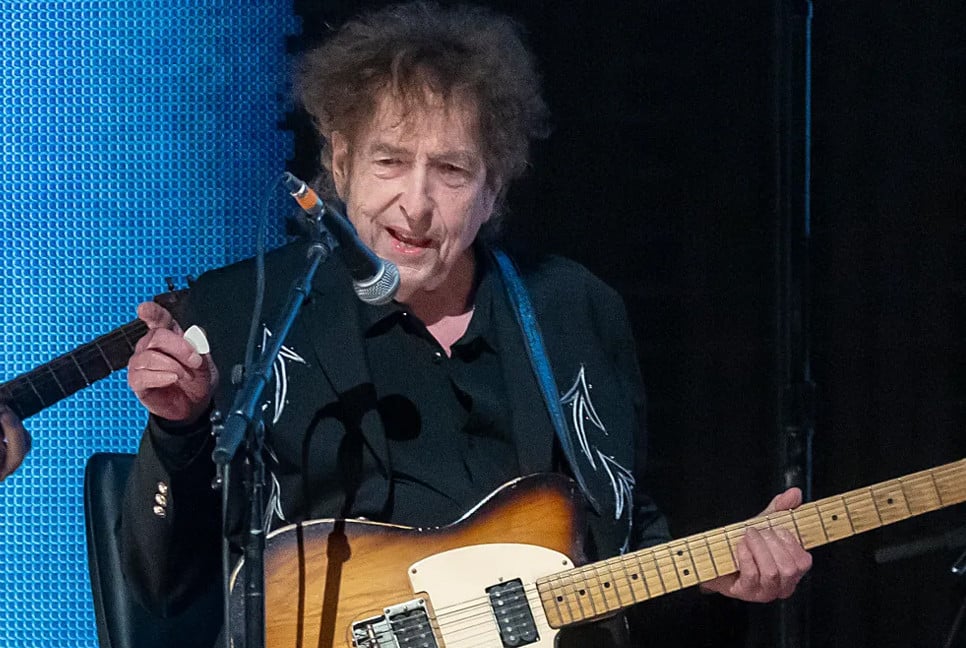
Go and see Dylan today and you’ll witness a wizened figure in a big hat, probably hiding away at the side of the stage, finding a way of keeping some of the most complex and evocative songs of modern times alive, breathing, forever changing. Dylan still appears to be searching for an elusive quality that goes beyond good, bad or indifferent: authenticity.
“I’m mortified to be on stage. But then again it’s the only place where I’m happy,” he said in 2012. “Ask any performer or entertainer who does this, they’ll tell you the same thing. That they like doing it and that it means a lot to people. It’s just like any other line of work. Only different.”
Courtesy: The Times
Bd-pratidin English/Lutful Hoque