Bangladesh’s national budget has undergone a remarkable transformation since its first presentation during the 1971 Liberation War, growing from a modest wartime financial plan to a nearly Tk8 trillion ((8 lakh crores)) fiscal framework.
The country’s first budget was unveiled on 19 July 1971 by the Mujibnagar Government. Prepared by then Finance Minister M Mansur Ali, it covered only three months and was designed primarily to finance the independence war. Revenue was projected at just Tk7.74 million, against expenditure of Tk8.62 million, resulting in a deficit of about Tk880,000.
Following independence, Bangladesh’s first national budget was presented by Tajuddin Ahmad on 30 June 1972, covering both the 1971-72 and 1972-73 fiscal years. The budget focused on reconstruction, rehabilitation and economic recovery in a war-ravaged country.
Over the following decades, successive governments used budgets to address major challenges, including post-war reconstruction, the 1974 famine, structural economic reforms, trade liberalisation, inflation, banking-sector weaknesses and infrastructure development.
Several landmark policy measures emerged through budget speeches, including the introduction of Value Added Tax (VAT) in 1991, expansion of social safety-net programmes in the late 1990s, repeated opportunities to legalise undisclosed income, public-private partnership initiatives, and more recently, economic recovery measures during the Covid-19 pandemic.
The size of the budget expanded steadily alongside the economy. From Tk719.43 crore in 1972-73, it crossed Tk1 lakh crore in 2009-10 and reached Tk7.97 trillion (Tk797,000 crore) in the 2024-25 fiscal year, presented by Finance Minister Abul Hassan Mahmood Ali.
Although the 2024-25 budget remained unchanged after the fall of the Awami League government two months later, the interim administration slowed development spending and deferred a number of projects.
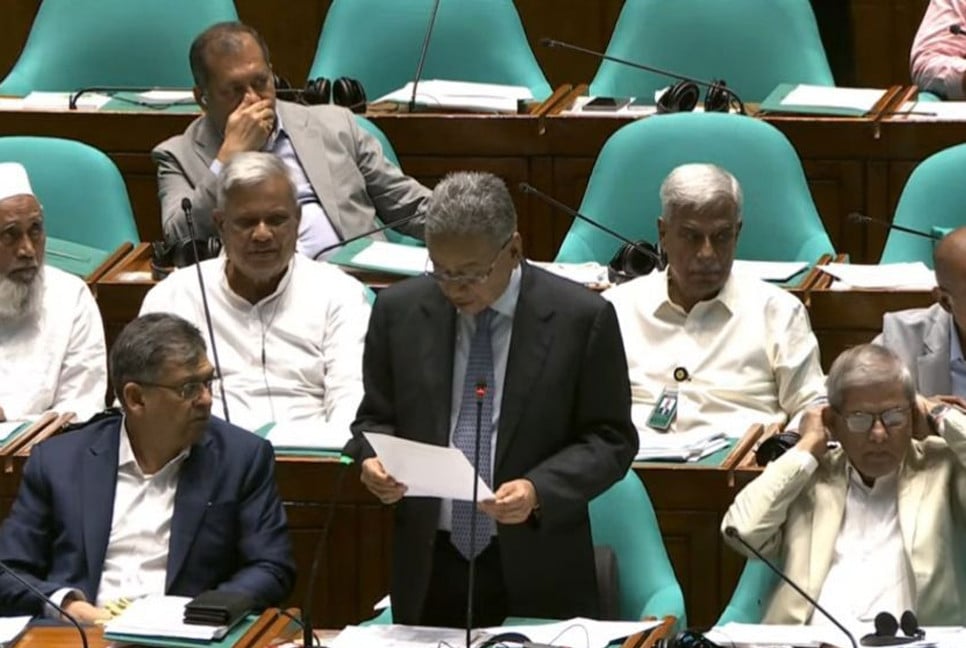
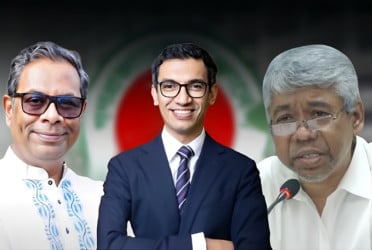
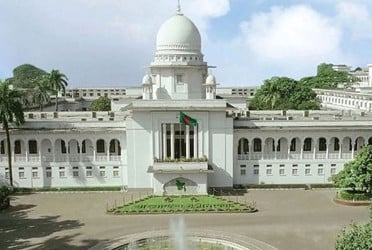
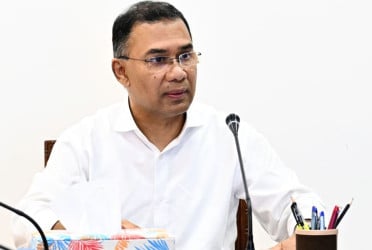
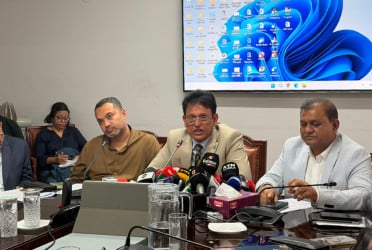
Finance Minister Amir Khosru Mahmud Chowdhury is set to place the national budget for fiscal year 2026-2027 at the Jatiya Sangsad on Thursday (11 June).
This will be the country’s 55th budget.
| Fiscal Year | Who Placed It | Total Size | ADP |
| 1972-73 | Tajuddin Ahmed | 786 | 501 |
| 1973-74 | Tajuddin Ahmed | 995 | 525 |
| 1974-75 | Tajuddin Ahmed | 1,084 | 525 |
| 1975-76 | Dr Azizur Rahman Mollik | 1,549 | 950 |
| 1976-77 | Maj Gen Ziaur Rahman | 1,989 | 1,222 |
| 1977-78 | Lt Gen Ziaur Rahman | 2,184 | 1,278 |
| 1978-79 | President Ziaur Rahman | 2,499 | 1,446 |
| 1979-80 | Dr MN Huda | 3,317 | 2,123 |
| 1980-81 | M Saifur Rahman | 4,108 | 2,700 |
| 1981-82 | M Saifur Rahman | 4,677 | 3,015 |
| 1982-83 | AMA Muhith | 4,738 | 2,700 |
| 1983-84 | AMA Muhith | 5,896 | 3,483 |
| 1984-85 | M Sayeduzzaman | 6,699 | 3,896 |
| 1985-86 | M Sayeduzzaman | 7,138 | 3,825 |
| 1986-87 | M Sayeduzzaman | 8,504 | 4,764 |
| 1987-88 | M Sayeduzzaman | 8,527 | 5,046 |
| 1988-89 | Maj Gen Munim | 10,565 | 5,315 |
| 1989-90 | Dr Wahidul Haq | 12,703 | 5,803 |
| 1990-91 | Maj Gen Munim | 12,960 | 5,668 |
| 1991-92 | M Saifur Rahman | 15,584 | 7,500 |
| 1992-93 | M Saifur Rahman | 17,607 | 9,057 |
| 1993-94 | M Saifur Rahman | 19,050 | 9,750 |
| 1994-95 | M Saifur Rahman | 20,948 | 11,000 |
| 1995-96 | M Saifur Rahman | 23,170 | 12,100 |
| 1996-97 | SAMS Kibria | 24,603 | 12,500 |
| 1997-98 | SAMS Kibria | 27,786 | 12,800 |
| 1998-99 | SAMS Kibria | 29,537 | 13,600 |
| 1999-00 | SAMS Kibria | 34,252 | 12,477 |
| 2000-01 | SAMS Kibria | 38,524 | 17,500 |
| 2001-02 | SAMS Kibria | 42,306 | 19,000 |
| 2002-03 | M Saifur Rahman | 44,854 | 19,200 |
| 2003-04 | M Saifur Rahman | 51,980 | 20,300 |
| 2004-05 | M Saifur Rahman | 57,248 | 22,000 |
| 2005-06 | M Saifur Rahman | 61,058 | 23,626 |
| 2006-07 | M Saifur Rahman | 69,740 | 26,000 |
| 2007-08 | Mirza Azizul Islam | 99,962 | 25,600 |
| 2008-09 | Mirza Azizul Islam | 99,962 | 25,400 |
| 2009-10 | AMA Muhith | 1,13,815 | 28,500 |
| 2010-11 | AMA Muhith | 1,32,170 | 35,130 |
| 2011-12 | AMA Muhith | 1,61,214 | 41,080 |
| 2012-13 | AMA Muhith | 1,91,738 | 52,366 |
| 2013-14 | AMA Muhith | 2,22,491 | 60,000 |
| 2014-15 | AMA Muhith | 2,50,560 | 75,000 |
| 2015-16 | AMA Muhith | 2,95,100 | 93,894 |
| 2016-17 | AMA Muhith | 3,40,605 | 1,10,700 |
| 2017-18 | AMA Muhith | 4,00,266 | 1,48,381 |
| 2018-19 | AMA Muhith | 4,64,573 | 1,73,000 |
| 2019-20 | AHM Mustafa Kamal | 5,23,190 | 2,02,721 |
| 2020-21 | AHM Mustafa Kamal | 5,68,000 | 2,05,145 |
| 2021-22 | AHM Mustafa Kamal | 6,03,681 | 2,25,324 |
| 2022-23 | AHM Mustafa Kamal | 6,78,064 | 2,46,066 |
| 2023-24 | AHM Mustafa Kamal | 7,61,785 | 2,63,000 |
| 2024-25 | AH Mahmood Ali | 7,97,000 | 2,65,000 |
| 2025-26 | Finance Adviser Dr Salehuddin Ahmed | 7,90,000 | 2,16,125 |
AMA Muhith and Saifur Rahman presented the highest 12 budgets each during different terms in their respective governments.
The evolution of Bangladesh’s budget reflects the country’s broader economic journey—from a newly independent nation financing a liberation war to one of South Asia’s fastest-growing economies managing a multi-trillion-taka fiscal programme.
Courtesy: The Daily Sun
Bd-Pratidin English/ AM