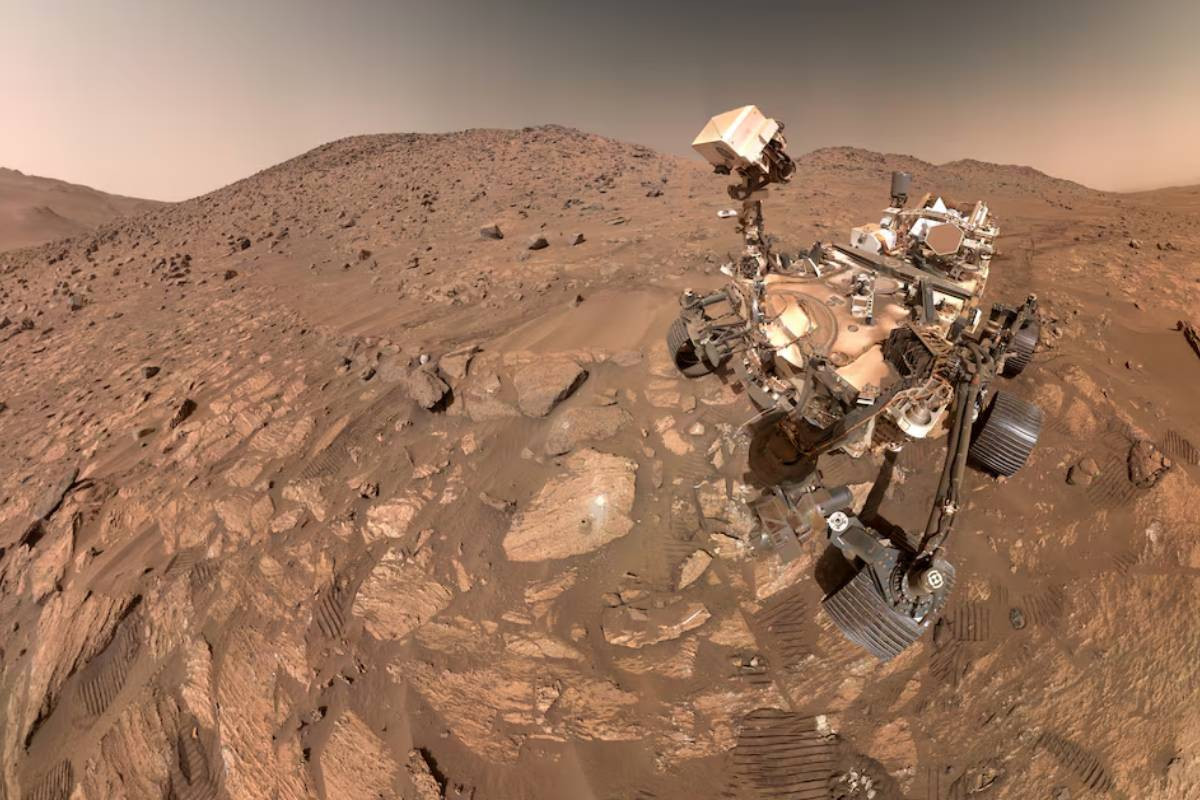
NASA’s Perseverance rover has uncovered some of the oldest evidence yet of water flowing on Mars, detecting the buried remains of an ancient river delta beneath the planet’s surface.
Using ground-penetrating radar, the rover identified geological structures as deep as 115 feet (35 meters) while traversing 3.8 miles (6.1 km) across Jezero Crater, a region believed to have once hosted a lake.
Researchers found layered sediments and eroded formations characteristic of a delta—where a river once flowed into a larger body of water. They estimate the now-buried delta dates back roughly 3.7 to 4.2 billion years, making it one of the earliest known indicators of water activity on Mars.
The findings suggest this delta predates a nearby surface feature known as the Western Delta, believed to have formed between 3.5 and 3.7 billion years ago.
The discovery was made using the rover’s radar instrument, which maps underground structures by sending signals beneath the surface and recording their reflections. The data, collected between September 2023 and February 2024, represents the deepest subsurface scan obtained so far.
Scientists say the presence of ancient water is crucial to understanding whether Mars once supported life. Billions of years ago, the planet is thought to have had a thicker atmosphere and a warmer climate capable of sustaining liquid water.
“This indicates that Jezero Crater once hosted a water-rich environment capable of preserving biosignatures,” said Emily Cardarelli of the University of California, Los Angeles, lead author of the study published in Science Advances.
A biosignature refers to chemical or physical traces that may indicate past or present life. On Earth, river deltas are known to concentrate sediments and create environments favorable for microbial organisms.
The findings build on earlier discoveries from Perseverance, which has been exploring Jezero Crater since 2021. Scientists believe ancient rivers once flowed into the crater, forming a lake.
“It’s very exciting that ground-penetrating radar can provide such detailed insight into these deposits,” said David Paige, a co-author of the study. “This reinforces its value as a powerful tool for studying planetary geology.”
The research adds to growing evidence that Mars once had widespread liquid water. Previous findings—including data from China’s Zhurong rover—have pointed to ancient shorelines and possible ocean features on the planet.
Scientists say each new discovery is helping piece together Mars’ complex early history and its potential to have supported life.
Source: Reuters
Bd-pratidin English/ Jisan