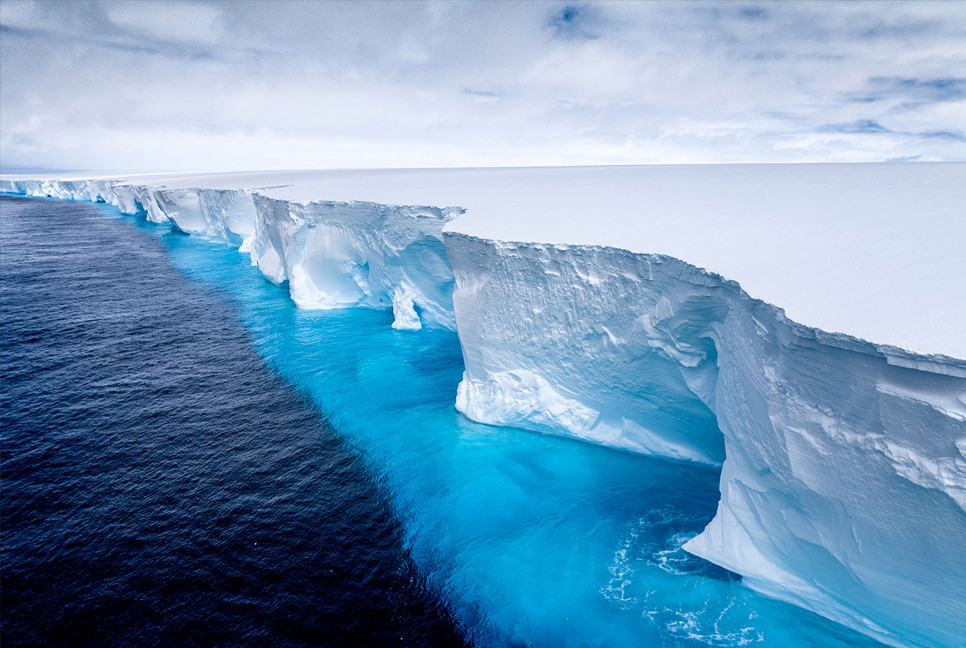
The story of one of the world's oldest icebergs is almost over, after a dizzying 40-year journey that has fascinated scientists.
The iceberg, known as A23a, was once the largest on Earth. But after a winding path, A23a has melted, broken off and disintegrated in spectacular fashion over the past year, the BBC wrote.
Now, far from the icy seas of Antarctica, what's left of A23a is being eroded by warmer waters. It's nearing its end, which is not expected to last more than a few weeks.
All icebergs eventually melt, but scientists have been looking at how this one broke up to find clues about how other parts of Antarctica might respond to climate change.
In 1986 the Filchner Ice Shelf - a massive piece of floating ice that extends from the Antarctic continent and into the Weddell Sea - was changing dramatically. One of the icebergs that broke away was A23a, then about 4,000 square km.
It quickly anchored in the Weddell Sea, where it remained stranded for more than 30 years. It wasn't until 2020 that scientists noticed signs that A23a was moving again.
In early 2025 — even after 39 years — A23a was still a colossus. During the first half of 2025, A23a shrank by about a quarter as chunks of ice broke off and ocean waters eroded its sides and base. By mid-year, A23a had lost its title as the world’s largest iceberg.
Several large icebergs broke away from A23a - icebergs large enough that they were given their own names, A23g, A23h and A23i, indicating that they separated from the original.
Prolonged exposure to the heat of the sea means that the remains will inevitably fragment and eventually melt.
By March 5, A23a had shrunk to approximately 180 square km, although estimates may vary slightly.
Once it reaches 70 square kilometers, scientists will stop tracking it, and that moment doesn't seem far away.
Bd-pratidin English/ ANI