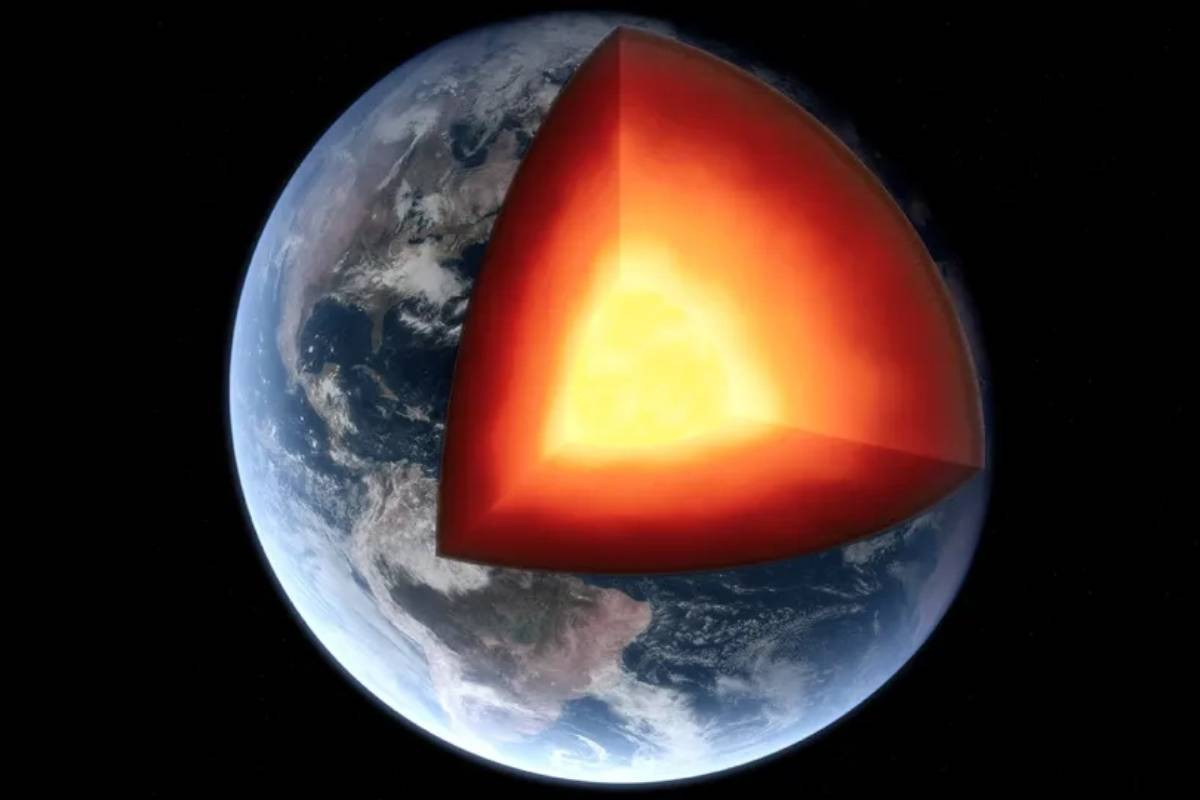
Earth’s oceans dominate the planet’s surface, but far greater quantities of water’s building blocks may be hidden deep below. New experiments suggest that enough hydrogen to form dozens of oceans of water could be locked inside Earth’s core, researchers reported February 10 in Nature Communications.
While hydrogen does not exist as liquid water in the core, it may gradually migrate upward into the mantle. There, it can react with abundant oxygen in mantle minerals to form water, said study co-author Motohiko Murakami, a geodynamicist at ETH Zurich. Such processes could influence volcanic activity and other surface phenomena.
Previous estimates of hydrogen in Earth’s core varied widely and were based on indirect methods, such as measuring how iron expands when hydrogen is added. Murakami and his colleagues instead designed experiments to more directly simulate conditions during the planet’s formation.
The team created artificial samples resembling early core material by sealing small pieces of iron inside hydrogen-rich glass. Using a diamond anvil cell — a device that compresses materials between two diamonds — they subjected the samples to extreme pressures and heated them with a laser to temperatures of up to 4,826 degrees Celsius.
Under these intense conditions, the materials melted into droplets of iron containing silicon, hydrogen and oxygen — similar to the molten blobs thought to have formed Earth’s early core when the planet was covered by a global magma ocean.
After rapidly cooling the samples, the researchers used advanced imaging techniques to analyze their structure. They found tiny solid inclusions within the iron composed of silicon and hydrogen in a one-to-one atomic ratio.
That ratio is significant because previous studies suggest the core contains between 2 and 10 percent silicon by weight. Based on their results, the researchers estimate hydrogen accounts for roughly 0.07 to 0.36 percent of the core’s total mass. That amount would correspond to the hydrogen needed to create approximately nine to 45 Earth oceans of water.
Over billions of years, some of this hydrogen may have seeped into the mantle, where it combined with oxygen to form water. The presence of water lowers the melting point of rocks, potentially making it easier for magma to form and fueling volcanic activity at the surface.
The findings point to a vast, hidden hydrogen reservoir deep within the planet — one that may play a subtle but significant role in shaping Earth’s long-term geologic evolution.
#With inputs from Science News
Bd-pratidin English/ Jisan