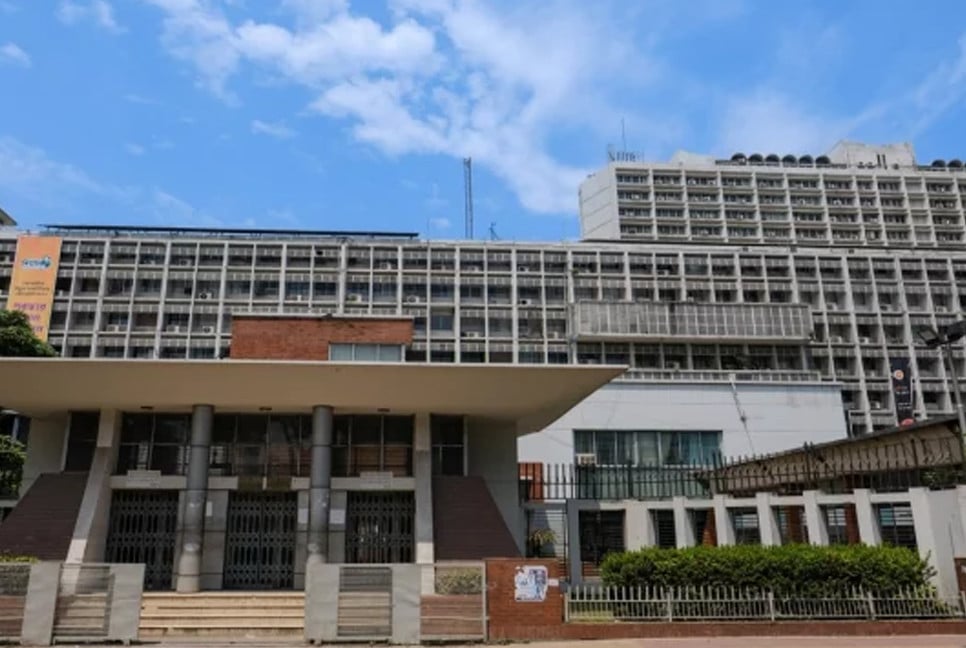
Government offices across country, including the Secretariat, reopened on Saturday after a 10-day Eid-ul-Azha holiday, but discontent among Government employees over the controversial 'Government Jobs (Amendment) Ordinance, 2025' remains unresolved, with threats of a fresh wave of protests looming.
Despite hopes that the interim government would withdraw or amend the ordinance before the Eid break, no decision was made, leaving many government employees frustrated. The law allows the dismissal of public servants for four types of disciplinary offenses—such as absence or inciting others to abstain from work—based solely on a show-cause notice, bypassing departmental proceedings.
On the last working day before the holiday, leaders of the Secretariat Officers-Employees Coordinated Council staged demonstrations, calling the ordinance a “black law” that opens the door to abuse of power. They announced plans for a major protest program on June 16, urging all staff to gather at the Secretariat in Dhaka.
Employees were upset with the promulgation of the 'Government Employment (Amendment) Ordinance, 2025', which provides for dismissal by just a show cause notice without filing a departmental case for four types of disciplinary offenses. Therefore, immediately after the promulgation of the ordinance on May 25, government employees went on a movement, informing it as a regressive and black law.
Earlier, since the draft was approved, they had been holding protest marches, work stoppages, and sit-in programs at the Secretariat to cancel it. At that time, they also submitted a memorandum to some advisors.
While observing the last working day's program, Md Badiul Kabir, co-chair of the Forum and a faction president of the Secretariat Officers-Employees Coordinated Council has called on the employees to prepare for June 16 so that no one is at work, and everyone should be present at the Secretariat at 11 am.
Meanwhile, the interim government formed a three-member committee on the last working day before Eid to review the situation arising from the ongoing agitation of government employees and formulate well-thought-out recommendations after discussing with the agitating organizations.
Members of the committee are Muhammad Fawzul Kabir Khan, Adviser to the Ministry of Power, Energy and Mineral Resources, and Dr. Sheikh Abdur Rashid, Cabinet Secretary. The committee will be provided with secretarial support by the Senior Secretary of the Land Ministry, the Secretary of the Ministry of Housing and Public Works, and the Secretary of the Statistics and Information Management Division.
When asked about this, Nurul Islam, co-chair of the Forum and a faction president of the Secretariat Officers-Employees Coordinated Council, told Bangladesh Pratidin, “Before Eid, we wanted the government to approve our demand. We all wanted to celebrate Eid with joy. The government has formed an advisory committee to review the matter, which is positive. The government has formed an advisory committee before Eid.”
“However, we have not discussed this issue with anyone or the government has not. Our demand is that if the ordinance is not repealed, there will be a tough movement. This movement is for everyone, regardless of party affiliation. It will spread to all offices in the division, district and city.”
He also said, “We will exchange Eid greetings with some secretaries and advisers on the first working day and will give a new program in the afternoon on the first working day itself. If the government does not accept our demand, we will be forced to go on a tough movement.”
The ‘Government Jobs (Amendment) Ordinance, 2025’ includes four crimes against government employees (all government employees are employees of the republic according to law). They are- if a government employee engages in any act that amounts to disobedience or creates disobedience among any other government employee or disrupts discipline or creates obstacles in the performance of duties; if he is absent from his work, either collectively or individually, without leave or without any reasonable cause, or if he fails to perform his duties; Incites or induces any other employee to be absent from work or to refrain from performing his duties and obstructs any government employee from attending work or performing his duties, then he will be punished for misconduct.
As punishment for these crimes, the guilty employee can be demoted to a lower rank or lower salary grade, removed from service or dismissed from service.
The Forum and a faction president of the Secretariat Officers-Employees Coordinated Council said that in this ordinance, dismissal or punishment can be given only through a letter instead of a departmental case - as a result of this provision, employees will become personal slaves to some self-interested officials. Abuse of power will increase. Officers and employees who are disliked for various reasons will be harassed at work. There will be opportunities to lose their jobs. If they are disliked, they will face the wrath of the officer.
According to them, female colleagues have to work in an atmosphere of fear. Some may also be affected in their jobs due to political ideology. Some may even face the wrath of officials for observing religious customs. This will restrict the freedom of thought and conscience of employees in serving the country and the nation. It will create great obstacles in implementing the demands of fairness and entitlement of employees and will lead to widespread abuse of power. However, two advisers also mentioned that this ordinance may lead to abuse of power.
(Translated by Tanvir Raihan)