Not Rangpur in the north, not Gazipur in the centre, nor the capital Dhaka is the central subject here. Neither is the National Citizen Party (NCP) or Sarjis. The core issue is the message to curb mob violence. That message is also a public call to action.
Despite stern warnings in an address by Army Chief General Waker-Uz-Zaman and strong messaging from the Army Headquarters against mob anarchy spreading across the country, many instigators seemed indifferent. A sense of impunity was taking root among them. Then came a signal from the northern district of Rangpur.
There, a senior army officer delivered a direct warning: there is no room for sabotage in the name of mob action. And it was not delivered to some vague or anonymous figure – it was addressed
straight to Sarjis Alam, a prominent NCP leader and a frontliner in the so-called “August Revolution”.
The chain of events began with the attack and vandalism at the Rangpur residence of GM Quader, chairman of the Jatiya Party. In this context, the army interrogated members of the Anti-Discrimination Student Movement and local BNP leaders. The questioning was led by Brigadier General Humayun Kaiyum, commander of the 72nd Infantry Brigade. Upon learning of the interrogation, Sarjis Alam rushed to the scene and, after a conversation with the army official, seemed to grasp the gravity of the message.
Showing a softer tone, he later told reporters, “Be it the Anti-Discrimination Student Movement, BNP, Jamaat or NCP – anyone can be interrogated as part of an investigation.” He only requested that such summonses occur during the day, not at night.
Mainstream and social media reports claimed that Brigadier General Humayun Kaiyum bluntly told Sarjis during their exchange, “As long as there is blood in our veins, we are not going to promote anyone. Vandalism, arson in the name of mob action – this ends now.”
There is no denying that the Jatiya Party was a constant ally of the ousted regime. They made repeated efforts to keep the Awami League afloat. Now, they too must face political consequences. While some political groups, including the NCP, have called for the party to be banned, does that justify setting fire to or vandalising the home of its chairman or any of its leaders? Not just the army – even the Ansar or village police would not tolerate such actions. Nor should they.
The army has been deployed on the ground with magisterial authority to help maintain law and order. Yet they are not resorting to excessive force. Instead, they are working in coordination with the police and other law enforcement agencies. Two contrasting narratives are emerging around the army’s presence. One group wants the army to take a tougher stance against mobs and criminality – brutally if needed. Another group is impatiently waiting for their withdrawal, hoping for the military to return to the barracks. These actors possess inside information. They know all too well that even without visible demonstrations, the army’s presence on the streets prevents them from seizing control.
As part of their responsibilities, army personnel are participating in joint operations against murder suspects, illegal arms holders, listed top criminals, smugglers, teenage gang members, kidnappers, muggers, extortionists and drug dealers. Detainees are being handed over to the police as the law says. They are patrolling various areas to ensure public safety. In industrial zones, the army is playing a key role in maintaining harmony between owners and workers, helping ensure timely payment of wages and bonuses – something that will be fully understood only after troop withdrawal.
Ahead of Eid-ul-Azha, the army is also monitoring temporary cattle markets, ensuring security and oversight. Their special patrols to keep Eid travel smooth and prevent black market ticket sales may go unappreciated by some, but criminal networks in the transport sector are seething with frustration.
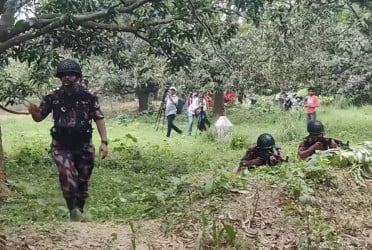
Recently, the army has started actively cracking down on mobs. The incident in Rangpur is just one sequence in this broader approach – a kind of symbolic action that delivers a message. This move was necessary in the wake of destructive mob incidents. The involvement of Sarjis Alam only heightened its significance.
The distinct character of the army – and its chief – has already become evident well before 5 August. At a critical moment, General Waker risked his own life and declared a “No Fire” order at gunpoint. If he had followed the fascist regime’s orders instead, the outcomes for Sarjis, Hasnat and the protesting students and citizens might have been drastically different. This needs no further analysis – only reflection and appreciation.
Now, mob justice – or pre-trial punishment – has become a kind of pandemic for any conscious citizen. It is in this context that the army chief issued his stern warning. Brigadier General Humayun Kaiyum’s statement in Rangpur “As long as there is blood in our veins, we are not going to promote anyone” resonates with the army chief’s message “Mob rule will not be tolerated anymore”.
No one wants to see this country turn into a land of unchecked violence. The rise of individuals through mob action is not only condemnable – it is alarming. As the old rural saying goes, “Bought at a price, sold at the same.” If someone rises through mob tactics, their fall is inevitable. The downfall of the ousted regime was largely due to arrogance and recklessness – turning anyone they disliked into enemies, drawing people in through coercion and forcing public praise for their criminal excesses. That too was a kind of mob rule. The outcome of that powerful regime is still fresh in our minds.
Now, those who, while criticising fascism, are unconsciously cloaking themselves in fascist and criminal behaviour will also face dire consequences. A return of the “bought-at-a-price, sold-at-the-same” cycle would be a collective tragedy for the nation.
The people are now watching to see the benefits of the army’s recent firm stance against mob politics. Provocations from home and abroad under the guise of revolution or ultra-revolution are not uncommon. Their backers have not disappeared; they remain active in various forms. The government should have acted more firmly and earlier. Its failure to set clear examples emboldened the instigators.
That is why the conscious public is hopeful about the army’s recent steps. As elections approach, this status quo cannot continue. Even one or two strong examples could deter mob violence.
Take the case of a local thug named Liton in the Paltan and Purana Paltan area. Recently, this former terror of the area – who once served Jubo League, the youth wing of the Awami League – was using BNP affiliations to carry out extortion, abduction and threats. Since 5 August, he had been terrorising local businesspeople, while some police officers looked the other way. Victims who went to the police were scolded. On 28 May night, army personnel caught Liton red-handed. They raided his office and home, recovering five mobile phones, Tk2,00,000, and $1,100 in cash. The area is now calm – like magic. So far, no one has stepped up to defend him. This is what it looks like when fire hits the monkey’s tail – or when a club lands on it.
The author is a journalist and columnist, deputy head of News, Banglavision