In the proposed budget for the 2025–26 fiscal year, the interim government has set a target of borrowing Tk one lakh four thousand crore from the banking sector, 5 percent higher than the revised target for 2024–25, which stood at Tk 99 thousand crore.
Business leaders have criticized this increased bank dependency to cover the budget deficit, warning that it will reduce available credit for the private sector, stifle loan flow, and negatively impact investment and employment generation.
The government also plans to borrow Tk 96 thousand crore from foreign sources in 2025–26, down from the revised target of Tk one lakh four thousand and 600 crore in the current fiscal year.
The Dhaka Chamber of Commerce and Industry (DCCI) has labeled this increasing reliance on banks as a worrying sign. The Chamber recommends expanding the tax net to raise revenue and reduce pressure on the banking system. It also notes that no visible steps have been outlined in the budget to curb inflation.
The government has cut its borrowing target from national savings certificates to Tk 12,500 crore for 2025–26, a 10.7 percent reduction from the current year’s revised target of Tk 14,000 crore.
According to the proposed budget, 47 percent or Tk two lakh and 21 thousand crore of the total budget deficit will be financed through loans. In comparison, the current fiscal year’s deficit financing from loans stands at 44 percent.
Mahmud Hasan Khan Babu, the incoming president of the Bangladesh Garment Manufacturers and Exporters Association (BGMEA), told Bangladesh Pratidin that banks prefer safe investments, and lending to the government is the safest option. This preference will drain liquidity from the private sector, discourage new investments, and hinder job creation. He urged the government to explore alternative funding sources rather than relying on banks to bridge the deficit.
As of 12 May this fiscal year, the government’s net borrowing stood at Tk 56,116 crore, 56.68 percent of its annual target. Meanwhile, credit growth in the private sector has been steadily declining. In February, it dropped to 6.82 percent—the lowest in 21 years, not seen since February 2004. Although growth slightly improved to 7.57 percent in March, the trend remains sluggish.
DCCI President Taskin Ahmed has urged the government to lower the cost of borrowing from banks to 6–7 percent. He also warned that the government’s heavy reliance on bank loans could further reduce credit availability for the private sector. Despite some initiatives to control inflation, rising operational costs may dampen overall economic momentum.
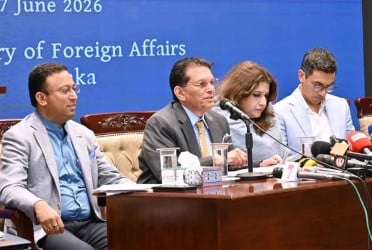
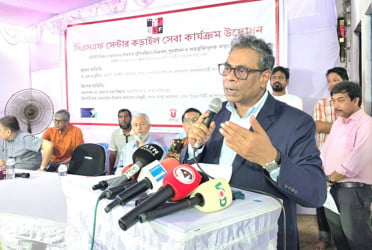
Reacting to the proposed budget during a press briefing at the DCCI auditorium, President Taskin Ahmed stated that the budget is unlikely to foster a business-friendly or investment-friendly environment due to the absence of a clear roadmap for entrepreneurs. Senior Vice President Rajib H. Chowdhury, Vice President Md Salim Solaiman, and other board members were also present.
Although the proposed budget includes some positive measures—such as inflation control, adjustment of minimum tax thresholds, and expansion of the tax net—it lacks specific guidance on expanding investment, improving business operations, and reforming the banking sector. According to Ahmed, these gaps hinder the creation of a conducive climate for business and investment.
Ahmed added that keeping personal income tax thresholds unchanged and removing the initial tax slab will increase the tax burden on the middle class, especially salaried professionals, in the next fiscal year. At the same event, he also pointed out that the increased import duty on auto parts—from 10 percent to 25 percent—will raise local manufacturing costs.
The DCCI president called for a reconsideration of the proposed turnover tax hike from 0.6 percent to 1 percent. Although internet usage costs are expected to drop, the rise in VAT on locally manufactured mobile phones may hinder the sector’s growth. Despite steps to contain inflation, operational expenses are set to rise, which could slow down the broader economy.
Ahmed concluded that the proposed budget lacks a clear roadmap for the development of the SME sector. With higher government borrowing targets from the financial sector, the private sector could face further credit restrictions.
Bd-Pratidin English/ AM