It is now evident that the interim government appears to be provoking confrontation with the BNP. The authorities seem determined to make the BNP its primary adversary, as evidenced by the state-sponsored emergence of the newly formed student-led National Citizens' Party (NCP), set up as a counterforce. This move signals a new phase of political polarisation and unrest. As a result, Bangladesh seems to be heading down a path of renewed political uncertainty—one which many fear may again lead to depoliticisation.
With the Awami League already excluded from politics since 5 August, it has effectively become irrelevant. Now, with the BNP as the dominant political force on the ground, many suspect that efforts are underway to sideline them too. Is this the reappearance of the infamous ‘One-Eleven’ formula in a new form? The most pressing political question of the moment is whether such a strategy can truly succeed.
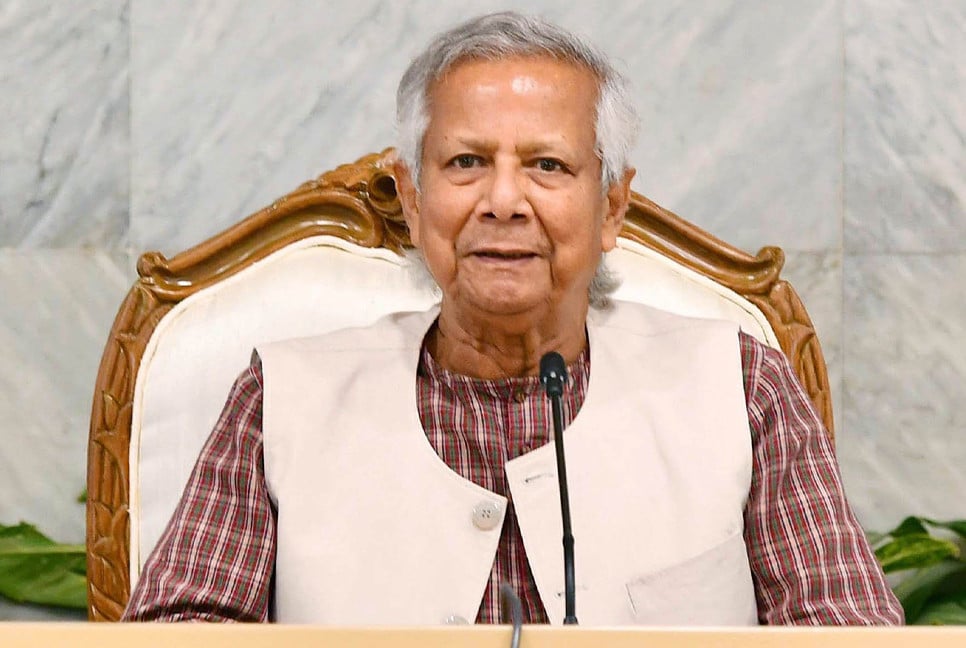
What is unfolding in Bangladesh today is a farcical display of "reform". These reforms seem designed less to improve governance and more to delay or derail the election. The government’s reluctance to hold elections appears to be part of a broader scheme to depoliticise the nation. On 28 May, BNP’s Acting Chairperson Tarique Rahman made it unequivocally clear: “The election must be held by December.” Soon after, Chief Adviser Dr Muhammad Yunus, while on a visit to Japan, claimed, “Apart from one party, no one wants elections in December.” This statement is simply untrue. Among the country’s 49 registered political parties, the vast majority support a December election. Over a hundred unregistered political groups have also expressed the same demand. Even Jamaat and Hefazat want elections by February next year. The only outlier is the NCP. Why then is the government seemingly prioritising the preferences of a party that isn’t even officially registered?
The popular uprising in July last year was born of a spontaneous student movement. By ousting a 15-year fascist regime, the youth sought to establish an egalitarian society free from discrimination, violence, and oppression—a system where freedom of speech and citizen rights would be guaranteed. It was this very aspiration that led to the overthrow of the previous regime on 5 August, with widespread public support. People hoped that, under the interim leadership of Dr Yunus, Bangladesh would swiftly return to normalcy and head towards democratic elections. But nearly ten months on, not only has there been no election, even the mention of one seems to unsettle the government. Any call for elections is met with excuses, diversions, or warnings of disorder. The government’s focus, instead, lies in irrelevant ventures—its greatest failure over the past ten months being its loss of neutrality. The interim administration appears increasingly aligned with a certain interest group and preoccupied with executing their agenda. Reforms and war crimes trials are being used to justify postponing elections, though both are long-term processes. These cannot be excuses to indefinitely withhold democratic transition.
Furthermore, the so-called reform agenda lacks clarity. The Chief Adviser had formed various reform committees, the results of which were submitted in February. Now, only two major reforms are truly necessary to facilitate elections: restructuring the Election Commission and amending the Constitution. On both fronts, political parties have already reached consensus on fundamental issues, including reinstating the caretaker government system, creating a bicameral parliament, appointing a Speaker from the opposition, forming key parliamentary committees chaired by the opposition, separating the judiciary, and amending Article 116 to ensure judicial independence. Political analysts believe these steps are enough to lay the foundation for a democratic and accountable state. Importantly, constitutional reform lies solely within the jurisdiction of an elected parliament, not an interim government. Therefore, elections must come first to enable full-scale reform. It’s unrealistic to expect full consensus across all issues—democracy by its very nature thrives on difference. A democracy without dissent becomes a form of authoritarianism.
There are differing views on proposed reforms, such as limiting any one person to two terms as Prime Minister. Some agree, others suggest allowing a return after a break. Such disagreement is natural and necessary. Democracy is pluralism—it means competing visions, competing paths, from which the people choose through elections. Unfortunately, the interim government appears disinterested in such pluralism. Dr Ali Riaz, Vice-President of the National Consensus Commission, recently announced that a “national charter” will be unveiled in July. Why July? What was wrong with June? In a country desperate for stability, every day counts—delays raise suspicion.
The reform proposals thus far shouldn't require such a long time to draft—this is a task of 15–20 days. Historically, reforms of this nature have been completed swiftly. Now, it seems elements of civil society are trying to lecture political parties on democracy, imposing their own preferences. It has become clear that reform is being used as a tool by the interim government to prolong its hold on power and implement agendas that neither reflect public will nor serve the nation’s interests.
What is telling is that almost all political parties, the armed forces, and the general public are united in their demand for elections. After ten months of this government, the people are exhausted. The administration has created chaos in every sector—law and order, the economy, trade, social cohesion, and politics. The most worrying part is that many of these crises seem deliberately manufactured.
Take the example of Ishraque Hossain’s mayorship. Why, even after the High Court ruling, has his swearing-in ceremony not taken place? An interim government should be neutral and above partisanship. But the people now suspect that this government is driven by a specific agenda. For example, revelations about links to the Arakan Army have only fuelled distrust. In diplomacy too, Bangladesh has adopted an enigmatic role. Decisions with far-reaching implications are being made in secret, without public consultation. The only force blocking these harmful policies is the BNP. When some students, perhaps naively, attempted to oust the President and create a constitutional vacuum, it was the BNP’s responsible stance that prevented such a crisis. The BNP also stood firmly against the so-called “Rakhine Corridor”, which would drag Bangladesh into a proxy war, and objected to handing over the Chattogram Port to foreign powers. This is why the interim government views the BNP as an obstacle. Their resistance makes it difficult for the government to implement its anti-national, undemocratic plans. Is this why efforts are underway to eliminate the BNP from politics?
The BNP has long supported the interim government and shown respect to Dr Yunus. But that patience seems to be wearing thin. It would not be surprising if, in the coming days, the people and political parties rise up in protest. Such a movement would mark the second phase of the struggle for democracy. It would be the fight to realise the unfulfilled dreams of the July Revolution—the fight to determine whether Bangladesh will be a democratic nation or a client state executing a foreign agenda.
The writer is a Playwright and Columnist. Email: [email protected]