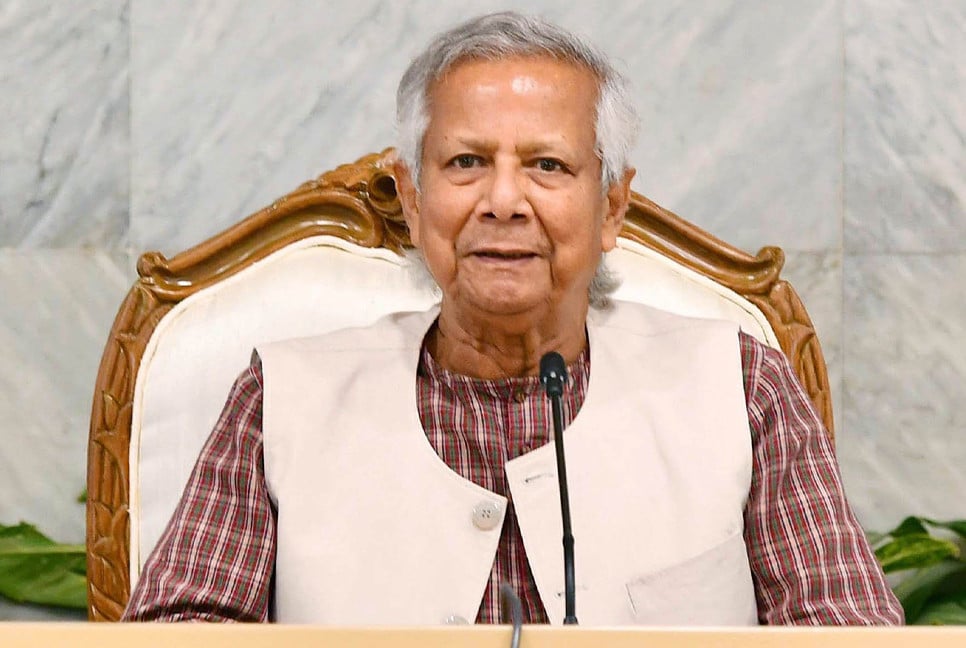
Just as squeezing a lemon too much turns it bitter, overusing the word "reform" is beginning to leave a bitter taste in politics. Chief Advisor Dr. Muhammad Yunus has made his stance on reforms very clear. He stated, "If extensive reforms are demanded, elections will be held in June. If fewer reforms are sought, the election will take place in December." He has reiterated this across multiple national and international platforms, including the BBC and Sky News. Dr. Yunus has made both a national and international commitment to hand over power to elected representatives through parliamentary elections by June. His message is straightforward: reforms should not be imposed. The country will proceed to elections based on the reforms that all political parties agree on. The rest should be resolved by the newly elected Parliament.
However, some actions by individuals seem contrary to the Chief Advisor’s vision. Instead of working toward his goals, they appear to be creating a politically complex situation. The gap between political parties is growing due to the activities of the National Consensus Commission.
The Consensus Commission is currently holding meetings with political parties over proposed reforms, led by its co-chair Dr. Ali Riaz. Since the July Revolution, the Commission has proposed various reforms on which the parties are giving feedback. If the Commission truly understands the Chief Advisor's intentions, its main task should be to document the issues where all political parties agree and submit them to the Chief Advisor. He will then finalize the July Declaration based on these consensuses, triggering the election countdown. The Commission is not a place for bargaining. Political parties shouldn't be forced into argumentative debates over reforms in these meetings. However, these sessions seem to be turning into stages for dispute between Commission members and political parties. The focus is shifting from “possibility” to “impossibility,” which is undesirable.
This divisiveness is most evident in the reform commissions' reports. Rather than unifying the nation, they are deepening divisions. For instance, the Women’s Reform Commission’s report is widely seen as unfit for implementation. It has offended religious sentiments and lacks connection with the general public. It was drafted by a few NGO-based activists without broad consultation. For the sake of national unity, this report must be set aside.
Similarly, journalists find the Media Reform Commission’s report unacceptable, biased, and one-sided. In my view, only two reform commission reports should be discussed before elections: the Constitution Reform Commission and the Election Reform Commission. All other reforms should be left to the elected government. Reforms are long-term processes and must involve public opinion. Implementing reforms without public consent could backfire. For example, the Public Administration Reform Commission has already caused rifts among civil servants, with different professional cadres turning against each other.
A dispassionate analysis of the reform discourse shows that our primary need is to establish an accountable democratic system where authoritarianism or fascism cannot reemerge. No ruling party should even consider elections like those in 2014 or 2018. One major recommendation of the Election Reform Commission is a return to the caretaker government system — a proposal no political party has objected to so far. Other recommendations also enjoy broad consensus. However, some are not only unrealistic but also unacceptable. For example, the Commission suggests disqualifying candidates indicted by the International Crimes Tribunal. This could become a dangerous political weapon. It contradicts the Constitution, which guarantees equality before the law. Unless convicted by the highest court, no one should be labeled guilty. Imposing such provisions defies the very spirit of the rule of law.
While there is controversy over other recommendations, we should focus only on those that have widespread political agreement. Every issue can be seen in two ways — positively or negatively. A half-filled glass can be seen as either half-empty or half-full. Let’s choose to focus on possibilities, not divisions. Yet, the Commission seems to be justifying its recommendations through prolonged debate, which the public sees as unnecessary. No reform should be enforced. Moreover, without the participation of elected representatives, no reform can truly be implemented.
BNP Standing Committee Member Salauddin Ahmed stated that of the 243 recommendations by the Election Reform Commission, BNP agrees with 141, partially agrees with 14, disagrees with 24, and has expressed differing opinions with comments on 64. This shows that there is significant room for agreement. Hence, reforms where consensus exists should be taken forward.
The Constitution Reform Commission’s proposals also merit discussion. Constitutional amendments lie solely within the authority of Parliament. However, the Commission may make recommendations on which political parties can build consensus. For example, the returns to the caretaker government system and limiting the Prime Minister to two consecutive terms have no opposition from major parties. BNP has suggested a break before a third term is allowed — their own perspective.
The balance of power between the Prime Minister and President is another critical constitutional issue. BNP agrees with some aspects of the proposal but not all. The party is also uncertain about increasing presidential powers through new law enforcement provisions.
BNP does not agree with proposals such as reducing the parliamentary term to four years, holding referendums after bicameral approval, emergency rule provisions, renaming the country in the Constitution, youth quotas, or lowering the age for candidacy to 21. However, it agrees with recommendations like abolishing Article 7(a), introducing a bicameral legislature, appointing a Deputy Speaker from the opposition, setting up procedures for presidential impeachment, renaming subordinate courts as local courts, capping interim governments to 15 members, and removing party symbols in local elections.
These consensus points indicate that we must seek unity, not division. However, last week’s meetings revealed growing fractures among political parties. That’s why a comprehensive all-party meeting should be held immediately based on areas of agreement, leading to a July Declaration. This would help steer the country away from uncertainty toward a clear electoral path.
If any party is forced into any reform, division will only grow. The longer such contentious discussions continue, the more disunity they will breed. That disunity is already in the air. We must prevent it from turning into a storm. Everyone must ensure that the Consensus Commission does not become a Commission of Division.
The writer is a playwright and columnist. Email: [email protected]