Though eight months have passed since the end of Sheikh Hasina’s authoritarian regime, the country's macroeconomic conditions remain stagnant. Political and social conditions have somewhat stabilized, economic activities continue to contract steadily. The business recession shows no sign of improvement, and joblessness is increasing.
Political disagreements surrounding the election have led to a slowdown in investment and job creation. Although the interim government has attempted to attract foreign investors through an investment summit, most investors remain in a wait-and-see mode due to the ongoing political stalemate.
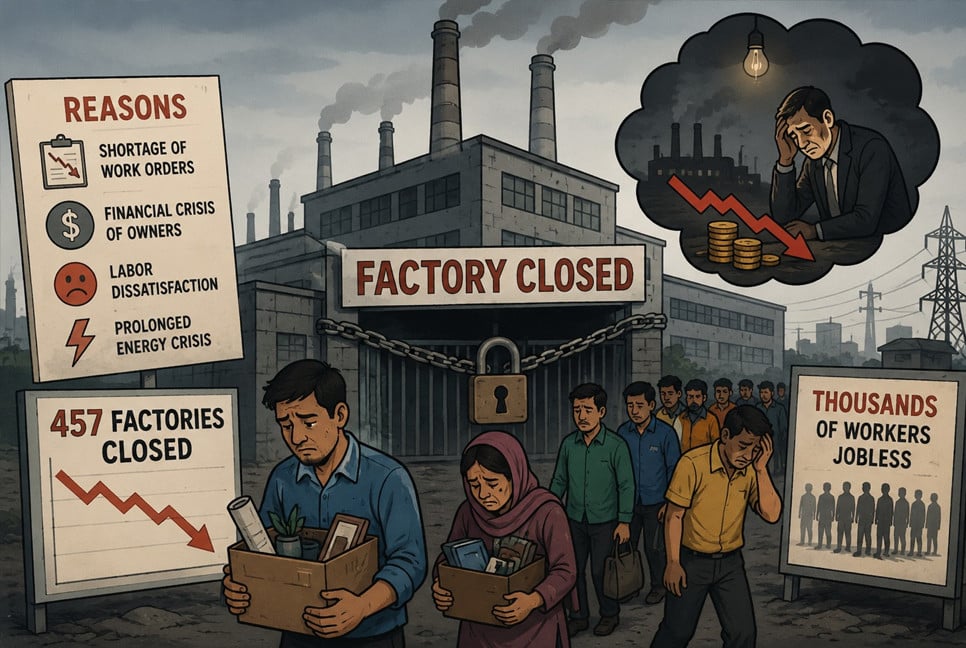
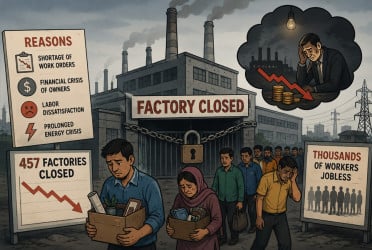
In addition, there is a growing crisis of self- believe among domestic investors. Not only are there no new factories being established, but hundreds of existing factories across various regions have also shut down over the past six months, resulting in thousands of workers losing their jobs.
Dr Hossain Zillur Rahman, a former advisor to the (2007-08) caretaker government, told Bangladesh Pratidin, “A significant change has occurred due to a major shock. This has affected all sectors related to investment, business, and the economy. Foreign investors are also likely to make decisions based on their understanding of the current situation, and they are concerned about the potential political developments in the near future. The nation’s macroeconomy is likewise shrinking.”
According to the World Bank, GDP growth could fall to 3.3 percent by the end of this year. Moreover, the World Bank forecasts that South Asia's growth will decline to 5.8 percent in 2025 which is 0.4 percent lower than its previous forecast made in October.
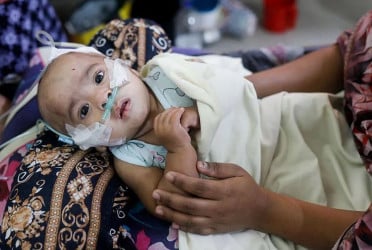
Additionally, it estimates that 3 million more people in Bangladesh will fall into extreme poverty this year. The World Bank predicts the poverty rate in Bangladesh could reach 22.9 percent in 2025, up from 18.7% in 2022.
Furthermore, inflation has remained in the double digits for more than two years. In the 2024–25 fiscal year, average annual inflation stood at 9.73 percent, far exceeding the government's target of 6 percent.
The government aims to bring inflation down to 6.5 percent in the 2025–26 fiscal year, but the World Bank disagrees with this projection.
The World Bank warns that purchasing power is declining and will likely continue to fall, resulting in a rise in the number of people living in poverty.
At the end of the first nine months (July-March) of the 2024-25 fiscal year, the revenue deficit has increased to 65,665 crore BDT. This is more than 58,000 crore BDT behind the revenue target for the first eight months of the fiscal year. Similarly, the budget implementation rate has dropped to its lowest level in a decade, with fears that it may end the year at under 80 percent.
Due to the continuous irregularities and corruption of the previous government, loan write-offs in the banking sector have increased. So far, this amount has exceeded 81,000 crore BDT. In other words, a large portion of these non-performing loans has been hidden through loan write-offs and will no longer be shown in the main balance sheet. Despite this, by December 2024, non-performing loans in the banking sector have risen to 3, 45,765 crore BDT, which accounts for 20.20 percent of the total disbursed loans.Of this amount, 17 percent, or 2, 91,538 crore BDT, is non-performing debt deemed unrecoverable.
Since August 5, increased remittances inflows have contributed halt the decline in foreign currency reserves. Simultaneously, the difficulties in opening Letters of Credit (LCs) have eased, allowing businesses to resume LC activities. Reserves have once again crossed the $27 billion mark. However, the price of the U.S. dollar remains high, with rates exceeding 122 BDT in the informal market outside the banking sector.
Research by the Metropolitan Chamber of Commerce and Industry (MCCI) and the research institute Policy Exchange of Bangladesh shows that the Purchasing Managers' Index (PMI) fell in February. Compared to January, the pace of expansion in the economy’s four major sectors slowed in February. The PMI for February stood at 64.6, down from 65.7 in January which is a decline of 1.1 percentage points. This indicates a slowdown in economic expansion in February compared to January. The World Bank predicts this trend may continue for another two years.
(Translated by Afia Nanjiba Ibnat)
Bd-pratidin English