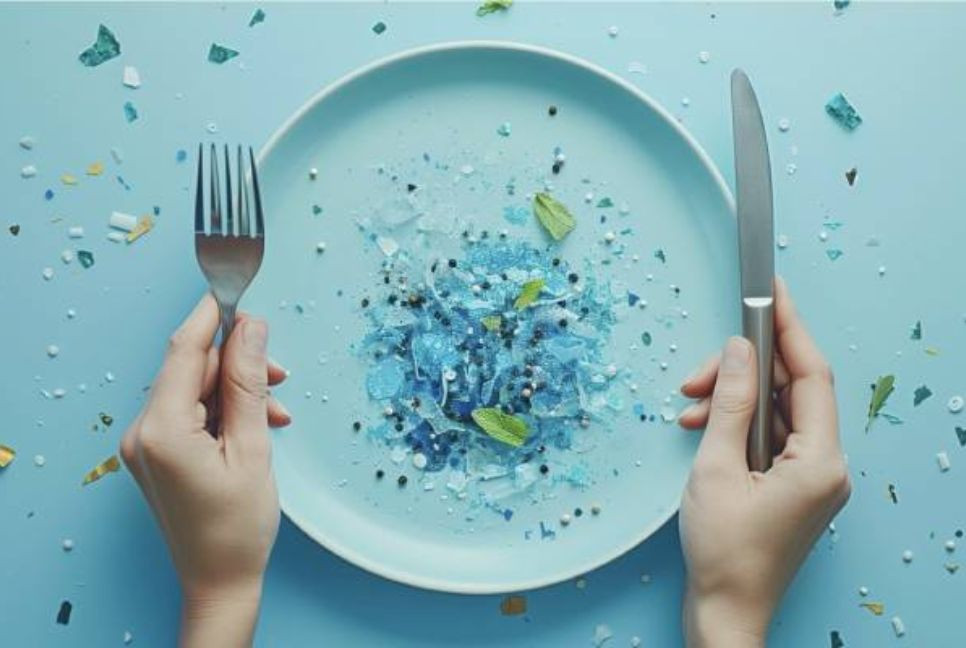
Microplastics gush out of our taps and flake off cookware. They find their way into the yolks of eggs, and deep into meat and vegetables. But if we take certain steps, we can eat less of them.
You can't see them, but they are there, hundreds of miniscule particles of plastic lurking in your steak. As it cooks in a hot pan, these unwelcome guests liquify, oozing into the meat before solidifying again as it cools down on your plate. Unwittingly, you are eating them all the time.
These interlopers in our food are microplastics and nanoplastics, particles of less than 5mm or between 1 and 1,000 nanometres respectively.
If you take a closer look around your kitchen, you'll start to recognise where microplastics enter our meals: they flake off the spatula you use to cook breakfast, leak from the plastic water bottle you put in your child's backpack and float in the cup of tea on your desk. They're also buried deep within the foods we eat.
It is possible to make changes to reduce the amount of microplastics we are exposed to in our kitchens.
Food
One study of 109 countries found the amount of these plastics people typically consumed in 2018 was more than six times what it was in 1990. Microplastics can get into our food when plants take them in by the roots, or animals consume them in feed.
"If you farm on a piece of land that was previously industrial and the soil is contaminated, [there is] potential for those plants to accumulate the contaminants in the soil," says Sheela Sathyanarayana, a professor of paediatrics at the University of Washington.
Once that the crops are harvested, there are many more opportunities for contamination during processing. "Factories use a huge amount of plastic to be effective and to have high throughput for their products."
For some foods, it is possible to get rid of some of the microplastics before you eat them. One study in Australia found that people were typically consuming 3-4mg of plastic per serving of home-cooked rice, and up to 13mg per serving of pre-cooked rice. The microplastics were just as present in rice that was packaged in paper, as in rice that came in plastic packaging. However, the researchers found that rinsing the rice reduced the microplastics served up by 20-40%. Washing meat and fish, too, can reduce microplastics – but not eliminate them.
For other foods, rinsing is impossible. Salt often contains microplastics due to contamination at mining and processing points. A 2018 study found that 36 out of the 39 salt brands analysed contained microplastics. Sea salt had the highest levels of microplastics, likely due to the high levels of microplastic pollution in the world's lakes, reservoirs, rivers and oceans.
Both Sathyanarayana and Annelise Adrian, a senior programme officer with the plastics and material science team at World Wildlife Fund, are proponents of switching to fresh, whole foods or, at the very least, avoiding ultra-processed foods whenever possible. "The more ultra-processed a food is, the more likely it is to have high plastic contamination, because there are so many touch points in a factory making that food," says Sathyanarayana.
Water
Whether it comes from a tap or from a bottle, water is another notable point of exposure to microplastics. One study found the simple act of screwing a plastic bottle cap on and off dramatically increased the amount of microplastics found in the water it carried. With each twist on or off, it generated 553 microplastic particles per liter of water.
The plastic inside us
A recent study found that there's up to a spoonful-sized amount of microplastics in an average human brain.
Microplastics are also commonly found in tap water. One UK study found them in all 177 samples of tap water tested, with no distinguishable difference in microplastics concentration with bottled water. Similar findings in China, Europe, Japan, Saudi Arabia and the US suggest this is a worldwide problem.
Adrian says investing in a decent filter makes a noticeable difference. Even a simple carbon filter, such as the one found in a water filter pitcher, can remove up to 90% of microplastics.
However, even if your water is low in microplastics, if you're planning to add a plastic-containing tea bag to make a cup of tea, it can release around 11.6 billion pieces of microplastic and 3.1 billion pieces of nanoplastic into your cup.
Packaging and containers
Then there's the plastic that much of our food comes packaged in.
Simply opening plastic packaging releases a burst of microplastics. Whether you use scissors, tear a packet open with your hands, cut it with a knife or twist a lid off, it can generate up to 250 bits of microplastic per centimetre, an Australian study found.
The age of a plastic container can also make a difference. Even if food is only in a container for a short time, there is still ample opportunity for contamination.
Kitchen utensils
The starting point for many dishes is the chopping board. Microplastic release varies between different people's chopping styles as well as between board types – a release of that much plastic would leave your chopping board in tatters after a few years of use.
"So, where did the plastic go? It must have gone somewhere,” says Snekkevik, who published a 2024 review on sources of microplastics in the kitchen.
Sometimes, it goes straight into the food chopped on it. These microplastics melted when the meat was cooked, and then solidified again as the meal cooled. Washing meat thoroughly for three minutes reduced but did not eliminate the microplastics inside it, the researchers found.
Scratched non-stick cookware can also release an estimated thousands to millions of microplastic particles per use. Even brand-new non-stick cookware used with a soft silicone whisk releases significant numbers of microplastics. Likewise, plastic mixing bowls and blenders release particles with each use.
Silicone is sometimes suggested as a safer alternative to plastic utensils, but Adrian says there isn't concrete evidence that it sheds fewer microplastics. "While silicone is technically more stable and withstands higher temperatures than single-use plastics, the issues of leaching and microplastics aren't fully avoided," she says. That said, considering its stability, she does use some silicone in her own kitchen.
Other alternatives for some kitchen items are glass and stainless steel, says Snekkevik.
Heat
Now the ingredients are prepared, it's time to cook.
As far as heat is concerned, hotter plastics get, the more microplastics they tend to release. One study found that plastic containers warmed in the microwave for three minutes could release up to 4.22 million microplastic and 2.11 billion nanoplastic particles from a single square centimetre of plastic. Using similar containers in the refrigerator can also release "millions to billions" of microplastics and nanoplastics – but over a much longer period of six months, the study found.
Putting a hot drink in a disposable plastic cup also generates microplastics.
Cleaning up
Now the meal's over, next comes washing the dishes.
Disposable kitchen sponges are yet another source of micro- and nanoplastics. For those that had a harder and a softer surface, it was the former that came with a higher risk of shedding microplastics. As they wear down, kitchen sponges can release up to 6.5 million pieces of microplastic per gram.
Adding detergents and other cleaning products to a sponge may make the sponge release even more microplastics.
For other common plastic cleaning products, there's still very little research on their microplastic release. Whether microfibre cloths release microplastics during cleaning was a much-overlooked topic of research at the time Snekkevik and her colleagues published their review in 2024.
However, synthetic textiles are well known to shed large quantities of microplastics, and they are thought to be a primary source of plastic pollution in the ocean.
What to do about a kitchen full of plastic
"Even after writing this paper, I do still have certain items in my kitchen that are plastic," Snekkevik says. "I'm not going to just throw everything out and be like, that's it."
One strategy is to focus on items that show obvious signs of damage – such as anything obviously scraped, cut up, flaking or melted. When it appears to be time to change the item anyway, Snekkevik says she'll generally choose a plastic-free replacement. "But I wouldn't go through my kitchen and throw everything out right now, because that's also not necessarily the environmentally friendly way to do it."
Beyond your plate
Food and drink may be the most direct way microplastics get into our digestive systems, but it's still far from clear what effect it has on us.
Some scientists have suggested it might disrupt the microbes that live in our guts or that some of the smaller particles may even pass into our blood stream.
Some of this foreign material may simply become lodged inside our bodies.
"Fossil-based plastics, in their micro- and nano- forms, have been detected in virtually every organ in our bodies that have been studied, including arteries, brain, blood, placenta and testicles," says Anastas.
It's possible that much of the plastic inside us might not cause health issues, says Sathyanarayana. "The argument could be made that the particles can be lodged in a place and be inert in that area," she says.
Adrian adds that there's also no consensus on how long plastic stays in the body, or whether it accumulates over time. So the microplastics you've already eaten and drunk today might not be destined to stay in your body forever.
Indeed, at least some of the microplastics we regularly eat have been observed passing straight out the other end.
Source: BBC
Bd-pratidin English/FNC