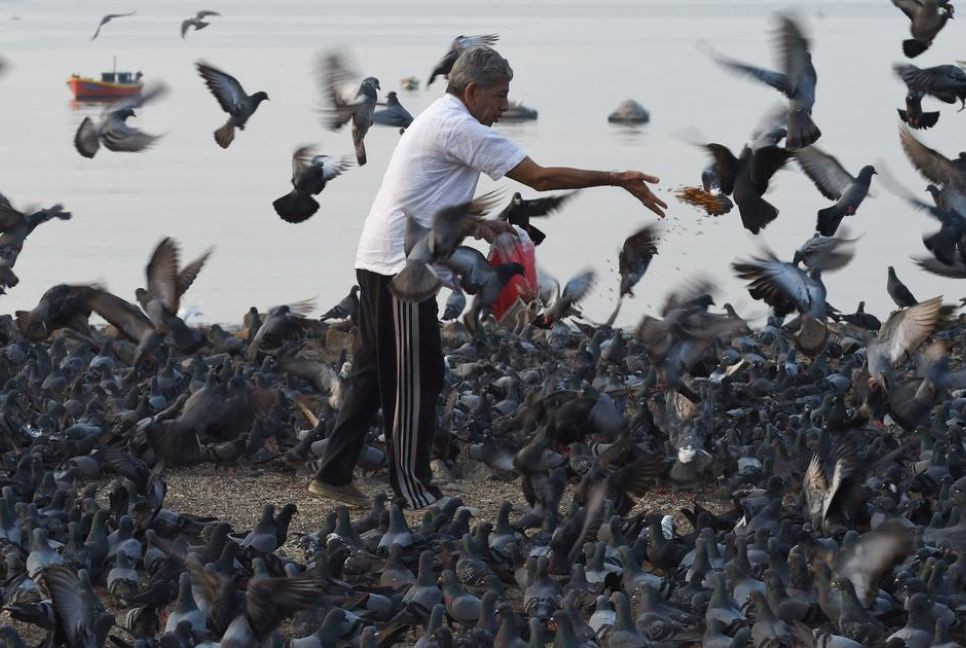
A recent court ban on feeding pigeons in public spaces in the western Indian city of Mumbai has become a major flashpoint between civic bodies, public health activists and bird lovers.
This month, hundreds of people clashed with police twice while protesting the closure of a decades-old pigeon feeding spot, locally known as “kabutarkhana”.
Some tore down the tarpaulin sheets covering the spot and threatened an indefinite hunger strike. Police briefly detained about 15 people at another protest, media reports said.
Authorities had imposed the ban due to concerns about health hazards due to pigeon droppings.
The problem is not unique to Mumbai. In Venice, feeding pigeons in historic squares is banned. Singapore imposes hefty fines, and New York and London have regulated feeding zones.
In India too, Pune and Thane cities in Maharashtra state - of which Mumbai is the capital - have imposed penalties on feeding pigeons. Delhi is mulling an advisory against feeding the birds in public spaces.
The crackdown has angered animal lovers and religious feeders, as pigeons are long woven into India's cultural fabric.
Indian films often use shots of grain-feeding pigeons to portray cities like Mumbai and Delhi, where the birds are a familiar presence on balconies and air-conditioners.
Some of Mumbai's kabutarkhanas are iconic heritage structures and are said to have originated as charitable spaces where communities could donate grain.
There are religious sentiments involved as well. In Mumbai, the Jain community, which considers feeding pigeons a pious duty, has been vocal in their protests.
Elsewhere too, many share a bond with pigeons -- seen as symbols of peace and loyalty.
In Delhi, Syed Ismat says he has been feeding the birds for 40 years and considers them his family.
But these sentiments are pitted against studies which show that prolonged exposure to pigeon droppings poses risks of pulmonary and respiratory illnesses.
A boom in India's pigeon population in recent years has heightened this risk, prompting the restrictions.
Delhi-based biodiversity expert Faiyaz Khudsar says easy availability of food has led to overpopulation of pigeons in many countries.
In India, he said, the challenge is compounded by a decline in birds like the goraiya, commonly known as the house sparrow, which are increasingly being displaced by pigeons.
"With easy food and no predators, pigeons are breeding faster than ever. They are outcompeting other urban birds, creating an ecological loss," Mr Khudsar said.
The 2023 State of India's Birds report says pigeon numbers have risen more than 150% since 2000 -- the biggest jump among all birds -- leaving homes and public spaces with droppings, as each bird can produce up to 15kg (33lbs) a year.
Studies show these droppings contain at least seven types of zoonotic pathogens that can cause diseases such as pneumonia, fungal infections and even lung damage in humans.
Nirmal Kohli, a 75-year-old Delhi resident, started complaining of persistent cough and had trouble breathing a few years ago.
"Eventually, a CT scan showed that part of her lung had shrunk," says her son Amit Kohli. "The doctors said it was due to exposure to pigeon droppings."
Last year, an 11-year-old boy died in Delhi due to hypersensitivity pneumonitis -- a disease that causes inflammation in lungs. Doctors said the reason was prolonged exposure to pigeon droppings and feathers.
RS Pal, a pulmonologist, told the BBC that such cases were common.
"Even if you don't directly feed pigeons, their droppings on window sills and balconies can cause hypersensitivity pneumonitis," he said.
These concerns are what led the Mumbai and other cities around the world to impose the feeding ban.
Delhi mayor Raja Iqbal Singh told the BBC that love for birds cannot come at the cost of people's well-being.
But many animal lovers disagree.
The Bombay High Court has set up an expert panel to suggest alternatives, and Mumbai civic officials say controlled, staggered feeding may be allowed based on its advice.
For Syed Ismat, the solution lies in rethinking the relationship between birds and urban spaces.
"Maybe it's time to reimagine how we share our cities, not just with pigeons but with all forms of life," he said.
Source: BBC
Bd-pratidin English/FNC