Science suggests we are hardwired for altruism, but do we really need to be thinking of others all the time?
Whenever I fly, one line jumps out from the pre-flight safety briefing. Somewhere between “welcome aboard” and “use this whistle for attracting attention”, we’re reminded to “put on your own oxygen mask before helping others”.
This is, essentially, an official instruction to be "selfish". And it is sage advice if there's an emergency at 33,000ft height at the speed of 550mph. If the cabin depressurises, you won't be able to assist others if you black out from oxygen starvation.
But on the other hand, in a world that often seems to reward narcissism, there could be a risk that that same line speaks to a somewhat troubling life philosophy. The idea of putting yourself first or selfishness trumps altruism.
Individualism was defined by social psychologist Geert Hofstede as "the extent to which people feel independent, as opposed to being interdependent as members of larger wholes". And in many parts of the world, particularly the West, individualism is not only endemic, but increasingly on trend. The question is whether that's a good thing or not.
Elements of psychology, economics and biology have normalised the assumption that competition means humans are intrinsically cruel, ruthless or selfish, says Steve Taylor, a senior lecturer in psychology at Leeds Beckett University. But while we clearly can all be selfish – our brain's first job, after all, is arguably to keep us alive – he adds that new research paints a more optimistic picture, challenging the somewhat gloomy notion that we only ever prioritise ourselves.
Take the "bystander effect", which first emerged in the 1960s. This is the widely cited idea that people typically avoid intervening in a crisis when others are nearby. The theory followed outrage over the 1964 New York murder of Kitty Genovese, a 28-year-old bartender who was reportedly raped and killed in front of nearly 40 witnesses, none of whom helped.
But the final detail of the story behind the "bystander effect" appears to be an apocryphal one. While, tragically, Genovese really was sexually assaulted and murdered, investigations suggest that reports of there being 38 passive bystanders were inaccurate. One 2007 paper, for example, stated there was no evidence that any people witnessed Genovese's murder and simply did nothing. The story, the researchers surmised, was a "modern parable, the telling of which has served to limit the scope of inquiry into emergency helping".
Research suggests that people are actually more than willing to prioritise others' safety over their own in many situations. A paper published in 2020, for example, investigated CCTV recordings of violent attacks in the UK, the Netherlands and South Africa. It found that one or more people had tried to assist in nine out of 10 of the attacks – with bigger groups making an intervention more, not less likely.
You might argue that even so-called "have-a-go-heroes" are on some level motivated by self-gratification, perhaps to gain group approval. But a 2014 study about recipients of the Carnegie Hero Medal, awarded to people who have risked their lives for others, found that such extreme altruists, largely described their actions as intuitive rather than deliberative, suggesting their altruism was a reflexive, or "automatic" response. It's something we are when we don't have time to think.
"There is a superficial level at which we can operate selfishly, and we often do," says Taylor whose book, DisConnected, explores how certain human behaviours can cause social problems. "But that's at the level of our ego, or socially constructed identity." Humans also have the capacity to be impulsively altruistic, he adds.
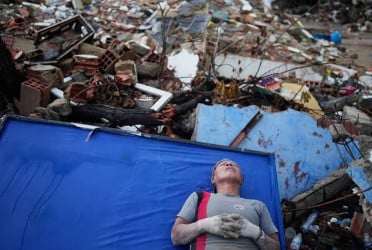
In May 2017, for example, a suicide bomber attacked an Ariana Grande concert in Taylor's home city: Manchester. A total of 22 people were killed and more than a thousand were injured. Despite the ongoing risk to survivors, however, the Kerslake Report, an independent review into the atrocity, highlighted "hundreds if not thousands of acts of individual bravery and selflessness". Similar cases of heroic altruism have been documented during 9/11 and the 2015 Paris terrorist attacks.
There are evolutionary reasons for human altruism, Taylor says. For most of our history, we have lived in tribes as hunter-gatherers – highly cooperative groups.
"There's no reason why early human beings should be competitive or individualistic," says Taylor. "That would not have helped our survival at all. It would have actually endangered our survival."
Some anthropological studies suggest that groups who still live in a similar way to our early ancestors remain egalitarian in how they share resources.
Research in children also suggests that we are "born altruistic", says Ching-Yu Huang, director of the Cambridge Alliance of Legal Psychology, a private company, in the UK and chief executive of National Taiwan University Children & Family Research Center.
Some studies have found that even 14- to 18-month-old infants will go out of their way to help others and cooperate in order to achieve a shared goal – specifically by handing over objects others couldn't reach. And young children will do this even if there's no reward on offer. A 2013 review of similar studies, for example, suggested that young children's prosocial behaviour is "intrinsically motivated by concern for others' welfare".
Being kind also makes us feel good. Volunteering, for example, has been linked to improved mental health, self-esteem and self-efficacy, and reduced feelings of loneliness. And there are physical benefits, too. Regular volunteers who were assessed as part of a study published in 2013 were 40% less likely to develop high blood pressure than those who didn't frequently volunteer. Altruism of this kind has even been associated with a reduced risk of mortality, though it's not yet clear why.
"There's such a strong association between wellbeing and altruism that it would be foolish not to live altruistically," argues Taylor.
The very structure of our brains might help dictate our predisposition towards altruism. Abigail Marsh, a neuroscientist at Georgetown University in the US, and her team have used brain scans to look for differences between people who had donated a kidney to a stranger and those who hadn't.
The organ-donating altruists had larger right amygdalae (brain regions associated with emotion), than the non-donor control group. The donors also showed increased activity in this region when viewing pictures of fearful facial expressions, perhaps making them more perceptive of and responsive to others' feelings. Indeed, the results from the donor group were the opposite of what you'd expect to see in psychopathic individuals.
Science suggests that most of us have the hardware to be selfless, often extraordinarily so. But that doesn't mean we can – or should – be selfless all the time. Whether we prioritise ourselves or others depends partly on circumstances, our prior experience and our culture.
Tony Milligan is a research fellow in the philosophy of ethics at King's College London. People should acknowledge that the vast majority of us are "morally mediocre", he says. But this isn't as uninspiring as it sounds.
Milligan argues that people tend to overestimate their own moral goodness. And this may have a particular impact when we are making deliberative, rather than automatic, decisions about our priorities. "Almost everyone we know is morally mediocre," he says, adding that it's unrealistic for most of us to try and copy the lives of extremely altruistic figures such as Nelson Mandela, Gandhi, Jesus or Buddha. "We can act in the light of them, but if you're not one of those statistical anomalies, we need to recognise that we really are in the middle."
According to Milligan, overestimating our moral goodness can leave us feeling guilty and disappointed when we inevitably fail to live up to overinflated standards. "The question you need to ask yourself is not 'What would Buddha do?'," he says, "But, 'What am I capable of? Is this within my reach?'."
This, he adds, requires some humility and self-knowledge. Because if we have a realistic appraisal of what we're capable of, we will be better able to consider others when we make decisions.
"You shouldn't be thinking of this in terms of developing something you can show off to other people, as something that will make you admired," says Milligan. "Think of it more as developing a skill. A skill is something that you slowly, incrementally work on improving."
People's altruistic tendencies are likely also greatly influenced by their experiences and culture.
Some countries, such as the UK and US, are more individualistic than others, such as many Asian countries, which are generally considered more collectivistic, where people prioritise the good of the wider group over themselves. This impacts not only how selfish or altruistic people tend to be but also the degree to which selfless acts are viewed as being either a choice, or a responsibility.
During the Covid-19 pandemic, for example, researchers found that people living in collectivistic cultures were more likely to wear masks than those in individualistic ones. The former group were more inclined to try and protect others. This difference between East and West is one that Huang has experienced personally.
She spent her childhood in Taiwan, which she describes as collectivistic, before settling for extended periods in the comparatively individualistic US and UK.
"I was brought up to really put everybody else first," says Huang. "If you're a woman, particularly a young woman, who wants to put yourself first and show your ability, this is actually really looked down on in this culture. They would call you a 'female tiger', the implication being that you're aggressive."
When Huang moved to the US and later the UK, she found it was more acceptable to prioritise herself – but initially held herself back because of her upbringing. Gradually, she found herself able to express her confidence and abilities: "I learned that, actually, I do sometimes need to be a female tiger, especially in the career sense."
Such cultural differences are captured in Huang's own research. She has explored two forms of compliance – "committed compliance" (in which you happily comply with instructions) and "situational compliance" (in which you comply even though you're reluctant to do so) – within three groups: young children from Taiwan; non-immigrant, white English families in the UK; and Chinese immigrant families in the UK.
While all groups showed the same level of committed compliance, the Taiwanese children demonstrated much greater situational compliance because they were more likely to prioritise their parents' instructions over their own desires versus the white English and Chinese immigrant children who had grown up in the more individualistic UK.
In collectivistic cultures "we're more likely to comply even if we don't really want to", says Huang.
That doesn't mean there's one right way to do things. While altruism can benefit both ourselves and others, we do need to be mindful of our own needs and how past experiences, context and culture influence our behaviour.
"Things become hard in cultures where the expectation always to be altruistic is supercharged," says Huang, "such as in Taiwan when you're a young woman." Essentially, the responsibility to always prioritise others can become overwhelming.
Most of us are capable of extraordinary selflessness and altruism appears to be something that does us good. It has even helped our species to become uniquely successful. But our decisions and behaviours are also influenced by a wide range of factors, from culture to our own "moral mediocrity". In other words, helping others is great – but recognise that it's okay to look after yourself too.
Courtesy: BBC