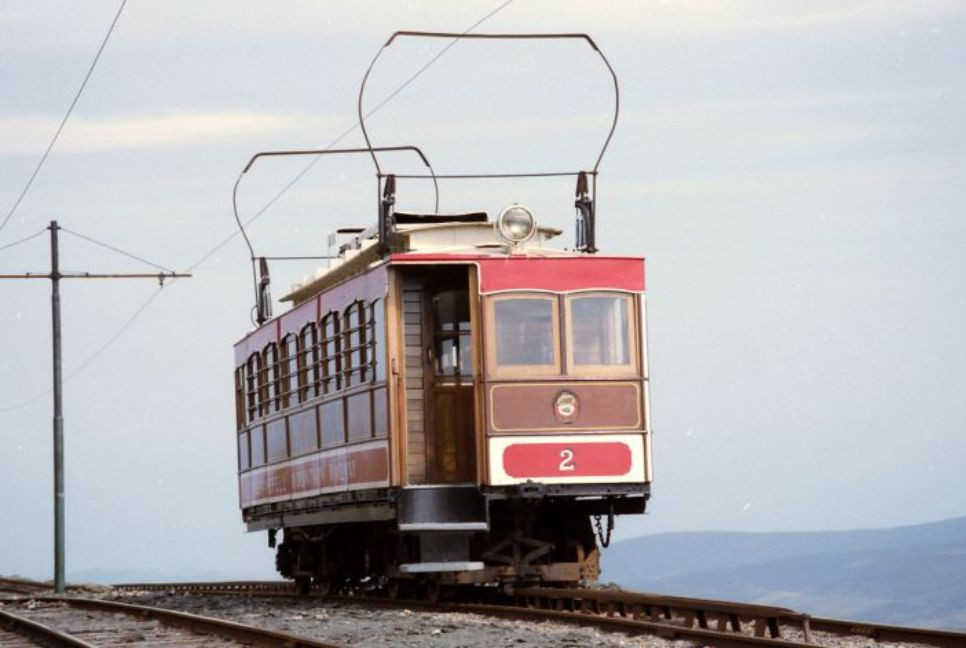
The Snaefell Mountain Railway has been running for over 130 years since 1895, operating between Laxey and the summit of the Isle of Man’s only mountain, with most of its Victorian-era infrastructure and rolling stock still in use. It serves as a gateway to the seven mythological kingdoms.
An individual named Mike MacEacheran shared his experience of this unique railway in a BBC article. This is what he shared:
Our train was crawling slowly up a steeply pitched valley that felt hidden from the rest of the world. To the right of the tracks, the Laxey River dropped suddenly, turning south to vanish into the Irish Sea. Here and there, sheep grazed and the soft scent of gorse wafted into the carriage. I gazed out as the vegetation disappeared and we rattled higher – higher – as the train spiralled around the mountain's bald summit.
A howling wind greeted our arrival at the top station. According to folklorists, the summit is where one can glimpse seven kingdoms, including those that aren’t acknowledged by any map. I could see England, Ireland, Wales, Scotland and the Isle of Man, but up there you can also see that of Manannán mac Lir, son of the sea and king of the otherworld in Gaelic mythology, and the kingdom of heaven. For believers, the journey is an imagined pilgrimage.
Snaefell, or "Snow Mountain", is no ordinary peak and the Snaefell Mountain Railway is no ordinary train. I was on the Isle of Man, atop the island's highest peak, having ridden the only electric mountain railway in the British Isles. The tradition to ride to the top is a profound one, but, equally, to learn about the train is to build a vivid portrait of the Isle of Man.
Katie King, the museum's curator of art and social history, shared, “In the mid-19th Century, the Isle of Man was in a mess. There was low population growth, no employment, exponential immigration and the island's coal industry was collapsing. The [Isle of] Man government was alarmed by all of this.”
At the time, this was a familiar lament across many communities in the British Isles. But the Isle of Man, a UK Crown Dependency, had a secret weapon: its influential lieutenant governor, Sir Henry Brougham Loch, 1st Baron Loch. In office from 1863 to 1882, Loch realised the island's potential as a destination for spa tourism. Seaside holidays were booming in Queen Victoria's era and the Isle of Man, with sandy beaches and bracing waters, was primed to reap the rewards.
In one sense, the island's capital, Douglas, was sacrificed to tourism. A glossy marketing campaign appeared on the London Underground in the 1870s, featuring idyllic sailing boats and beautiful women in swimming costumes, transforming the working-class port town into a glamorous holiday destination.
The journey to get there, from ports including Blackpool, Whitehaven, Silloth, Ardrossan and Greenock by the Isle of Man Steam Packet Company, the world's oldest continuously operating passenger shipping company, was also portrayed as an exotic sea crossing to a mystical island.
The speed at which things changed was astonishing. At its peak, 11 steamer ships made the crossing from Liverpool daily; and, by 1880, nearly 3,50,000 visitors were arriving every summer. A staggering 1,500 hotels opened, and, within a decade, Douglas had been transformed with a seafront promenade, pier and the largest ballroom in Europe. Despite moral outcry from the influential Methodist community, the island attracted legions of unchaperoned single men and women. And with liberal drinking laws, it was once described, as King puts it, as "one of the most debauched places in Britain".
"But the governor wasn't content with stopping there," added King. "All those visitors only spent time in Douglas because there weren't opportunities to explore the island. So, building a train was the next obvious step."
Manx Electric Railway, first opened to the coastal town of Groudle in 1893, is now the oldest electric tram line in the world with its original rolling stock still in service. Then, two years later, the Snaefell Mountain Railway arrived as part of a further tourism push. Remarkably, the two connecting lines still run with much of their original Victorian-era infrastructure. Both feel like museums on wheels.
First, the Manx Electric Railway rattles, stutters and sways along the seven-mile track from Derby Castle Station to Laxey; then it's a quick switch onto the Snaefell Mountain Railway as it pushes uphill for a further five miles to 621m. Inside, the shallow arched carriages are polished ash and pitch pine. There are glazed vestibules, mirrored panels and sliding windows. For the Manx, the legends and reality of the train are ingrained in their psyche.
Andrew Scarffe, Manx Heritage Railways' technical support officer, said, “Droves of people came over on the ferry just to see its electric technology and innovation. What's rarely spoken of is we were 130 years ahead of the rest of the world with green travel. We began generating our own power back in the 1890s to run the railway, and the electric tram cars are still doing what they were built to be doing. Slow travel by electric train? It all started here.”
The trains leaves Derby Castle Station for Laxey every three minutes. These days, the Isle of Man's holiday traditions have been eroded, but the train still completes around 200,000 passenger journeys a year, from April to October. Like me, many come for the ride through the glens and fields, the train clawing past beech trees bursting to green before the hillside peters into rocks.
Some come for the rare experience of driving the tram itself, with one day train-driving tutorials available. And those of a more spiritual bent come to savour the seven kingdoms.
Before dusk, I reflected on much of this as I scrambled to Snaefell's true summit above the rail tracks. Ireland lay in front of me, with Wales, Scotland and England at my back, facing east. Above, so Manx folklore says, was the domain of "otherworld", a legend more difficult to ignore because of the remains of a Victorian-era observatory at the summit. Around me was the watery kingdom of Manannán mac Lir (fun fact: he's reputedly buried under a grassy knoll behind the walls of Peel Castle on the island's west coast).
All of this was a confusion of the real and make-believe. And yet, looking out at this island full of stories made me realise that my short journey onboard the Snaefell Mountain Railway had taken me to more places than I ever could've imagined. It seems an ordinary train, but the tracks of this tiny electric mountain railway continue to keep both fantasy and so much of Manx history and culture alive.
Courtesy: BBC
Bd-pratidin English/FNC