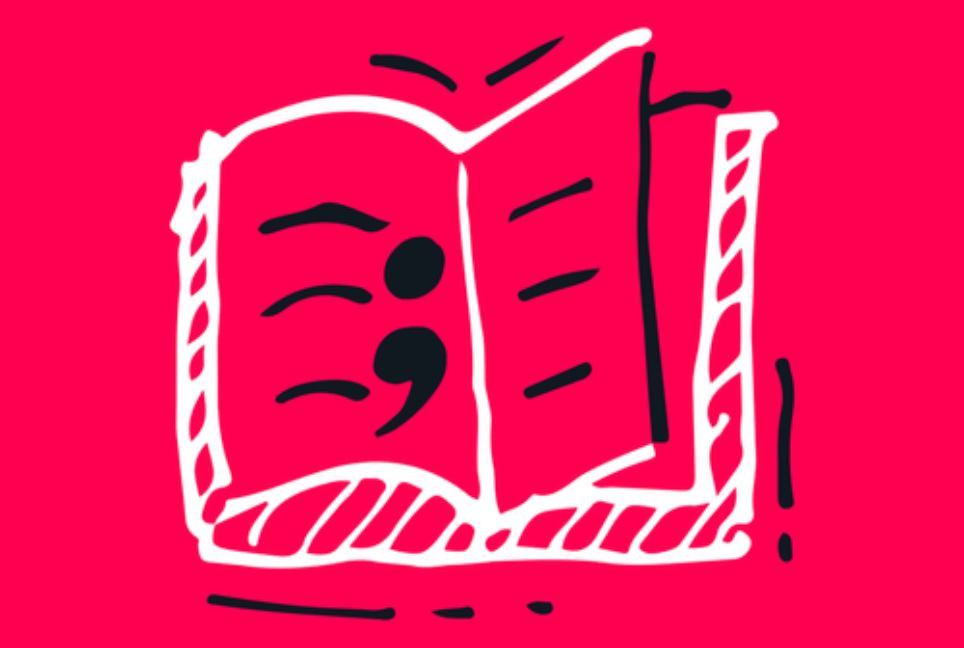
A study suggests that UK authors do not use the semicolon in English books much as before. The usage plummeted by almost half in two decades – from one appearing in every 205 words in 2000 to one use in every 390 words now.
Moreover, further research by Lisa McLendon, author of The Perfect English Grammar Workbook, found that 67 per cent of British students never or rarely use the semicolon. Just 11 per cent of respondents described themselves as frequent users.
Linguistic experts at the language learning software Babbel, which commissioned the original research, were so struck by their findings that they asked McLendon to give the 5,00,000-strong London Student Network a 10-question multiple-choice quiz on the semicolon. She found more than half of respondents did not know or understand how to use it.
As defined by the Oxford Dictionary of English, the semicolon is “a punctuation mark indicating a pause, typically between two main clauses, that is more pronounced than that indicated by a comma”.
It is commonly used to link together two independent but related clauses, and is particularly useful for juxtaposition or replacing confusing extra commas in lists where commas already exist – or where a comma would create a splice.
But the form of punctuation also has its staunch supporters: along with Charles Dickens, Mark Twain and Jane Austen, Abraham Lincoln stood strong on the issue. “I have a great respect for the semicolon; it’s a very useful little chap,” he said.
Virginia Woolf relied heavily on the semicolon in her novel-length meditation on time, Mrs Dalloway; the book includes more than 1,000 to echo its hero’s flow of conscious thought.
Nor could Salman Rushdie, John Updike and Donna Tartt have reached the literary heights that they have achieved without the help of an average of 300 semicolons for 100,000 words each.
Google Books Ngram Viewer shows that semicolon use in English rose by 388 per cent between 1800 and 2006, before falling by 45 per cent over the next 11 years. In 2017, however, it started a gradual recovery, with a 27 per cent rise by 2022.
Courtesy: The Guardian
Bd-pratidin English/FNC