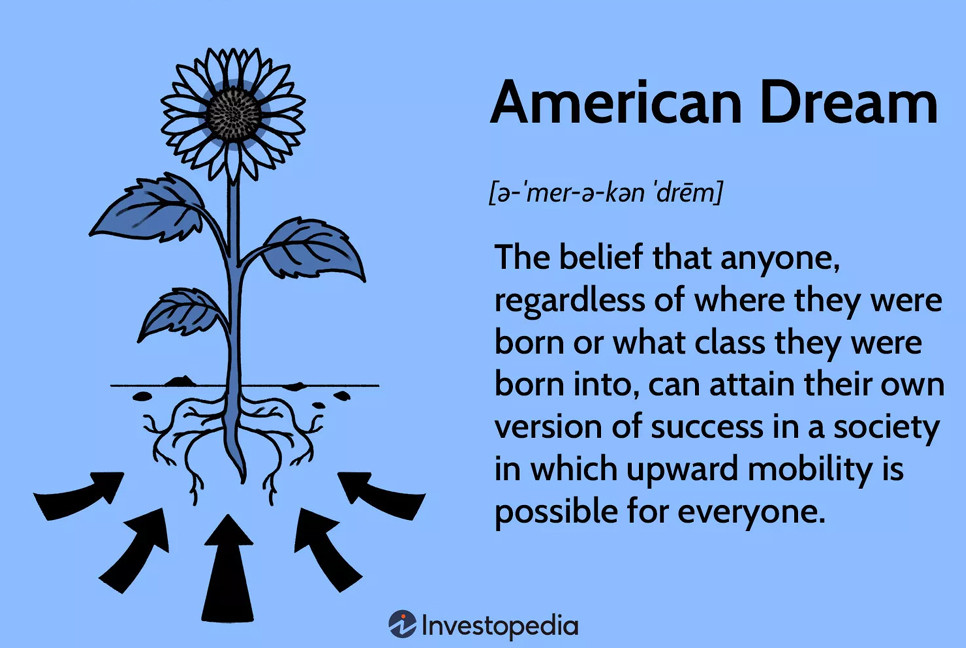
The American Dream is a foundational national ethos centered on the belief that everyone, through hard work, determination, and equal opportunity, can achieve success and upward social mobility, regardless of their background or birth circumstances.
Core Philosophical Principles
The philosophy is rooted in the U.S. Declaration of Independence, which famously states that "all men are created equal" and are endowed with the rights to "Life, Liberty and the pursuit of Happiness". Key principles include:
- Individualism and Self-Reliance: A strong belief that individuals hold the power to shape their own destiny and that success is a result of personal effort and free will.
- Equality of Opportunity: The ideal that everyone should have a level playing field and face few formal barriers to success in a democratic and capitalist society.
- Aspiration and Optimism: A forward-looking spirit and faith in progress, motivating people to strive for a better life for themselves and their children.
- Meritocracy: The idea that wealth and power should be distributed according to individual ability and achievement rather than social class or inherited position.
Evolution and Key Interpretations
The meaning of the American Dream has evolved significantly since the term was popularized by historian James Truslow Adams in his 1931 book, The Epic of America.
- Original Vision (Early 20th Century): Adams defined it as a "dream of a social order in which each man and each woman shall be able to attain to the fullest stature of which they are innately capable". This vision emphasized democracy, equality, and the moral/spiritual development of the individual, not merely material gain.
- Post-WWII to Modern Era: The philosophy has often been linked to tangible markers of success, such as homeownership, a stable job, raising a family, and material abundance.
- Contemporary Perspectives: The ideal continues to be debated and redefined. For many immigrants and marginalized communities, the dream centers on basic safety, freedom from fear and persecution, and the opportunity for their children to have a better life.
Criticisms and Challenges
The philosophy faces significant criticism, as reality does not always align with the ideal for many Americans. Critics point to several issues:
- Systemic Inequality: Historically, many groups, including Black Americans and Native Americans, were excluded from the dream due to slavery, discrimination, and a lack of equal rights.
- Declining Social Mobility: Data indicates that social mobility in the U.S. has declined in recent decades, and income inequality has risen, making it harder for lower-income individuals to out-earn their parents.
- Materialism vs. Fulfillment: Many literary works and social commentators argue that the focus on consumerism and wealth acquisition has corrupted the original, more altruistic dream, leading to an "American Nightmare" of moral decay and disillusionment.
Despite the challenges, the American Dream remains an influential and motivating force, continuing to shape individual aspirations and national identity.
Bd-pratidin English/Lutful Hoque