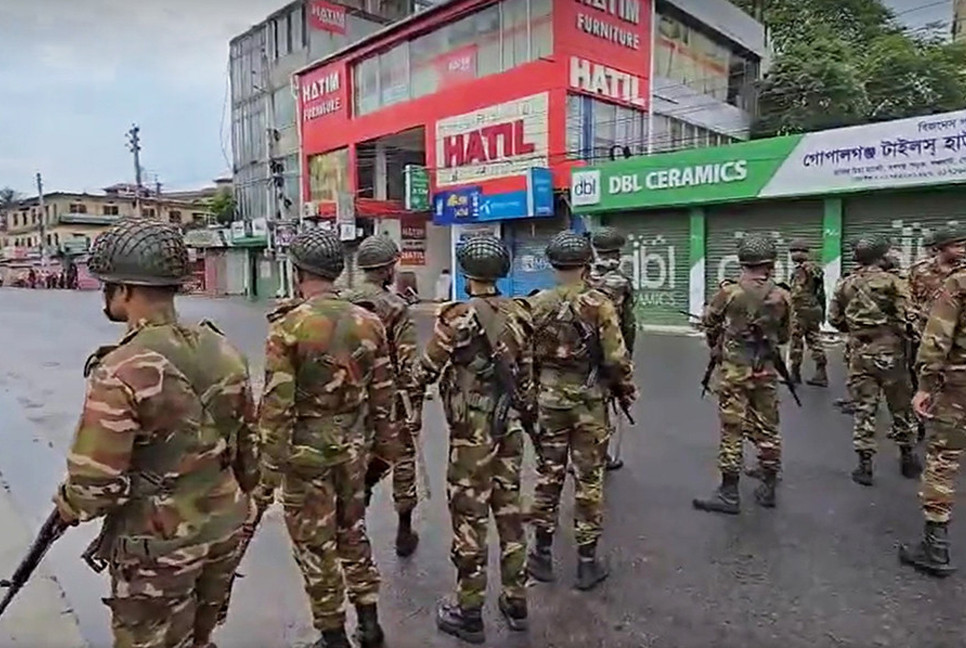
When students and citizens stood up against fascism with nothing but courage, the army stood as their only pillar of trust. Over the past 11 months, as police and other forces struggled to maintain law and order, the army took charge, dedicating itself to public service far beyond the confines of the barracks.
The horrific incident in Gopalganj yesterday (July 16) reaffirmed this once again — in times of crisis, the army remains a source of hope. Leaders of the National Citizens’ Party (NCP) — Sarjis Alam, Hasnat Abdullah, and Akhtar Hossain — left Gopalganj under tense conditions in an armored personnel carrier (APC) provided by the army. Initially, they had taken shelter at the district police superintendent’s office, from where the army safely evacuated them.
Earlier, during the NCP rally, attackers chanting "Joy Bangla" slogans launched assaults with sticks and weapons. Army personnel, alongside police, fired sound grenades and blank rounds to bring the situation under control.
There are numerous instances of the army stepping in during critical times. On August 25 last year, 50 students including Hasnat Abdullah were attacked by Ansar members at the Secretariat. The army responded swiftly, rescuing them and arranging for the critically injured students to be admitted to Dhaka CMH (Combined Military Hospital).
Yet, criticism of the army by some NCP leaders has also surfaced. Just six weeks ago, NCP Northern Organizer Sarjis Alam questioned the army’s role, posting on social media about the lack of action against Awami League-linked killers over the previous nine months. Similarly, in March, NCP leader Hasnat Abdullah made controversial comments on Facebook, indirectly targeting the army chief — a move that drew discomfort even within his own party. Fellow NCP leader Nasiruddin Patwary later criticized Hasnat’s post as “discourteous.”
Around the same time, Asif Mahmud Sajib Bhuiyan, interim government’s advisor on Local Government, Rural Development, and Cooperatives, also made adverse remarks about the army chief. Despite these provocations, the army has generally chosen not to respond. However, in one instance, Sweden-based media outlet Netra News cited army headquarters describing Hasnat’s remarks as “absurd and immature storytelling.”
Since the fall of Sheikh Hasina’s fascist regime on August 5, the army chief has consistently urged unity for national reconstruction, sovereignty, and communal harmony. He has publicly declared his commitment to keeping the army free from political interference.
Dr. Muhammad Yunus, Chief Advisor of the interim government, has also lauded the military's role following the 2024 student-led uprising. At the inauguration of the 2024 Army Headquarters Selection Board on October 6, he said,
“At a time of national crisis, the Bangladesh Army stood by the people, accelerated the formation of an interim government, and helped rescue the country from instability. As a result, the Bangladesh Army has once again earned the trust of the people.”
Bd-pratidin English/ ANI